Why Moly Heating Elements Are Preferred in Crystal Growth Furnaces
Crystal growth furnaces are among the most demanding high-temperature systems in industrial and laboratory applications. Whether growing sapphire, silicon, or advanced oxide crystals, precise thermal control is critical for:
● Crystal purity and stoichiometry
● Minimization of thermal gradients
● Avoiding contamination and defects
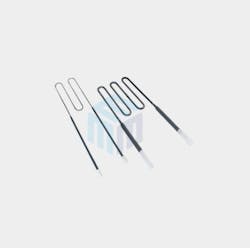
At the heart of these furnaces, the heating element determines not just temperature but process stability. For high-temperature crystal growth, molybdenum disilicide (MoSi₂) heating elements, also called MOSi₂ heaters, are the preferred solution.
Understanding why requires a close look at thermophysical properties, operational stability, and failure mechanisms.
1. Thermophysical Advantages of MoSi₂ Heating Elements
1.1 High Operating Temperature
● MoSi₂ elements operate continuously at up to 1800°C in air, higher than traditional Kanthal or nickel-chromium alloys.
● In inert or reducing atmospheres, they can reach 2000°C, ideal for high-temperature crystal growth.
1.2 Oxidation Resistance
● MoSi₂ forms a protective SiO₂ layer at the surface above 400°C.
● This self-passivating layer prevents rapid oxidation, even under prolonged high-temperature operation.
● The oxide layer also minimizes contamination risk in sensitive crystal growth environments.
1.3 Thermal Shock Tolerance
● MoSi₂ elements can withstand rapid heating and cooling cycles better than ceramic-coated metallic elements.
● This is critical in crystal pulling, where temperature ramps must be precise and controlled.
1.4 Electrical Efficiency
● Low electrical resistance combined with high emissivity makes MoSi₂ elements efficient radiative heaters, reducing energy consumption for large crystal growth chambers.
2. MoSi₂ Heating Elements in Crystal Growth Furnaces
Crystal growth processes, like Czochralski or Bridgman techniques, require:
● Stable axial and radial temperature profiles
● Minimal contamination from heating elements
● Long-term durability over hundreds of cycles
MoSi₂ heating elements provide:
|
Requirement |
MoSi₂ Performance |
|
Max temperature |
1800–2000°C |
|
Oxidation resistance |
Excellent (SiO₂ passivation layer) |
|
Lifespan |
3–5× longer than metallic heaters in similar conditions |
|
Contamination |
Minimal, inert oxide layer prevents metal diffusion |
|
Thermal uniformity |
High, due to radiative heating and stable geometry |
3. Why MoSi₂ Outperforms Other Heating Elements
● Kanthal / FeCrAl alloys: Limited to ~1400°C in air; suffer rapid oxidation and scaling.
● Tungsten or Molybdenum wires: Excellent at 2000°C, but oxidize quickly in air; require protective atmospheres.
● Graphite heaters: High temperature tolerance, but release carbon, which can contaminate crystals.
MoSi₂ balances temperature tolerance, oxidation resistance, and chemical stability, making it the best compromise for industrial crystal growth.
|
Property |
MoSi₂ Element |
Kanthal (FeCrAl) |
Tungsten/Moly Wire |
Graphite |
|
Max Temp (Air) |
1800°C |
1400°C |
1100°C |
3000°C |
|
Oxidation Resistance |
Excellent (SiO₂ passivation) |
Poor above 1400°C |
Poor |
High |
|
Contamination Risk |
Minimal |
Moderate |
Moderate |
High carbon contamination |
|
Lifespan |
3000+ hours |
<1000 hours |
Low in air |
Medium, needs inert atmosphere |
|
Thermal Homogeneity |
Excellent |
Moderate |
Poor |
Good |
Takeaway: MoSi₂ provides the best combination of high temperature, chemical stability, and mechanical robustness for crystal growth.
4. Selection Criteria for MoSi₂ Heating Elements
When choosing MOSi₂ heating elements, consider:
- Element Geometry
○ Tubular, flat, or custom shapes affect heat distribution.
○ Tubular elements are often preferred for uniform radiative heating.
- Power Density
○ Determine watts per cm² for uniform temperature distribution.
- Atmosphere Compatibility
○ Standard MoSi₂ works in air.
○ For reducing or inert atmospheres, ensure surface passivation is intact.
- Mechanical Mounting
○ Proper support prevents sagging or deformation at high temperatures.
- Replacement & Maintenance
○ Choose elements from reliable suppliers with verified MOSi₂ heating element quality and pricing.
5. Failure Mechanisms in MoSi₂ Elements
Even MoSi₂ elements are not invincible. Common failure modes:
● Silica layer breakdown: Above 1800°C, the protective SiO₂ layer can crack under thermal cycling.
● Creep or sagging: Long-term exposure to high temperatures leads to slight elongation.
● Electrical shorts: Occur if the passivation layer is damaged and the element contacts conductive surfaces.
● Mechanical damage during installation: Fine MoSi₂ elements are brittle; mishandling can cause fracture.
Correct design and proper installation extend service life significantly.
6. Cost vs Performance: Why MoSi₂ Is Economically Preferable
|
Feature |
MoSi₂ Element |
Alternative (Kanthal/FeCrAl) |
|
Maximum continuous temperature |
1800°C |
1400°C |
|
Service life at high temperature |
3000+ hours |
500–1000 hours |
|
Oxidation & contamination |
Minimal |
High |
|
Replacement frequency |
Low |
High |
|
MOSi₂ heating element price |
Moderate |
Lower initial cost, higher total lifecycle cost |
Although MoSi₂ elements have a higher upfront price, their long lifespan, stability, and contamination-free operation reduce downtime and process loss in critical crystal growth applications.
7. Applications Where MoSi₂ Heaters Excel
● Sapphire Czochralski crystal furnaces
● Silicon crystal growth for semiconductors
● Oxide and ceramic crystal production
● High-temperature vacuum or inert atmosphere crystal pulling
In each case, process consistency, contamination prevention, and element longevity make MoSi₂ the preferred choice.
8. Supplier Selection and Quality Considerations
When purchasing MoSi₂ heating elements:
● Verify manufacturer-controlled purity and microstructure
● Check for tensile strength and thermal cycling tests
● Confirm geometry and watt density specifications for your furnace type
● Evaluate MOSi₂ heating element price relative to expected lifespan
Reliable suppliers ensure that elements survive the repeated thermal cycles and deliver consistent crystal growth results.
Conclusion
For crystal growth furnaces, MoSi₂ heating elements are not just a convenience—they are a requirement. They provide:
● Extreme temperature tolerance
● Oxidation resistance via SiO₂ passivation
● Radiative heating uniformity
● Long-term stability
By selecting the correct MOSi₂ element shape, size, and supplier, furnace engineers ensure:
● Stable thermal profiles
● Minimal contamination
● Extended element lifespan
● Predictable crystal growth outcomes
High-Quality MoSi₂ Heating Elements from M-Kube Enterprise LLC
M-Kube Enterprise LLC supplies:
● Molybdenum disilicide heating elements
● MOSi₂ heaters and tubular elements
● Custom shapes and sizes for industrial crystal growth furnaces
Delivered across the USA, engineered for reliable, contamination-free, high-temperature crystal growth.
Because in crystal growth, the heater defines the crystal.