“Research in Brief”: Insights into current topics from the FBH
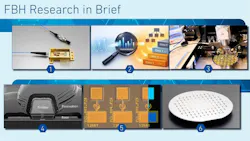
The third issue of the quarterly format “Research in Brief” presents a curated selection of recent research results from the Ferdinand-Braun-Institut (FBH). The articles provide a concise overview of the institute’s latest work.
Berlin, April 22, 2026
This issue features contributions in photonics, III/V electronics, and III/V technology – including compact laser sources for quantum technologies, new approaches to spectroscopic data analysis, fast characterization methods for GaN devices, improved passivation concepts for high-frequency transistors, as well as advances in VCSEL structures and miniaturized vapor cells.
The selection is based on the research news published every two weeks on the FBH website. These articles provide regular insights into new scientific results across the institute’s research fields and document the continuous progress of FBH research.
Photonics
Compact laser modules below 620 nm enable scalable quantum and industrial applications
We have developed compact diode laser modules emitting at 619 nm – a wavelength crucial for quantum technologies and industrial use. These efficient, wavelength-stabilized sources enable scalable, miniaturized systems previously achievable only with complex solid-state lasers.
Advanced chemometrics for accurate classification of spectroscopic data
We developed an innovative peak finder approach for effective dimensionality reduction of spectroscopic data. It retains interpretability of results while outperforming selected state-of-the-art feature reduction methods in classification accuracy.
Read more on the FBH website
III/V-Electronics
MHz load-line measurements for model parameter extraction
Reliable and rapid characterization of GaN HEMTs is essential for accurate models and circuit design. We have developed a MHz load-line technique that enables efficient extraction of compact model parameters, offering a fast alternative to conventional pulsed measurements.
Read more on the FBH website
Tuning surface properties of dielectrics on InGaAs: on the passivation of InP HBTs for high-frequency devices
We have developed a low-temperature ALD passivation for InP/InGaAs HBTs tailored to aggressively scaled devices. By improving surface control, the approach supports reliable millimeter-wave and sub-terahertz applications and leads to higher gain and improved RF performance.
Read more on the FBH website
III/V-Technology
Tunnel junction apertures by ion implantation: the impact of ion scattering on measurement results
Ion implantation can define tunnel-junction apertures in VCSELs without oxidation, but lateral proton straggle alters their effective size. By modelling this effect, we extract reliable specific resistances across different designs – without needing full layer or implantation details.
Read more on the FBH website
Microfabricated alkali vapor cells for compact atomic sensing applications
Alkali vapor cells are a key component in many integrated atomic devices. Size, weight, reliability and production cost determine their applicability and economic viability. We have developed a technology for producing highly miniaturized vapor cells that meets the increasing demands of future mobile applications, including navigation, sensing, and telecommunications.
Read more on the FBH website
Contact
Dr. Aiko Onken
Communications Manager
Ferdinand-Braun-Institut gGmbH
Leibniz-Institut für Höchstfrequenztechnik
Gustav-Kirchhoff-Straße 4, 12489 Berlin, Germany
Email aiko.onken@fbh-berlin.de
Web www.fbh-berlin.de/en
LinkedIn linkedin.com/company/ferdinand-braun-institut
About the FBH
The Ferdinand-Braun-Institut (FBH) is an application-oriented research institute in the fields of high-frequency electronics, photonics, and quantum technologies. It researches electronic and optical components, modules, and systems based on compound semiconductors. In photonics, FBH develops light sources from the near-infrared to the ultra-violet spectral range: high-power diode lasers with excellent beam quality, UV light sources, and hybrid laser modules. Applications range from materials processing, medical technology, and high-precision metrology to optical communication in space. In quantum technologies, FBH translates laboratory-scale proof-of-concept experiments into robust, application-ready systems. In high-frequency electronics, FBH develops high-efficiency multi-functional microwave power amplifiers and millimeter-wave transceivers targeting energy-efficient wireless communications, industrial sensing, and imaging. The FBH has a strong international reputation and ensures rapid transfer of technology by working closely with partners in industry and research. The institute has a staff of 400 employees and a revenue of 44.5 million euros. It is a member of the Leibniz Association and part of »Research Fab Microelectronics Germany«.
www.fbh-berlin.de/en