FBH at Photonics Days: from high-power diode lasers to quantum technologies
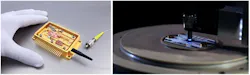
Ferdinand-Braun-Institut (FBH) will contribute numerous scientific presentations at Photonics Days Berlin Brandenburg on October 7 and 8, 2026. The focus will be on current developments in diode lasers and UV light sources and their diverse applications in laser fusion, medical technology, or materials analysis. FBH researchers will also lead several sessions as chairs or co-chairs. In the accompanying exhibition, the institute will showcase exhibits from its broad range of expertise. On October 6, FBH will also open its laboratories to conference participants.
Berlin, 21.09.2026
Ferdinand-Braun-Institut (FBH) will be represented at the Photonics Days in Berlin-Adlershof with numerous presentations and in key roles within the scientific program. The spectrum ranges from high-power diode lasers and UV emitters to micro-integrated laser modules and quantum technologies. In this way, FBH is contributing its expertise to the conference, which brings together experts from research and industry to discuss current developments in photonics and quantum technologies. Together with Microtec Academy, coordinated by FBH, the institute is also represented in the accompanying exhibition. The platform’s offerings range from career entry and career-change opportunities to continuing education for specialists and executives.
Diode lasers for fusion, medicine, and spectroscopy
Eldad Bahat Treidel from the High-Power Diode Lasers Lab at FBH will show in the “Laser and Beyond” session how high-power diode lasers can be further developed for future fusion power plants. These facilities require large numbers of high-power, efficient diode lasers to pump high-energy lasers. To this end, FBH is working on robust III-V semiconductor technologies and new device concepts. Current diode laser bars already achieve 1,000 watts of output power with a narrow spectrum.
Krista Bodenhagen from the Laser Modules Lab will present diode laser-based light sources for the deep ultraviolet (DUV) spectral range. Frequency conversion enables the creation of compact DUV light sources with precisely selectable wavelengths, such as for spectroscopic applications. Her colleague Nils Werner presents beam sources that generate tailored wavelengths in the visible spectral range through frequency conversion. The micromodules combine diode lasers, micro-optics, and precision assembly techniques in a compact design. These integrated laser sources are intended for future use in ophthalmology.
High-power UV micro-LEDs for medicine and sensing
UV technologies are another key focus. Sven Einfeldt, who heads the Joint Lab GaN Optoelectronics at FBH, is co-chairing the “UV and X-ray” session. In this session, Jens Raß will present novel micro-LEDs for the far-UVC spectral range. Up to 125,000 of these LEDs – each measuring only about 1.5 micrometers – can be integrated into a single square millimeter. This allows approximately five times as much light to be coupled into an optical fiber as with conventional far-UVC LEDs. The technology is particularly interesting for medical applications: Wavelengths below 235 nanometers barely penetrate the deeper living layers of the skin. As a result, pathogens, including multidrug-resistant pathogens, can even be inactivated directly on the skin. In the future, compact, fiber-coupled light sources could also reach hard-to-access areas such as the nasopharynx. Additional applications include sensor applications and communications.
Electron microscopy for materials analysis and quality assurance
In his conference presentation, Carsten Netzel demonstrates how FBH characterizes semiconductor materials, analyzes degradation mechanisms in devices, and ensures their quality. Scanning and transmission electron microscopy provide insights down to the nanometer scale. The results feed directly into the optimization of materials, processes, and devices.
FBH researchers in key roles at quantum symposia
FBH also plays a central role in the four Berlin Quantum Symposia. Two professors from Humboldt University of Berlin (HU Berlin), who also head Joint Labs at FBH, are helping to shape the program: Tim Schröder serves as Chair of the symposia, and Markus Krutzik serves as Co-Chair. Also serving as Co-Chairs are Tommaso Pregnolato from FBH and Gregor Pieplow from HU Berlin.