Research in Brief: Current Insights into FBH’s Research
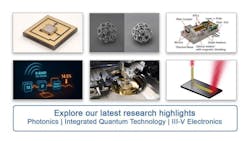
With this issue, the Ferdinand-Braun-Institut (FBH) continues its quarterly format “Research in Brief”. It presents recent results and developments from the past three months, concisely summarized and grouped by topic.
Berlin, January 21, 2026 - Ferdinand-Braun-Institut (FBH)
The selection is based on the research news published by FBH on its website on a biweekly basis. These articles provide insights into new scientific results from the institute’s various fields of work and illustrate the continuous progress of its research.
Integrated Quantum Technology
Laser system for excitation of fluorescent light sources on a CubeSat
We have developed a compact fiber-coupled laser source emitting at 698 nm to excite a single-photon emitter in low Earth orbit. Built and qualified faster and cheaper compared to a traditionally certified payload, this system embodies the “new space” developing philosophy. Read more on the FBH website
Double helical optical antennas for direct coupling to on-chip waveguides or quantum emitters
We’ve developed, to the best of our knowledge, the world’s smallest chip-integrated double helical antennas that are sensitive to the circular polarization state of visible to telecom light. The antennas are written directly using a focused electron beam in a 3D nanoprinting process. Read more on the FBH website
Photonics
Far-UVC micro-LEDs for enhanced fiber coupling
We have developed far-UVC LEDs with a micrometer-structured surface design that improves light extraction and enables efficient fiber coupling. This advancement supports disinfection applications in hard-to-reach areas, including human body cavities. Read more on the FBH website
780 nm mode-locked monolithic diode laser for two-photon polymerization
We have developed a compact, mode-locked monolithic diode laser emitting at 780 nm that delivers ultrashort, high-power pulses. It enables precise micro-3D printing via two-photon polymerization, achieving quality comparable to or even better than large Ti:sapphire laser systems. Read more on the FBH website
III/V-Electronics
Precise radio frequency transistor testing with automation and machine learning
Our new optically guided probing method and image-analysis machine learning algorithms enable precise, fully automated on-wafer measurements of RF transistors. This approach improves probes’ position accuracy below 2 µm in measurements up to 50 GHz. Read more on the FBH website
Realtime power monitoring of wireless communication systems for high data rate links – first results
First laboratory results demonstrate that real-time power monitoring at component level enables significant energy savings in high data-rate wireless systems. Dynamic adjustment of supply voltages reduced overall power consumption by 14.5 % without impairing performance. Read more on the FBH website
Contact: Dr. Aiko Onken, Communications Manager, Ferdinand-Braun-Institut gGmbH
Phone +49.30.6392-58373
Email aiko.onken@fbh-berlin.de
Web www.fbh-berlin.de/en
LinkedIn linkedin.com/company/ferdinand-braun-institut
About the FBH: The Ferdinand-Braun-Institut (FBH) is an application-oriented research institute in the fields of high-frequency electronics, photonics and quantum physics. It researches electronic and optical components, modules, and systems based on compound semiconductors. These devices are key enablers that address the needs of today’s society in fields like communications, energy, health, and mobility. Specifically, FBH develops light sources from the infrared to the ultra-violet spectral range: high-power diode lasers with excellent beam quality, UV light sources and hybrid laser systems. Applications range from medical technology, high-precision metrology, and sensors to optical communications in space and integrated quantum technology. In the field of microwaves, FBH develops high-efficiency multi-functional power amplifiers, and millimeter wave frontends targeting energy-efficient mobile communications as well as car safety systems. The FBH has a strong international reputation and ensures rapid transfer of technology by working closely with partners in industry and research. The institute has a staff of 390 employees and a revenue of 44.5 million euros. It is a member of the Leibniz Association and part of »Research Fab Microelectronics Germany«.