Exail delivers a space-grade laser source to CNES for Europe’s CARIOQA quantum pathfinder mission
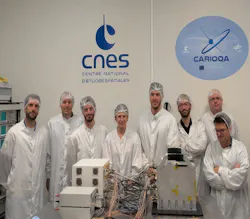
Saint-Germain-en-Laye, France, September 3, 2026 - Exail has delivered the engineering model of its ultracompact, space-grade laser source to the French Space Agency (CNES) for CARIOQA-PMP project. Commissioning and performance validation of the laser source were successfully completed at CNES in Toulouse, with no anomalies detected.
Funded by the European Union, the project is preparing a pathfinder mission designed to pave the way for the first in-orbit cold-atom gravimetry demonstration for Earth and climate monitoring. At the heart of the instrument, Exail’s laser source will generate the frequency-stabilized laser beams needed to trap, cool and interrogate a cloud of atoms. These atoms act as the test mass in an atom-interferometry accelerometer, enabling extremely precise measurements of gravity-related acceleration. Bringing this capability into orbit requires the close integration of state-of-the-art quantum and space technologies in a compact and robust system.
“Delivering this laser source is a decisive step in de-risking cold-atom laser technology for space,” said Aurélien Eloy, Laser Systems Engineer and CARIOQA-PMP Coordinator at Exail. “Our objective was to transfer the metrological stability of our laser systems for terrestrial quantum gravimetry into an architecture that meets the severe size, weight, and power (SWaP) constraints of space. Passing CNES validation demonstrates that our team is ready to bridge the gap between quantum physics and operational flight missions.”.
Initiated by CNES and its partners, CARIOQA (Cold Atom Rubidium Interferometer in Orbit for Quantum Accelerometry) brings together European expertise to mature atom-interferometry technology for space and prepare a first in-orbit demonstration in the next decade. It will help monitor phenomena linked to the water cycle, climate and geophysical hazards. Exail is already contributing to Phase B of CARIOQA through several ongoing developments focused on space-grade optical and electronic components.
Exail has experience in optical components and system-level design across three strategic areas: laser systems that cool and trap rubidium atoms (including in Pasqal quantum processors); TRL9 optical components; and field-deployable quantum sensing, with its Absolute Quantum Gravimeters operating worldwide, from Antarctica to Mount Etna. CARIOQA draws on these capabilities, as well as more than a decade of collaboration with CNES on technology transfer and space qualification, to extend cold-atom sensing from Earth to space.
“The delivery of the laser system is a key milestone for the CARIOQA project, marking a significant technological breakthrough in advancing the maturity of these systems for space based applications. In particular, its compactness, substantially smaller than previous generations, is truly impressive. —Thomas Lévèque, Technical Coordinator, CARIOQA Project
Through this ambitious European mission, Exail is helping establish the technologies required for quantum sensing in space. The milestone reinforces its position at the intersection of quantum systems, space-qualified photonics and precision sensing.