Exail selected to equip ITER’s fusion reactor with diagnostic fibers
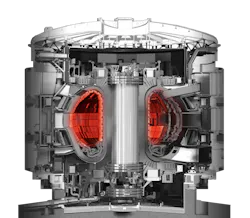
Saint-Germain-en-Laye, France, June 11, 2026 - Exail has reached a major milestone in the fusion energy sector: the ITER Organization has ordered its radiation-resistant, aluminum-coated optical fibers for its tokamak reactor. The fibers, manufactured utilizing the Photonics Bretagne technological platform, will be integrated into the world’s largest fusion device, currently under construction in southern France, for critical monitoring applications.
A total of 12 kilometers of optical fiber will be used to manufacture the mechanical monitoring system for the ITER Blanket and Divertor, two of the most plasma-exposed systems in the ITER machine. The fibers will be integrated into FBG-based optical sensors and cables to measure deformation, supporting fatigue damage prevention and residual lifetime assessment of these in-vessel components.
This order from ITER is a direct result of the successful development and industrialization of aluminum-coated fibers capable of operating at temperatures up to 400°C and in radiative environments, at a level of maturity equivalent to the global state-of-the-art. Those highly specific optical fibers were developed in the framework of the 3F2E project (2021-2025), led by Exail, with Photonics Bretagne, SEDI-ATI, EDF and TechnicAtome as partners. Funded by France Relance*, the project enabled to setting up a "100% Made in France" industry of optical fibers for sensing applications in nuclear environments, a direct contribution to strengthening the capabilities and sovereignty of the national nuclear industry.
According to ITER Organization “Optical fibers for in-vessel applications must withstand extreme conditions: temperature up to 250°C, high vacuum, GGy (gigagray) level gamma dose, and neutron fluence up to 1019-1020 n/cm². Radiation-hard aluminum-coated fibers supplied by Exail were selected for this application. They are currently being integrated into 4 mm stainless steel tubes (optical loom cable) installed on the inner surface of the vacuum vessel.”
“This success is a new confirmation of the strong capability of Exail to deliver specialty optical fibers for the most demanding operations, including extreme temperature and/or radiation levels,” said Mathieu Bergont, Specialty optical fiber product manager at Exail “Exail has strengthen its expertise in the development of radiation-resistant optical fibers thanks to a decade of research collaboration with experts from Hubert Curien Lab. Following the installation on the LLNL/NIF in the US, and the successful demonstration in December 2022, this is a new confirmation that our technology can address the greatest challenges and help push high-energy laser and nuclear fusion facilities to the next technological frontier.”
“We are very proud to be contributing to a project as ambitious and wide-reaching as ITER. This collaboration demonstrates the ability of the Photonics Bretagne team to develop and master a stable and robust optical-fiber metal-coating process that fully meets the industry requirements for operation in harsh environments,” said David Mechin, Director of Photonics Bretagne. “This exceptional expertise, acquired as part of the 3F2E project, now offers new opportunities for development, particularly when combined with the other fibers in our catalogue (microstructured fibers, active fibers, etc.).”
Beyond ITER, the project strengthens Exail’s position as a leading provider of sensing technologies for harsh environments and confirms the growing strategic importance of specialty optical fibers for critical industrial and scientific infrastructures.