Pockels Cell & Q-Switch Driving
Pockels Cell & Q-Switch Driving
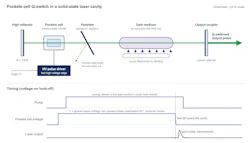
A Pockels cell is an electro-optic crystal whose polarization response changes with applied voltage. Place one inside a lasercavity, hold it at the right potential, and it becomes a fast optical switch: the cavity can be held below threshold while energybuilds in the gain medium, then switched open in nanoseconds to dump a giant pulse. That is the heart of active Q-switchingand cavity dumping, and the quality of the optical pulse is set almost entirely by the quality of the high-voltage pulse thatdrives the crystal.
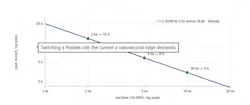
The crystal presents a small capacitance to the driver, typically a few to tens of picofarads. Switching it means movingkilovolts across that capacitance in nanoseconds, which takes amperes of peak current (Figure 1), at a set instant relative tothe pump and the cavity. The driver therefore has to deliver a fast high-voltage edge into a capacitive load with low jitter,because in a Q-switched cavity the timing of the switch sets the timing and the energy of the emitted pulse.
The Challenge
Rise time is the first constraint, and it couples directly to cavity timing. In Q-switching, the cell has to switch in a time shortcompared with the build-up of the giant pulse; a slower transition lets the pulse start to build while the cell is only partlyswitched, which lowers the peak power and lengthens the pulse. Cavity dumping is tighter: the transition has to becomparable to or shorter than the cavity round trip, 2L/c, which is 5 ns for a 0.75 m cavity and 20 ns for a 3 m cavity.
Jitter is the second constraint, and it is where cavity dumping is most demanding. Dumping requires the switch to fire at aprecise moment in the intracavity build-up, and any shot-to-shot variation in that moment translates into variation in outputenergy and timing. For systems that synchronize the laser to an external event, an amplifier chain, a probe pulse, a machineclock, low jitter between the trigger and the HV edge is what makes the laser usable as a timed source rather than a free-running one.
Repeatability ties the two together. A driver that produces a slightly different edge or delay on each shot makes every opticalpulse slightly different, which matters in precision machining, ranging and scientific work. Overshoot or ringing after the edgemodulates the retardation of the cell, so the settled level after the transition matters as much as the speed of the transition.
The BNC Approach
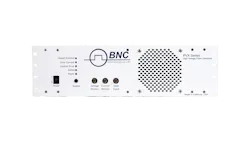
The DEI PVX pulse generators are built for this load: a small capacitance that needs a fast kilovolt transition placed preciselyin time. The half-bridge (totem-pole) output drives the crystal actively in both directions, so the edge that opens the switchand the edge that closes it are equally fast, with over/undershoot under 5 percent. The output switches between two user-supplied DC supplies, VHigh and VLow: the cell rests at one level, for example the quarter-wave voltage that holds a Q-switched cavity closed, and switches to the other for the width of the gate. The TTL gate sets pulse width and repetition rate;the supplies set amplitude.
Shot-to-shot jitter is under 200 ps on the PVX-4141 and under 1 ns on the PVX-4130 and PVX-4151, which suits thesedrivers to synchronized Q-switching. Front-panel voltage and current monitors (1000:1 into 1 MΩ and 10 A/V into 50 Ω on thePVX-4141) let the laser engineer observe the edge into the real crystal, check the switching level, and confirm that the tophas settled before the optical pulse is generated.