Laser Diode & Array Driving
Laser Diode & Array Driving
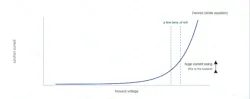
A laser diode is a current-driven device, not a voltage-driven one. Its optical output tracks the current through the junction,and the junction tolerates very little of the transient current a poorly regulated supply can produce. Above turn-on the currentrises steeply with forward voltage (Figure 1), so a diode driven from a stiff voltage source turns a small change in forwardvoltage into a large, uncontrolled swing in current, which appears as an unstable optical pulse or, at worst, a damagedemitter. The job of a diode driver is to deliver a defined current with a defined edge, hold it flat for the pulse, and returncleanly to zero, while keeping the device safe through power-up, power-down, and fault conditions.
Berkeley Nucleonics, through its Directed Energy Division, builds current-source drivers for this work. The lineup runs from a3 A precision source for a single emitter to the 450 A PCX-7500-EX for large bars and stacked arrays, with one support pathacross the range.
The challenge
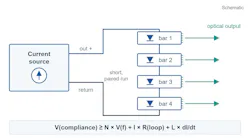
Three problems sit at the center of diode and array driving. The first is current control. The pulse the emitter sees has tomatch the pulse the experiment asked for, in amplitude, in width, and in edge speed, without overshoot that pushes thejunction past its rated current. The second is compliance voltage. A current source can only force its programmed current if ithas enough voltage headroom to overcome the forward drop of the diode string plus the resistive and inductive drops in thecabling. Stack more bars in series and the required compliance climbs, so the driver has to carry margin or the pulse flattensand distorts.
The third problem is protection. A diode array represents a large investment, and a single fault can take it out inmicroseconds. The driver has to guard against reverse voltage, has to limit current under a short, and has to leave the outputin a safe state whenever it is disabled rather than floating in a way that could stress the load. Cabling matters here too.Series inductance in the path between driver and diode slows the edge and rings the pulse, so the physical connection is partof the circuit, not an afterthought.
The BNC approach
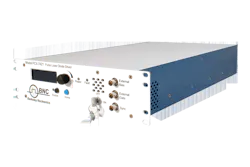
DEI drivers are current sources with the output stage and protection treated as one system (Figure 2 shows the PCX-7421).The user programs current, and the driver holds that current across the pulse as long as the load stays inside its compliancewindow, which each datasheet states so a system designer can budget headroom against the diode string before ordering.This matters most in QCW operation, where the device runs quasi-continuous-wave bursts that sit between short pulsedshots and full CW drive. QCW lets an array reach high peak optical power without the continuous thermal load of true CW,and it depends on a driver that holds a long, flat current pulse rather than a short spike.