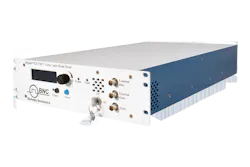
Driving Laser Diodes Safely
Why a Current Source, Not a Voltage Source
A laser diode is a diode first. Its current rises steeply once the forward voltage crosses the knee, and above that knee a tinychange in voltage produces a large change in current. Drive a diode from a voltage source set just past the knee and you arebalancing on the steep part of an exponential curve. A few tens of millivolts of error, from a warm connector, a noisy supply,or the diode itself heating up, turns into amps of extra current.
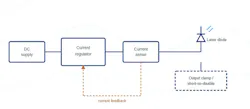
That feedback runs the wrong way. More current heats the junction, a hotter junction conducts harder at the same voltage,and harder conduction draws still more current. The loop can run away in microseconds and take the diode with it. A currentsource breaks the loop (Figure 1). It sets the current you ask for and lets the forward voltage land wherever the diode needsit, so a drifting junction voltage no longer moves the operating point. Every BNC DEI driver in this note is a regulated currentsource for exactly this reason. If you want the deeper treatment of how a fast driver behaves into a reactive load, see thecompanion note on driving capacitive loads.
The short version
Set the current, not the voltage. A voltage-driven diode sits on the steep side of its I-V curve where small voltage errorsbecome large current errors, and thermal runaway is a real failure mode.
Compliance Voltage
A current source can only push its rated current if it has enough voltage headroom to do so. That headroom is the compliance voltage: the maximum voltage the driver can develop across everything in the output loop while still regulatingcurrent. The loop includes the diode forward drop, the drop across any series resistance, and the drop across the cabling.
Add it up before you assume a driver fits. A diode bar might drop several volts, the harness and connectors add more, and asense or ballast resistor adds its own share at full current. If the sum approaches the driver compliance, the regulator runsout of headroom at the current peak and the pulse clips. The fix is either a higher-compliance driver or a lower-resistance output path. The mapping table in section 9 lists compliance for each model so you can check headroom against your realload.
Rule of thumb
Required compliance is the diode forward drop plus the drop across series resistance and cabling at peak current. Leavemargin; a driver that barely meets compliance will clip the top of a fast pulse.
CW, QCW, and Pulsed Operation
Three operating modes cover most laser-diode work, and they trade optical output against heat in different ways. Figure 2sketches the current waveform of each.
CW, continuous wave, holds a steady current indefinitely. The diode runs at a constant operating point and the full averagepower has to be removed by the heatsink. CW is the simplest mode and the most demanding thermally.
QCW, quasi-continuous wave, drives the diode hard but only for a burst, typically a few hundred microseconds to a fewmilliseconds at a low duty cycle. During the burst the diode behaves as if it were CW, but the low duty keeps the averagepower, and therefore the heat, far below the CW case. QCW lets you reach peak powers a CW setup could not survive.