Berkeley Nucleonics publishes 42-page pulse and delay generator handbook covering the Model 765 and 765-HV
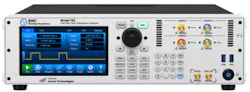
The Berkeley Nucleonics Model 765 Fast Pulse and Delay Generator delivers rise and fall times below 70 ps, with 10 ps timing resolution and up to four independently programmable channels.
San Rafael, Calif., October 25, 2026: Berkeley Nucleonics Corporation (BNC) has published Rev C of its Digital Delay Generator Handbook (BNC-HB-003), a 42-page reference covering the practices, terminology and techniques behind demanding pulsed applications. The new edition adds full reviews of the Model 765 fast pulse and delay generator and its high-voltage counterpart, the Model 765-HV, with worked guidance for using both at the bench. Every specification in the handbook is quoted with its test condition and its source document.
The Model 765 delivers rise and fall times below 70 ps (20% to 80%) at up to 5 Vpp into 50 ohms, with period, width and delay set in 10 ps steps on two or four independent channels. Period jitter is 4 ps RMS (integrated from 100 Hz to 10 MHz at a 200 MHz output). Multi-pulse mode places up to four independently timed pulses on each output, for repetition rates up to 800 MHz. Amplitude adjusts from 10 mVpp to 5 Vpp, with pulse widths starting at 300 ps and extending up to the programmed period minus 300 ps, subject to operating conditions.
The Model 765-HV carries the same platform to high voltage. It delivers up to 50 Vpp into 50 ohms, with an adjustable DC offset of ±25 V and rise times below 400 ps (20% to 80%) at zero offset. It offers one or two independent channels, repetition rates up to 400 MHz in multi-pulse modes (200 MHz in single-pulse mode), and the same 10 ps timing resolution.
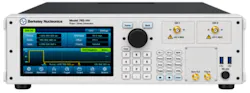
The Berkeley Nucleonics Model 765-HV High-Voltage Pulse and Delay Generator delivers pulses up to 50 Vpp with rise times below 400 ps and 10 ps timing resolution.
The handbook turns those specifications into working benches. Its application chapters show how to:
- Drive laser diodes and run LiDAR benches. The 765-HV supplies the fast, high-voltage pulses that laser-diode drivers require, and one timebase sets the fire, gate and capture timing around them.
- Emulate radar and LiDAR returns. Four pulses on one Model 765 output act as four targets at programmed ranges, and each 10 ps delay step moves a target by 1.5 mm. A dedicated bench covers ground-penetrating and UWB radar.
- Run semiconductor short-pulse and stress tests. Pulse width and amplitude are stepped finely enough to map device behavior at its margins.
- Emulate detector front ends. The 765 supplies clock and trigger timing on one timebase, so readout electronics can be tested before any beam is available.
- Measure fast edges correctly. A chapter on the physics of a fast edge explains rise-time conventions and slew rate, and an oscilloscope-bandwidth table shows how much scope a 70 ps edge needs.
The handbook also sets out the design rule behind every recipe: run the pulse generator as the timing master of the bench, so that each critical interval falls between two channels of one instrument. On the Model 765, channel-to-channel jitter is specified below 10 ps RMS with all channels at the same frequency in single-pulse, continuous mode, which lets one timebase carry the start, the stop and every interval in between.
Beyond the 765 family, the handbook reviews the Model 577, Model 588B and Model 745T Digital Delay Generators, with chapters on Q-switched lasers, particle image velocimetry, pump-probe spectroscopy, gated cameras and coincidence counting.
The handbook is available now online. Visit Digital Delay Generators in the pulsed laboratory
Printed copies are available free of charge on request (email [email protected] for more information).
Product Information and Datasheets
Model 765
Product page: https://www.berkeleynucleonics.com/lp/model-765
Datasheet: https://www.berkeleynucleonics.com/docs/bnc-model-765-datasheet.html
Model 765-HV
Product Page: https://www.berkeleynucleonics.com/lp/model-765hv
Datasheet: https://www.berkeleynucleonics.com/docs/bnc-model-765hv-datasheet.html.
About Berkeley Nucleonics Corporation
Berkeley Nucleonics Corporation (BNC) has been a trusted name in precision electronic instrumentation since 1963, serving defense, research, academic, and industrial customers with digital delay generators, arbitrary waveform generators, RF/microwave signal generators,pulsed power systems, and nuclear radiation detection equipment. With 60+ years of reliability and responsive technical support, BNC is flexible and listens to your application.
Media and product contact
Berkeley Nucleonics Corporation 2955 Kerner Blvd, San Rafael, CA 94901 Email: [email protected] | phone:(415) 453-9955 | https://www.berkeleynucleonics.com