BitFlow CoaXPress Frame Grabber Accelerates Tissue Sample Analysis in Groundbreaking Van Gogh™ Microscopy System from CellTivity
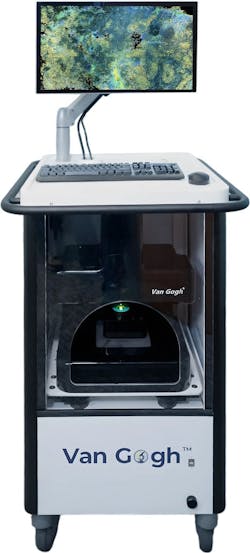
WOBURN, MA, February 5, 2026 -- In cancer diagnostics, tissue samples obtained through a biopsy or surgical resection will confirm the presence of cancer, determining its type, subtype, grade, stage, and various molecular characteristics. One of the most significant recent innovations in cancer diagnosis is the Van Gogh™ Microscopy System from CellTivity Scientific, an FDA-registered medical imaging platform for real-time, intraoperative assessment of freshly excised tissue biopsies.
Acting as a crucial interface, or bridge between the Van Gogh’s camera and its PC, is a BitFlow Cyton CXP4 CoaXPress 1.1 compliant quad-link frame grabber. It maintains image quality and prevents data loss during transmission, which is fundamental for the Van Gogh’s accurate diagnosis and unprecedented speed.
DIAGNOSTIC FEEDBACK IN LESS THAN TWO MINUTES
Unlike conventional methods that require tissue samples to be sent to a lab for analysis, Van Gogh yields feedback in less than two minutes, enabling physicians to make informed decisions on the spot. Van Gogh leverages CellTivity’s patented Dynamic Cell Imaging™ (DCI™) optic techniques to capture unique data from biopsies and produce a “heat map” of highly active cells within a biopsy sample. DCI algorithms evaluate tissue with exceptional precision, streamlining the diagnostic process, and improving patient care.
A hallmark of cancer cells is their ability to reprogram metabolism to support uncontrolled cell growth and proliferation. The Van Gogh highlights metabolic activity at the cellular level, empowering proceduralists to identify and interpret different cell types such as cancer cells, immune cells, granuloma, and others to properly assess biopsy samples for adequacy. This data allows pathology to prioritize focus on specific specimens for further examination, delivering on the promise of ROSE (Rapid On-Site Evaluation).
FirstHealth and Pinehurst Medical Clinics in North Carolina are among the first health centers harnessing Van Gogh to improve lung cancer detection. “This technology allows us to see how cells are behaving in real time—while the patient is still in the procedure room,” said Bradley Icard, D.O., interventional pulmonologist at FirstHealth and Pinehurst Medical. “It helps us tell the difference between malignant cells and benign findings like inflammation, right then and there. That means faster answers, better biopsies and smarter care.”
VAN GOGH IMAGING SYSTEM
The Van Gogh is a self-contained device with an onboard Windows-based computer that handles real-time image processing, data analysis, and display. An Intel Core i9 processor runs the proprietary DCI™ software, which processes interferometric images from the microscope's camera to generate metabolic heat maps and virtual slices displayed on a large touchscreen LCD right in the operating room.
The 2MP CoaXPress (CXP6) camera mounted on an interferometric phase microscope and serves as the Van Gogh’s core detector. Coherent light is split into sample and reference paths per Michelson principles and is recombined to create interference patterns. This technique captures temporal fluctuations to generate endogenous contrast based on organelle motility.
THE IMPORTANCE OF COAXPRESS
The BitFlow Cyton CXP4 CoaXPress 1.1 quad-link frame grabber serves as the critical interface between camera and PC, preserving image integrity and eliminating data loss during high-speed transmission—essential capabilities that enable the Van Gogh system's diagnostic accuracy and breakthrough performance.
For those unfamiliar with the interface, CoaXPress is a high-speed digital standard that transmits video, control signals, and power over a single coaxial cable. Its speed has made CXP popular in medical imaging, factory automation, defense, and scientific instrumentation including systems like the CellTivity Van Gogh platform.
In addition to the acquisition of immense data flows at rates up to 6.25Gb per second, the Cyton CXP4 ensures precise timing and seamless synchronization within the interferometric imaging pipeline, maintaining the microsecond-level timing precision required for accurate phase contrast measurement.
Being FDA approved, the Cyton CXP4 does not require alterations for use in the Van Gogh or any medical device.
ELIMINATING PERFORMANCE BOTTLENECKS
Besides speed, CellTivity specified the Cyton CXP4 frame grabber for its reliability, a capability built on two BitFlow patented technologies: Scatter-gather DMA and StreamSync.
BitFlow scatter-gather Direct Memory Access (DMA) architecture delivers zero-CPU overhead for maximum processing power. Scatter-gather DMA streams image data directly into Van Gogh’s host memory, completely bypassing its CPU. This architecture ensures processing resources remain fully available for critical image processing algorithms and system operations, eliminating the performance bottlenecks that plague traditional frame grabber implementations.
The Cyton CXP4 caches scatter-gather instructions so that during times when access to resources is reduced due to other system activities, its DMA engine can continue to run and move image data to host memory. No images are lost during times of heavy memory and bus traffic.
The BitFlow StreamSync engine maintains image alignment through any disruption, whether from electrical interference on camera cables or PCIe bus congestion that blocks memory access. When incoming packets are corrupted or lost, StreamSync automatically accounts and compensates for the missing data in real-time. When outgoing transfers are blocked, StreamSync intelligently "burns" corresponding scatter-gather instructions, ensuring subsequent packets land precisely where they belong in host memory.
StreamSync guarantees an application stays synchronized with minimal image degradation—no cascading errors, no buffer misalignment, no system crashes. The imaging pipeline recovers and continues operating, even under conditions that would cripple conventional frame grabbers.
LONG-TERM PARTNERSHIP
Guided by innovation and expertise, CellTivity Scientific aims to maximize diagnostic yield and readiness for next-generation sequencing. It is doing so by disrupting the process of diagnosing cancer by digitally measuring intracellular and metabolic activity throughout extracted tissue with Van Gogh.
CellTivity Scientific traces its research and development roots back to Paris — BitFlow has been with CellTivity virtually from the start. In 2015, an engineer developing an early-generation Van Gogh system encountered frame grabber challenges; BitFlow responded with rapid support—providing a sample unit of the Cyton CXP4 that kept the project on track. Reynold Dodson, the President and co-founder of BitFlow, Inc., and Donal Waide, Director of Sales for BitFlow, Inc., hand delivered the sample to CellTivity’s office in Paris, offering to answer all the engineer’s image acquisition questions. This collaborative approach exemplifies BitFlow's commitment to empowering innovation in advanced imaging applications, ensuring engineering teams have the hardware solutions they need when it matters most.
"Our decade-long partnership with BitFlow has been instrumental in pushing the boundaries of what's possible in real-time medical imaging," said CJ Jiang, Chief Operating Officer of CellTivity Scientific. "The Cyton's exceptional bandwidth and deterministic low-latency performance were critical enabling technologies for the Van Gogh system. This integration represents a significant technical achievement—delivering the speed and precision required to transform tissue assessment from a wait-and-see process into an immediate, actionable diagnostic capability that can reduce repeat procedures and accelerate patient care."
BitFlow introduced the original Cyton CXP4 frame grabber in 2013 as a major advancement in CoaXPress technology. It predated the dual-link version, the Cyton CXP2, that launched in 2015 and supports CXP speeds from 1.250 to 6.250 Gb/S. Since that pivotal 2015 meeting, CellTivity has integrated the BitFlow Cyton CXP4 into every subsequent generation of the Van Gogh platform—a testament to proven performance and reliability.
“Our working relationship demonstrates how the right frame grabber solution becomes the foundation for sustained innovation, enabling CellTivity to consistently move forward with cutting-edge imaging capabilities across multiple product generations,” explained Reynold Dodson of BitFlow, now a division of Advantech. “But the driving force behind CellTivity's continued commitment to BitFlow extends beyond hardware specifications. Three factors secured this long-term relationship: consistent product availability, responsive technical support, and—most importantly—BitFlow's dedication to solving real-world image acquisition challenges.”
When engineering teams need more than components—when they need a partner invested in their success—BitFlow delivers expertise that accelerates development and ensures mission-critical systems perform flawlessly.
ACCELERATING MEDICAL INNOVATION AT POINT-OF-CARE
Integration of BitFlow CoaXPress technology helps Van Gogh deliver unprecedented imaging performance for clinical applications, capturing short, high-speed bursts of raw interferometric images at hundreds of frames per second. On average, this enables diagnostic-quality metabolic imaging in 102 seconds — fast enough for physicians to confirm tissue adequacy during active bronchoscopy procedures for suspected cancer. By reducing the diagnostic process from days to mere seconds, the Van Gogh system empowers physicians to create immediate, tailored treatment plans.
Learn more at www.bitflow.com and www.celltivity.com.
About BitFlow
BitFlow has been developing reliable, high-performance Frame Grabbers for use in imaging applications since 1993. BitFlow is the leader in CoaXPress and Camera Link frame grabbers, building the fastest frame grabbers in the world, with the highest camera/frame grabber densities, triggering performance, and price. With thousands of boards installed throughout the world, into hundreds of imaging applications, BitFlow is dedicated to using this knowledge and experience to provide customers with the best possible image acquisition and application development solutions. BitFlow, located in Woburn, MA, has distributors and resellers located all over the world including Asia, the Americas, and Europe. BitFlow was acquired by Advantech in 2023.
About Advantech
Advantech’s corporate vision is to enable an intelligent planet. The company is a global leader in the fields of IoT intelligent systems and embedded platforms. To embrace the trends of IoT, big data, and artificial intelligence, Advantech promotes IoT hardware and software solutions with the Edge Intelligence WISE-PaaS core to assist business partners and clients in connecting their industrial chains. Advantech is also working with business partners to co-create business ecosystems that accelerate the goal of industrial intelligence.