Optical imaging and spectroscopy enhance precision agriculture
Agricultural decisions depend on information that’s often invisible, such as whether a crop is experiencing stress, a ripe tomato is sweet, or supplemental lighting is delivering useful photons. Conventional inspection and occasional destructive sampling provide only part of the picture. Photonics extends observation beyond visible appearance and, through controlled illumination, provides a way to take actions based on plant development.
This opportunity spans the food value chain: Cameras and spectrometers can operate on drones, agricultural robots, or packing lines; lasers can measure crop structure and physiological responses; and light-emitting diodes (LEDs) can adjust growing conditions. It’s an engineering challenge to connect each optical measurement to a practical decision—ranging from directing irrigation to grading produce or changing a lighting schedule.
Choose the right spectral information
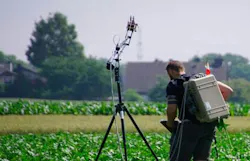
Hyperspectral imaging combines spatial information with many contiguous spectral bands (see Fig. 1). A spectrum at each pixel captures differences associated with pigments, water, tissue structure, and chemical composition. Combined with calibrated analytical models, these measurements can reveal quality attributes or distinguish healthy material from damaged produce.
HySpex illustrates the approach via hyperspectral systems for laboratory and industrial inspection. For berry analysis, spatially resolved spectral data can support defect identification and quality assessment that conventional RGB cameras can’t readily provide. Images show where a feature occurs, which makes them useful for automated sorting rather than simply reporting an average value.
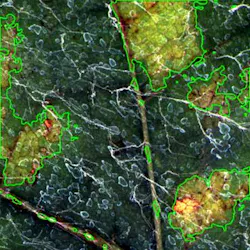
For many field tasks, acquiring a full spectral cube is unnecessary. Multispectral cameras select fewer bands, reducing data volumes and processing requirements. Vegetation indices such as the normalized difference vegetation index (NDVI) use red and near-infrared (NIR) reflectance to characterize vegetation, but interpreting them requires knowledge of canopy structure, soil background, and growing conditions. CSEM, a Swiss innovation center, develops multispectral systems with embedded machine learning that balances spectral information, spatial resolution, and acquisition speed (see Fig. 2).
These options represent different design choices. Hyperspectral measurements can help identify informative wavelengths during development, but a simpler multispectral instrument may then suit deployment. In either case, illumination variation, motion, and changing viewing geometry must be managed before spectral differences can reliably guide treatment.
Portable spectrometers offer another route when a full image is not required. Ocean Optics supplies compact instruments for acquiring spectra, which allows developers to build handheld or vehicle mounted systems. A point measurement sacrifices spatial coverage but can simplify an instrument intended to answer a narrowly defined question. The choice should follow the measurement requirement rather than assume more spectral channels always deliver greater value.
Composition measurement without destroying produce
NIR spectroscopy links optical measurements to internal quality. Absorption features associated with molecular vibrations contain data about water and organic constituents. Because food is a scattering heterogeneous material, quantitative predictions generally require calibration against reference measurements, followed by validation across representative samples. Sensor performance alone does not establish the accuracy of a composition estimate.
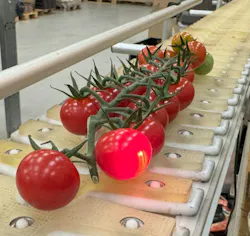
Within Norway’s DigiFoods research center, Nofima and SINTEF developed noncontact NIR measurements for cherry tomatoes (see Fig. 3). Trials on moving produce connect predicted sugar content with sensory sweetness, which are opening a route toward grading that goes beyond color. Related work studies strawberries measured on the plant under daylight conditions. These examples bridge laboratory spectroscopy, packing lines, and measurements made before harvest.
Compact optical components make such systems easier to integrate. Hamamatsu Photonics offers miniature Fourier transform NIR engines using microelectromechanical systems (MEMS) interferometry and indium gallium arsenide (InGaAs) detection. Its InGaAs line sensors also support NIR and shortwave-infrared (SWIR) inspection on conveyors. Depending on the application, these components enable compositional analysis or provide spectral contrast for distinguishing products and unwanted material.
Measurement geometry matters as much as miniaturization. Reflection, transmission, and interactance probe different volumes of a sample. Selecting the illumination and collection arrangement determines sensitivity to the surface, internal tissue, and stray light. Integration must also accommodate throughput, cleaning, and product variability.
This distinction is especially critical when moving from a demonstration to routine operation. A classifier trained on one cultivar or growing season may not transfer to another. Reference standards, repeat measurements, and independent validation help establish what the instrument can actually distinguish. Farmers and processors need a clear relationship between the reported optical indicator and the action it supports—including situations where another measurement is needed.
Active optical measurements
Active sensing supplies its own illumination. Light detection and ranging (LiDAR) uses laser ranging to reconstruct terrain and canopy geometry, which supports crop height, volume, and spatial structure measurements. Combining geometric data with spectral observations helps separate changes in plant architecture from changes in optical response.
Laser-induced fluorescence provides a complementary physiological measurement. Excitation produces chlorophyll emission and its behavior reflects competition between photochemistry, fluorescence, and heat dissipation. Fluorescence intensity alone is not a universal indicator of plant health. Interpreting stress requires a defined measurement protocol and, where appropriate, parameters describing photosystem efficiency or quenching.
Compact spectrometers and controlled excitation sources provide the building blocks for these measurements. Turning them into a field instrument requires control of ambient light, excitation conditions, and timing. The useful output is an interpretable physiological indicator, which is validated for the crop and stress mechanism being investigated.
Avantes provides compact UV–VISIBLE–NIR spectrometers for reflectance and fluorescence measurements, which combine spectral detection with dedicated illumination and collection optics for agricultural sensing. In France, Photonics Bretagne develops optical demonstrators for crop assessment, including multispectral LiDAR for measuring leaf reflectance. This illustrates how photonic components become application-specific instruments, with optical design addressing working distance, collection efficiency, and rejection of ambient light to support reliable measurements outside the laboratory.
Light to control growth?
Greenhouses and vertical farms can use photonics as an actuator. Horticultural LEDs allow growers to adjust intensity, spectral balance, and photoperiod. Blue and red wavelengths influence photosynthesis and plant development, while far-red and UV treatments can affect morphology or other crop characteristics. Responses depend on species, growth stage, dose, and environmental conditions. There is no universal lighting recipe.
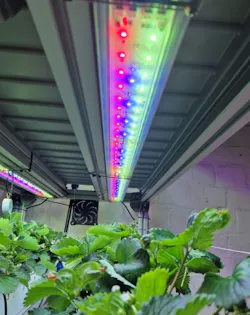
Seoul Semiconductor supplies horticultural LED technologies (see Fig. 4), and Crocus Labs develops systems with independently controlled spectral channels and sensor feedback. Architectures like these can adjust supplemental lighting as conditions change, rather than maintaining a fixed output regardless of available daylight. Their value should be judged through crop performance and electricity consumption together.
From optical performance to practical adoption
Commercial deployments show that agricultural optics can deliver value beyond laboratory demonstrations. Yara’s tractor-mounted N-Sensor uses canopy reflectance and agronomic models to guide variable-rate nitrogen application. John Deere’s camera-based See & Spray identifies weeds and controls individual spray nozzles. The company reports deployment across more than five million acres during the 2025 growing season, with average reductions of nonresidual herbicide use by nearly 50%. Downstream, TOMRA reports more than 800 installed sorting machines for fresh potatoes and vegetables. These examples connect optical measurements directly to fertilization, crop protection, and product sorting, although their benefits remain application-dependent.
Broader adoption requires more than a capable sensor. Farmers must judge whether a system will work with their crops, machinery, and existing practices, and whether its benefits justify purchase, subscription, maintenance, and training costs. OECD research identifies cost, limited relevance, complexity, skills requirements, and distrust of algorithms as barriers to digital agriculture. A central challenge is to demonstrate a credible return under the conditions of a particular farm. An accurate measurement has limited value if interpreting it requires specialist expertise or acting on it disrupts an established workflow.
Suppliers should address these constraints from the beginning of development. Designing and testing instruments with farmers, agronomists, and equipment manufacturers can help ensure that outputs support a specific action. Field validation should span seasons, varieties, and operating conditions, with comparisons against current practice and transparent reporting of both benefits and failures. Automatic calibration checks, straightforward interfaces, compatibility with existing machinery, and accessible technical support can reduce operating effort. Contractor services, cooperative ownership, or leasing can also make expensive instruments accessible without requiring every farm to purchase its own system.
The next advance in agricultural optics will be measured by how reliably optical information becomes useful action. Systems that combine robust measurements with agronomic guidance, manageable costs, and dependable support have the strongest prospect of becoming routine tools for growers and processors.
About the Author
Jérémy Picot-Clémente
Jérémy Picot-Clémente is photonics technologies manager for the European Photonics Industry Consortium (EPIC), and is based in Auvergne-Rhône-Alpes, France.