Tiny ‘upconverter’ turns invisible near-infrared patterns into visible green light
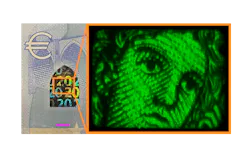
A tiny monolithic upconverter—<1-µm thick—converts invisible NIR images into green light and preserves its spatial information, thanks to the combination of five organic NIR photodetectors and a green-emitting organic light-emitting diode (OLED).
Bernhard Siegmund, research project leader at the Institute for Materials Research of Hasselt University and imec, as well as a Senior Postdoctoral Fellow at the Research Foundation—Flanders in Belgium, drew inspiration for the upconverter from previous work developing a NIR photodetector technology for a spinoff that was acquired by Zeiss Spectroscopy, as well as from his later work with commercial tandem solar cells.
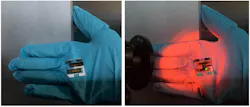
The device’s emitted photons have higher energy than the incoming NIR photons, but no external power supply is needed. Why? By connecting the photodetectors in series, photovoltages build up under NIR illumination to power the integrated OLED. “This provides a simpler route to imaging than conventional electric readout,” says Siegmund.
Low lateral charge mobility within the organic layers keeps the photogenerated signal spatially confined as it reaches the OLED, which helps preserve sharp image features that can then be recorded with a conventional or smartphone camera.
Self-powered upconverter thin films
During the past 20 years, researchers explored self-powered thin films to visualize NIR light. “Earlier approaches required intense illumination, often from a laser, which limited their use for practical imaging,” says Siegmund. “But we separate NIR detection and visible emission into optimized semiconductor devices and couple them electrically—rather than relying on a nanoscale upconversion process within the active material.”
The team’s device begins efficient upconversion at merely 9 µW/cm2, which is more than 4,000x lower than previous self-powered upconverter films with comparable energy efficiency. “It combines this low threshold with a high external upconversion efficiency of ~2%, a broad linear intensity range over three orders of magnitude, and good spatial resolution,” he says. “Based on the cost of current components, we estimate our device could ultimately make NIR imaging two orders of magnitude less expensive than specialized indium gallium arsenide (InGaAs)-based camera systems.”
Multi-year effort to achieve a functioning device
Turning their initial concept into a functioning device “was a multi-year effort with both scientific and technical challenges,” says Siegmund. “It required close collaboration between physics and chemistry—including specialized material synthesis and establishing a dedicated laboratory for multilayer device deposition and characterization. Scientifically, we had to optimize the entire stack as a coupled system because the requirements of its components are interdependent.”
It was no small challenge to optimize the five photodetectors—like subcells within a tandem solar cell—so their voltages increase. But the photocurrents must be balanced because the detector with the lowest current limits the entire stack.
“Simultaneously, the recombination layers must minimize optical and voltage losses, while the OLED requires a low driving voltage and high external quantum efficiency,” he says. “We also optimized the positions of the absorber and emission layers within the optical field to balance the detector currents and maximize light outcoupling, using extensive experiments and millions of optical simulations to arrive at our final 38-layer stack.”
Low-cost imaging systems ahead
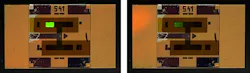
The team’s device architecture is ideal for widely deployed, low-cost imaging systems. “An immediate application is for optical laboratories, because our device produces a stronger visible response to weak NIR light than a commercial NIR laser detection card. We demonstrated this advantage up to 880 nm and we expect it to extend further into the NIR,” says Siegmund. “For agriculture and environmental monitoring, future systems may help to assess crop or grape ripening, water stress, forest health, or infrastructure leaks.”
Experiments by the researchers also showed their device can image structures beneath the surface of biological samples, which has potential for future biomedical imaging. Farther out on the horizon, upconverters may become part of optical interfaces for smart implants beneath the skin, for example, to monitor healing after an organ transplant.
An important next step now is “to integrate the upconverter directly with a conventional camera,” says Siegmund. “This requires moving from the current reflection-mode geometry to a transmission-mode device with a transparent top electrode to enable better use of the device’s spatial resolution. Beyond this, other promising next steps are to develop application-specific prototypes and explore new materials to extend the sensitivity deeper into the NIR.”
FURTHER READING
X. Jiang et al., Commun. Mater. (2026); https://doi.org/10.1038/s43246-026-01286-8.
More Coverage
About the Author
 Sally Cole Johnson
Sally Cole Johnson
Editor in Chief
Sally Cole Johnson is Laser Focus World’s editor in chief, and she has more than 25 years’ experience as a science and technology journalist. She specializes in physics and semiconductors, and wrote for the American Institute of Physics for more than 15 years, and also covered theoretical physics and neuroscience for the Kavli Foundation, and complexity for the Santa Fe Institute. Johnson has also written extensively about military embedded systems, high-performance computing, software-defined networks, and infosec. She is a member of the National Association of Science Writers (since 2001).
When she isn’t writing about optics, photonics, or quantum advances, you can find her outside in northern NH in the garden with birds landing in her hand or heading for the mountains with her bike, skis, or crampons and ice axe.