
The race is on for laser-driven fusion energy
Back in August 2022, LLNL’s National Ignition Facility fired a shot that achieved a yield of 1.35 megajoules (MJ) of fusion energy with 1.9 MJ of laser energy. It signaled fusion burn had occurred. Later that year during another laser-driven fusion experiment, researchers at NIF attained ignition—a thermonuclear fusion reaction created within the lab. This kicked off a global race to build fusion pilot plants and to put carbon-free laser-driven fusion energy on the grid by the 2030s or 2040s.
Gleason will explain how laser architecture advances are helping and ways the technology continues to evolve, as well as discuss the importance of partnerships with industry and funding.
Speaker:
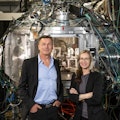
Arianna Gleason
Deputy Director
SLAC's High Energy Density Science Division
Arianna Gleason is a staff scientist in the Fundamental Physics Directorate at the SLAC National Accelerator Laboratory and Adjunct Faculty in both the Geological Science Department, Stanford University & Dept. of Mechanical Engineering at the University of Rochester where she focuses on dynamic mesoscale materials properties. She earned her Ph.D. from the University of California, Berkeley in 2010 working on high- pressure mineral physics and planetary sciences. She was the Frederick Reines and Director’s Postdoctoral Fellow at the Los Alamos National Laboratory from Shock and Detonation Physics 2014-2018. Her research spans geo- and planetary sciences to fusion energy research by applying ultrafast x-ray probes to dynamic materials processes. In 2019, she received the DOE’s Early Career Award in Fusion Energy.