Join us as Dr. Gretarsson reveals how advances in mirror design and laser technology are shaping the next generation of gravitational wave detectors—and what it will take to explore deeper reaches of the universe. Register now!
March 18, 2026
6:00 PM UTC
1 hour
Sponsored by
Now Available On Demand Already registered? Click here to login now!
Dr. Gretarsson will discuss the history and future of gravitational wave detection and the technological challenges ahead. Gravitational waves are notoriously difficult to detect. To improve the current gravitational wave detectors, we need mirrors with lower thermal noise and much lower optical absorption. An exciting new type of laser mirror: the semiconducting supermirror is one of the technologies that will allow the next-generation gravitational wave detector network to hear farther into the universe. The network will need mirrors that are essentially optically flawless—a significant challenge indeed.
Speaker:
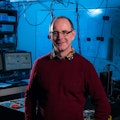
Dr. Andri M. Gretarsson
Active Researcher, LIGO Scientific Collaboration
Professor of Physics, Embry-Riddle Aeronautical University
Dr. Andri M. Gretarsson has been an active researcher in the LIGO Scientific Collaboration since its founding in 1996. As an instrumentalist, he works to characterize and improve the noise properties of the mirrors—the test masses—that form the heart of modern gravitational wave detectors. As a professor of physics at Embry-Riddle Aeronautical University, he strives to hook young people on the excitement and creativity of laboratory work. At present, his lab is investigating birefringence and damage thresholds of a new generation of ultra-low noise crystalline mirrors.