• Home >
  • Back Issues >
  • Laser Focus World >
  • Volume 45, Issue 4
  • Volume 45, Issue 4

    More content from Volume 45, Issue 4

    (Courtesy of Osram)
    An InGaN-based laser diode emits at 500 nm (blue-green). Further reducing the threshold current density will result in lasers with even longer wavelengths; reaching 520 nm (green) will make lasers like these a key component in miniature projectors.
    Laser diodes excel at emitting blue or red light; it’s in the green that they falter.
    April 1, 2009
    Researchers at Drexel University (Philadelphia, PA) and the Naval Research Laboratory (Washington, D.C.) have increased the photocurrent reaching a metal-semiconductor-metal (...
    April 1, 2009
    Because rare-earth-doped glasses exhibit a large Faraday (or magneto-optical) effect, polarization and birefringence effects within these glasses can be directly correlated to...
    April 1, 2009
    By combining characteristics of fluorescent and cathodoluminescent (CL) lamps into a single emitter, researchers at the Industrial Technology Research Initiative (Chatung, Taiwan...
    April 1, 2009
    Th Cnt 01
    Conductive-carbon-nanotube (CNT) thin films–developed as a replacement for more-brittle indium tin oxide materials–have been studied in the visible wavelength range for applications...
    April 1, 2009
    (Courtesy of Edmund Optics and Leybold Optics)

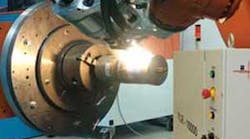
    FIGURE 1. An automatic substrate loading device in the Helios APRS magnetron sputtering system maximizes throughput and minimizes particle contamination of optics such as TECHSPEC filters.
    Magnetron sputtering systems for production of high-precision optical coatings promise benefits in capability over traditional evaporation techniques, as well as potential cost...
    April 1, 2009
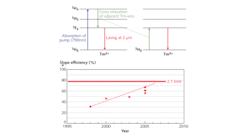
    FIGURE 1. Optimization of the cross-relaxation process in Tm-doped fibers (top) has increased the efficiency of 2 µm fiber lasers to the point where they now approach the efficiency of Yb fiber lasers at 1 µm (bottom).
    High-power fiber lasers emitting at the “eye-safe” wavelength of 2 µm are fabricated from thulium-doped silica fiber and pumped with 790 nm light.
    April 1, 2009
    FIGURE 1. The Newport ST-UT2 Series optical table can be upgraded with an iQ active damper system (shown) without dismantling your experiment (left; Courtesy of Newport). The 5300 Series optical table from Kinetic Systems features broadband damping plus quad-tuned dampers in each corner. Retractable castors are an optional accessory (right; Courtesy of Kinetic Systems).
    Setting up an optical laboratory begins with specifying the optical table–a task more complex than it sounds. Understand your requirements before you place an order.
    April 1, 2009
    (Courtesy of Sarnoff)
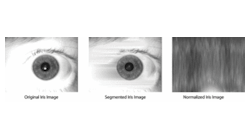
    FIGURE 1. Iris on the Move technology from Sarnoff uses an array of 15 frames/s video cameras with 850 nm LED illumination to image the irises of individuals coming within 3 m of the system at a rate of 30 people per minute (top). The system first segments the iris (middle), then remaps the iris image from Cartesian coordinates to polar coordinates in a normalization process (bottom). In the normalized image, increasing radius goes from top to bottom, while increasing angle goes from left to right, allowing the formatted image to be matched against reference irises.
    Recognizing that the potential for national-security breaches along our borders and in our waterways is significant, imaging companies and research organizations are stretching...
    April 1, 2009
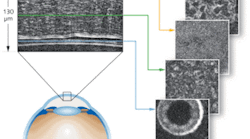
    FIGURE 1. What looks like a more traditional OCT image (left) is actually a reconstruction of all slices registered during Cell OCT imaging of a rat’s anterior eye (cornea). The Cell OCT approach enables cellular-resolution views of transverse slices (right).
    Newly developed Cell OCT, an approach to full-field optical coherence tomography, has enabled researchers to image breast-cancer tissue with histology-like results.
    April 1, 2009
    (Courtesy of the Max Planck Institute for Biophysical Chemistry)
    A STED microscope easily resolves individual nitrogen vacancies in a diamond crystal (center), while a conventional confocal microscope shows nothing of interest (left). The positions of the vacancies can then be found to a 0.15 nm precision (right).
    A group of researchers at the Max Planck Institute for Biophysical Chemistry (Gottingen, Germany) has beaten the diffraction limit by a factor of 40 in a world-record demonstration...
    April 1, 2009
    FIGURE 1. Standard CMOS technology offers three types of p-n junctions: n-plus to p-substrate (left), p-plus to n-well (upper right), and n-well to p-substrate (right).
    A novel CMOS-based photodetector uses concentric octagonal structures to detect and demultiplex spatially separated communications signals emitted from an optical fiber.
    April 1, 2009
    (Courtesy of IPG Photonics)
    FIGURE 1. High-power fiber lasers present new challenges for laser safety, complicated by a flexible fiber beam delivery system that requires monitoring for potential breakage during operation.
    In the last few years, integration of fiber lasers into process machines has proved challenging when trying to comply with laser-safety regulatory agencies. Recent developments...
    April 1, 2009
    An interferometer relies on the effect of varying polarization of the combined laser beam to cause changes in the fluorescence of sodium vapor (top; PBS = polarizing beamsplitter). As the movable interferometer arm is scanned, the conventional beat signal from the laser beam is captured by a photodiode (bottom left), while the fluorescence signal from the vapor is sent via optical fiber to a PMT (bottom right). The fluorescence signal shows twice as many fringes as the beat signal for the same scan.
    Two scientists at the Université Joseph Fourier (Saint Martin d’Hères, France) have developed an extraordinary interferometer.
    April 1, 2009
    (Courtesy of the Optoelectronics Industry Development Association)
    FIGURE 1. Major optoelectronic-component categories can be further subdivided on the basis of five metrics that define what constitutes Green Photonics technology.
    The organizers of the inaugural OPTOmism conference (www.optomism.com) weren’t kidding when they developed its tagline: “Powering the green revolution through photonics.”
    April 1, 2009
    (Courtesy of Technion-Israel)
    With Technion-Israel’s “underground fence,” each 15-mile section is monitored by one BOTDR analyzer. The system can pinpoint tunnel-digging activity to within 6 to 9 ft.
    Beneath the nine-mile border between Gaza and Egypt lie an estimated 300 makeshift tunnels, according to a Jan. 12 article in Asia Times.
    April 1, 2009
    Th 314461
    Record high output power generated from ytterbium-doped fiber amplifiers above 1150 nm has been achieved in a solid-core photonic-bandgap fiber.
    April 1, 2009
    (Courtesy of Colorado School of Mines)
    Among the invited talks, Jeff Squier and his group at the Colorado School of Mines will discuss a photon-counting microscope that simultaneously captured these single-harmonic-generation mosaic images of crystalline cellulose at two orthogonal polarizations of the excitation beam.
    Because of its diversity and leading-edge technological nature, photonics as a profession has shown itself to have a built-in resilience.
    April 1, 2009
    (Courtesy of Alfalight)
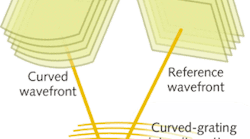
    The secret ingredient in Alfalight’s surface-emitting distributed-feedback laser is a holographically fabricated curved grating that produces a much brighter beam, among other positive attributes, compared to edge-emitting devices.
    A curved-grating resonator in a semiconductor quantum-well laser design is the basis for a high-brightness surface-emitting distributed-feedback (SE-DFB) laser developed by Alfalight...
    April 1, 2009
    Rogue waves of light–rare and explosive flare-ups that are mathematically similar to their oceanic counterparts–have recently been tamed by a group of researchers at the University...
    April 1, 2009
    Though often taken for granted because of their relative invisibility, optical coatings are an indispensible element of almost all of today’s optical components.
    April 1, 2009
    Although the society was quite small, it was probably the most formidable assemblage of science and technology brain power ever to present papers and argue scientific discoveries...
    April 1, 2009
    1304qa Chang New
    Q: I work for a telecom company and am concerned because I see big losses year after year.
    April 1, 2009
    Th 314576
    The 10 and 3 kV Pockels cell drivers provide fast, high-voltage switching to drive the latest Pockels cells in high-power laser applications.
    April 1, 2009