Microfluidic software gets Texas Tech student $225K NSF grant
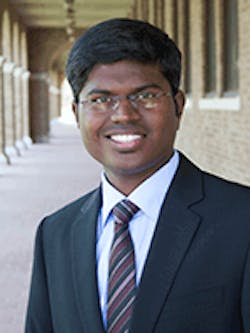
Lubbock, TX--A Texas Tech University student set to earn a doctorate in chemical engineering in August was awarded a $225,000 National Science Foundation Small Business Technology Transfer (NSF STTR) grant to help commercialize his doctoral work in microfluidics that could take years off biomedical and pharmaceutical trials, and thereby save lives.
Jeevan Maddala came to Texas Tech in the fall of 2009 hoping to develop new technology and commercializing it through a startup company. He developed an interest in microfluidic devices that allows scientists to speed up the drug discovery by processing large amounts of chemicals.
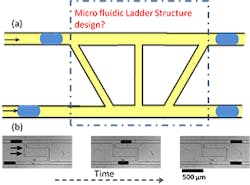
Currently, microfluidic devices are manufactured in prolonged trial-and-error processes with many physical mockups. Maddala's idea is to create a computer program to create those mockups virtually, which would allow him to fine tune and speed up the process. The software also would enable Maddala to develop very complex and large devices, and then manufacture them with a three-dimensional 3D printer.
Collaborating with chemical engineering professors Raghunathan Rengasamy and Siva Vanapalli, Maddala developed a set of algorithms that would allow him to build the software, and virtually create hundreds of microfluidic-device designs that meet the specifications of the user. Each of the designs are analyzed and modified by the algorithms, resulting in thousands of design possibilities in a relatively short amount of time. Maddala knew it was time to seek funding when a software prototype showed great promise.
"Texas Tech provided me with the right environment to pursue my dreams," Maddala said. "My background in engineering helped me prepare the technical part of the proposal for the National Science Foundation; the challenge was in writing the business plan."
He approached the Texas Tech Office of Technology Commercialization (OTC) and the Texas Tech University Small Business Development Center for help. Through the OTC, Maddala and Rengasamy filed a patent for his technology.
"We need more graduate students, like Jeevan, to have an entrepreneurial mindset and to focus their research on solving real world problems," said Ryan Reber, a technology licensing specialist in the OTC. "The end goal is to actually transfer this innovation to the market. We are still a long way from doing that, but by filing for a patent and beginning to develop a business plan with Jeevan's team and the Small Business Development Center, our office has taken steps to expedite the commercialization process."
Meanwhile, the NSF grant allows Maddala to focus on the development and demonstration of the software system. If successful, he will move forward with further enhancements and the development of prototypes. He hopes to eventually build a fully automated system that will design and physically construct highly complex droplet-based microfluidic platforms, starting from just a design concept of a user.
SOURCE: Texas Tech University; http://today.ttu.edu/2013/07/engineering-student-receives-225000-to-start-business/
About the Author
 Gail Overton
Gail Overton
Gail Overton served as a senior editor for Laser Focus World from 2004 through 2020. She has more than 30 years of engineering, marketing, product management, and editorial experience in the photonics and optical communications industry. Before joining the staff at Laser Focus World, she held many product management and product marketing roles in the fiber-optics industry, most notably at Hughes (El Segundo, CA), GTE Labs (Waltham, MA), Corning (Corning, NY), Photon Kinetics (Beaverton, OR), and Newport Corporation (Irvine, CA). During her marketing career, Gail published articles in WDM Solutions and Sensors magazine and traveled internationally to conduct product and sales training. Gail received her BS degree in physics, with an emphasis in optics, from San Diego State University in San Diego, CA in May 1986.