• Home >
  • Back Issues >
  • Laser Focus World >
  • Volume 49, Issue 01
  • Volume 49, Issue 01

    More content from Volume 49, Issue 01

    A handheld spectrophotometer device uses a “virtual” LED emitter and inexpensive photodetectors to scan a sample and create a unique wavelength-vs.-intensity plot or ChromaID that uses spectral pattern matching to compare the plot to a database of known ChromaID signatures to identify the substance under test.
    A new lower cost and potentially less bulky method of spectrophotometry from Visualant eliminates the need for delicate optical components and expensive detectors by using a “...
    Jan. 16, 2013
    Different types of grating apodization are depicted, with refractive index n varying with respect to x.
    One of the hottest areas in lasers now is the use of incoherent beam combining to create very high-power laser diode systems.
    Jan. 15, 2013
    (Courtesy of Duke University)
    A scanning electron microscopy (SEM) image shows the silver nanocubes deposited on the gold film (a); a darkfield image shows how cube size can influence the color they diffuse (b). The cubes are shown in a SEM image as fabricated (c) and in an artist’s view (d).
    An alternative metamaterial absorber uses a simple, lower-cost method that randomly adsorbs silver nanocubes onto a polymer layer on gold film.
    Jan. 15, 2013
    Pulsed electric-discharge DF laser produces 4.95 J pulses
    Chinese scientists have modeled the nonchain deuterium fluoride laser and used the results to build a prototype laser with an optimized sulfur hexafluoride-to-deuterium (SF6 to...
    Jan. 14, 2013
    1301breaks Fig3
    MLD Technologies (MLD) has successfully scaled up an ion-beam sputtering (IBS) deposition process to provide uniform (less than 1% variation), low-loss (less than 15 ppm total...
    Jan. 14, 2013
    Graphene delivers ultrashort mid-IR laser pulses
    Researchers at Cambridge University and Imperial College London, both in England, have demonstrated that graphene is a promising broadband saturable absorber with ultrafast response...
    Jan. 14, 2013
    Several types of boron nitride (BN) were studied via terahertz time-domain spectroscopy by Mira Naftaly of the National Physical Laboratory and Jon Leist of Momentive Performance...
    Jan. 11, 2013
    1301breaks Fig1
    Holographic maps developed by Zebra Imaging and sponsored by a US Army contract allow soldiers to view three-dimensional (3D) landscapes and cityscapes prior to entering a battle...
    Jan. 11, 2013
    DTU Fotonik
    FIGURE 1. In a photon-counting mid-IR image-upconversion system, mid-IR light is converted by adding the energy of a laser photon as the signal passes through a nonlinear crystal (a). The process is virtually instantaneous (occurring at the speed of light), and a whole image can be processed at once. An experimental conversion device is small and rugged (b). An internal view of the conversion device shows the light path (c).
    A photon-counting upconversion imager allows new kinds of quantitative measurements in the mid-infrared wavelength range—the "fingerprint region"—which is of great technical and...
    Jan. 1, 2013
    FIGURE 1. Closed-loop adaptive optical system for examining the retina. Light from an external source is focused into the eye where aberrations change the wavefront reflected back into the optical system. Wavefront sensors detect aberrations of the wavefront and adjust the surface of an adaptive mirror to cancel out the aberrations, producing a corrected wavefront that produces high-resolution images.
    The eye may look as clear as the air, but both media have aberrations that can warp optical wavefronts and blur images. Adaptive optics can compensate for the eye's internal aberrations...
    Jan. 1, 2013
    Conard Holton2
    The "global headwinds" phrase on our cover this month is a fair description of the recent and forecasted general economic environment—and it understates the whirlwind that many...
    Jan. 1, 2013
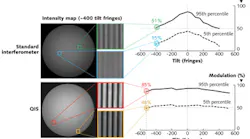
    FIGURE 1. QIS modulation is independent of fringe density, allowing for more robust data acquisition at high fringe densities and acquisition at a higher percent of Nyquist. Here, modulation vs. fringe density is shown for a standard interferometer and QIS.
    The QIS, a coherent imaging Fizeau interferometer, has been developed to measure high fringe densities for non-null, aspheric stitching interferometry.
    Jan. 1, 2013
    FIGURE 1. A QCL has multiple active regions through which electrons cascade, each of hundreds of semiconductor layers deposited with nanometer precision.
    The widely tunable quantum-cascade laser is becoming a valuable light source in the "fingerprint" region; these devices can be integrated into small, rugged spectrometers for ...
    Jan. 1, 2013
    FIGURE 1. Multiple lasers and wavelengths can be readily combined and directed with a few dichroic mirrors and filters, enabling simpler, more efficient systems that contain fewer parts to maintain, replace, and stock.
    Sputter coatings for laser mirrors and dichroic filters offer advantages over traditional coatings to designers creating systems that combine multiple lasers.
    Jan. 1, 2013
    FIGURE 1. A high-resolution infrared image of the greater Boston area was collected at night using a 256 × 256 digital-pixel focal plane array. Insets include the Boston Financial District and MIT.
    Combining focal plane array detection, digitization, and image-processing electronics into a massively parallel architecture simplifies system design while improving capabilities...
    Jan. 1, 2013
    FIGURE 1. Global shape descriptors are shown for some common optical components.
    Recent design methods and software advances make it much easier to design aspheric surfaces that actually work in production and test by considering manufacturability issues at...
    Jan. 1, 2013
    (Courtesy Georgia Institute of Technology)
    FIGURE 1. A silicon-on-insulator (SOI) microdonut optical-resonator array is demonstrated for on-chip spectroscopy. Each portion of the input spectrum is picked up by an individual resonator. The difference of the outer radii of the fabricated optical resonators is only 1 nm, such that a resolution of 0.6 nm is achieved.
    Still somewhat of a newcomer to the Moscone Convention Center in San Francisco, SPIE Photonics West is slightly delayed to the first week of February; however, attendance and ...
    Dec. 6, 2012