• Home >
  • Back Issues >
  • Laser Focus World >
  • Volume 44, Issue 8
  • Volume 44, Issue 8

    More content from Volume 44, Issue 8

    (Courtesy of the University of Texas)
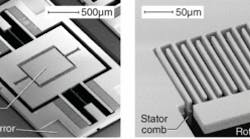
    FIGURE 1. Scanning electron micrographs of the two-axis MEMS scanning micromirror show the mirror surface, torsion springs, gimbal structure, and bond pads for electrical connection (left) and, in a close-in view, the electrostatic actuation mechanism (right).
    While nonoptical medical imaging techniques such as computed tomography, magnetic-resonance imaging, and ultrasound can be very useful in guiding surgical procedures, they lack...
    Aug. 1, 2008
    Sony’s 3-mm-thick XEL-1 organic-light-emitting-diode (OLED) TV received SID’s 2008 Gold Award for Display Device of the Year. While the XEL-1 may be expensive at $2500 (considering it is only 11 inches on the diagonal), OLED technology is here to stay, as it promises better picture quality, lower power consumption, and hopefully, lower prices as numerous companies enter the market and improve manufacturing capabilities.
    Display Week 2008 was clearly dominated by an emphasis on energy-saving, environmentally sustainable displays and photonic technologies.
    Aug. 1, 2008
    Th 0807lfw05f1
    Near-infrared hyperspectral imaging is important to semiconductor-device research; integrating an InGaAs image sensor with hyperspectral microscopy provides data to a level of...
    Aug. 1, 2008
    (Courtesy of Max-Planck-Institut für Quantenoptik)
    A sub-1.5-cycle ultrafast laser pulse strikes a jet of neon atoms, ionizing some of them (top). The recombination of the electrons with the atoms creates a pulse of extreme-UV light with an 80 as duration (bottom).
    By carefully controlling the waveform of an ultrafast laser pulse and sending it through a jet of neon gas, briefly ionizing it, researchers at the Max-Planck-Institut für Quantenoptik...
    Aug. 1, 2008
    (Courtesy of F. Intonti)
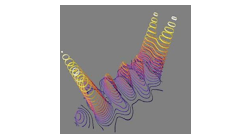
    The electric field of the fundamental mode of a PC-MC is rendered based on measurements made with the SNOM tip.
    One promising avenue in the field of nanophotonics—confining and manipulating light on the nanometric scale—is the use of photonic crystals (PCs) in optical microcavities.
    Aug. 1, 2008
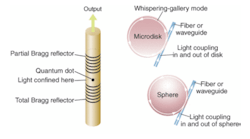
    FIGURE 1. Two types of microcavity lasers include one in which a Fabry-Perot microcavity confines light horizontally in a thin pillar and vertically between a pair of Bragg reflectors (left) and another in which a whispering-gallery microcavity confines light by total internal reflection in the plane of a disk or in the volume of a sphere (right).
    Strong coupling of a light wave with matter in microcavities creates unusual effects, including novel lasers—microlasers and polaritons—and strong nonlinearities.
    Aug. 1, 2008
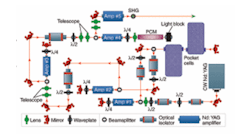
    FIGURE 1. A pulse-burst Nd:YAG laser system provides tunable, high-repetition-rate ultraviolet pulses with individual pulse energy high enough to allow PLIF imaging of turbulent flows.
    While planar laser-induced-fluorescence (PLIF) imaging of aerodynamic and combustion flows has developed enormously since its inception in the early 1980s, the ability to directly...
    Aug. 1, 2008
    Th 0808lfw05f1
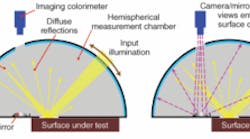
    Imaging-sphere technology enables fast optical characterization of surfaces to produce quantitative, comprehensive evaluation that the human eye can’t.
    Aug. 1, 2008
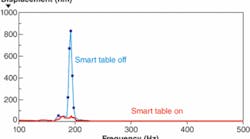
    FIGURE 1. The magnitude of movement that can be experienced by an optical mount in a typical lab environment when subject to broadband noise is influenced greatly by the damping capabilities of the optical table on which the mount sits.
    Optical tables and vibration isolation supports have become the de facto standard for providing a stable environment for complex laser systems and their applications.
    Aug. 1, 2008
    (Courtesy Leonid Butov/UCSD)
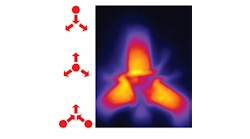
    In an excitonic integrated circuit (EXIC) with three exciton optoelectronic transistors (EXOTs), a directional switching scheme uses voltage differentials at one electrode (colored spot) to channel “indirect exciton” flux (arrows) toward electrodes to the left and right (left top). In another scheme, equal voltages direct the flux from a central electrode, creating a three-beam star geometry (left center, and right). A third scheme demonstrates the merging of indirect exciton flux (left bottom).
    For the first time, scientists have reportedly manipulated exciton fluxes in tiny circuits using voltage as a control, an important step in the development of optically active...
    Aug. 1, 2008
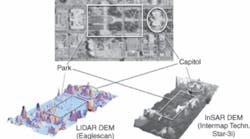
    FIGURE 1. While synthetic-aperture-radar data can be easily and inexpensively obtained from orbiting Earth satellites, the resolution can be limited. By overlapping the data with more specific lidar data from areas within the same region, the inherent distortions found in SAR images can be adjusted for, as shown in this integrated SAR and lidar image of Denver, CO.
    Advances in high-resolution image processing are helping governments better manage urban sprawl and fallout from natural and man-made disasters.
    Aug. 1, 2008
    Th 0808lfw7f1
    Power-transmission tests of IR light through fiber-optic delivery systems show the viability of commercial-grade fluoride fiber for medical and dental applications.
    Aug. 1, 2008
    Researchers at Argonne National Laboratory (Argonne, IL) and the University of California at Los Angeles (UCLA) are developing an x-ray free-electron laser (FEL) in an oscillator...
    Aug. 1, 2008
    Researchers from the University of Arizona (U of A; Tucson, AZ) and the Jet Propulsion Laboratory (Pasadena, CA) have coupled an optical vortex coronagraph (OVC) to an 8-in.
    Aug. 1, 2008
    Chalcogenide glasses are useful for their wide transmission range, which extends through the mid-infrared.
    Aug. 1, 2008
    Scientists have no problem generating immense data sets, but visualizing the data on a large scale is a challenge that requires a display system of equally immense resolution....
    Aug. 1, 2008
    Although continuous-wave blue diode lasers are available, output power, beam quality, and tunability are limited.
    Aug. 1, 2008
    Th Nwsbksatomic
    Optical storage of information is a tricky obstacle to overcome in the realization of quantum information processing.
    Aug. 1, 2008
    By announcing shipment of its ten-millionth chip, transceiver and components company Phyworks (Bristol, England), whose products cover 1 to 10 Gbit/s data rates for fiber-to-the...
    Aug. 1, 2008
    Th 0808lfwnewport
    The Excelsior-594 is a multilongitudinal-mode laser with 30 mW output at 594 nm.
    Aug. 1, 2008
    1304qa Chang New
    How does a recent grad even begin to think about starting a company?
    Aug. 1, 2008
    Chances are that you have never heard of the man who turned acoustics into a true science although you almost certainly have listened to music that has benefited from his exemplary...
    Aug. 1, 2008
    Conard Holton2
    As airline fleets age, maintenance issues inevitably arise and aircraft inspection becomes more critical.
    Aug. 1, 2008
    Anticipating the “green revolution,” Laser Focus World published in September 2006 a staff-written Special Report highlighting the role that photonics and optoelectronics can ...
    Aug. 1, 2008
    Ultrafast Lasers–2008, a new report from Strategies Unlimited (Mountain View, CA) forecasts that the ultrafast laser market will reach about $260 million in 2008 with healthy...
    Aug. 1, 2008
    Laser Focus World (Nashua, NH) and the Optoelectronics Industry Development Association (OIDA; Washington, D.C.), a not-for-profit association that serves as the nexus for vision...
    Aug. 1, 2008
    S.E.T. Smart Equipment Technology (Saint Jeoire, France), a supplier of die-to-die, die-to-wafer bonding and nanoimprint lithography solutions, installed a Kadett High Accuracy...
    Aug. 1, 2008
    Th 0808lfwmkt
    The last decade has witnessed a revolution in the way we image and measure the Earth.
    Aug. 1, 2008
    (Courtesy Max Planck Institute for Biophysical Chemistry)
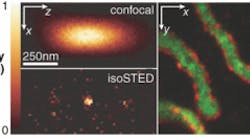
    Different proteins within mitochondria are tagged with different fluorophores and imaged using the isoSTED technique at a resolution of roughly 50 nm.
    The imaging resolution of far-field fluorescence microscopy techniques is limited by the point-spread function (PSF) of the focal spot, which quantifies the blur of the object...
    Aug. 1, 2008
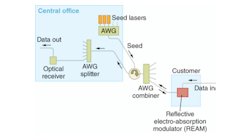
    Each customer in a wavelength-division-multiplexed passive optical network has a R-EAM that allows individual uplinking of data at 10 Gbit/s.
    The first commercial reflective electro-absorption modulator (R-EAM) has been released by CIP Technologies (Ipswich, England).
    Aug. 1, 2008
    Th 0808lfwdesk Web
    Combining laser beams can boost power at the target far above that produced by a single laser.
    Aug. 1, 2008
    (Courtesy of Osaka University)
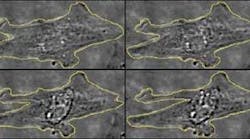
    These images illustrate the contraction of a single cardiomyocyte under the influence of laser irradiation.
    A research team at Osaka University in Japan has shown that cultured heart-muscle cells synchronize their contractions in response to pulses from a femtosecond laser.
    Aug. 1, 2008
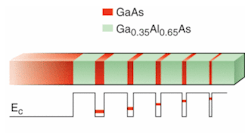
    Laser cooling was achieved on a semiconductor sample of undoped GaAs quantum wells of varying thickness separated by GaAlAs barriers. Each QW produced photoluminescence with an amplitude proportional to its thickness.
    Lasers are widely known for their use in industrial applications for cutting through metals, or for their potential as defensive weapons: they bring to mind powerful, visible,...
    Aug. 1, 2008
    (Courtesy of KAIST)
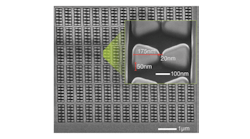
    A nanoscale array of gold bowties on a 400-μm-thick sapphire plate generates high harmonics from 10 fs, 800 nm ultrafast light pulses and flowing argon gas. The array contains 36 × 15 bow ties.
    Because extreme-ultraviolet (EUV) radiation is so difficult to produce, any scientist or engineer who happens to come up with a good idea using EUV light is soon confronted with...
    Aug. 1, 2008
    (Courtesy of the NRC)
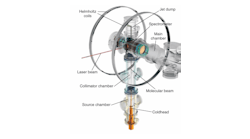
    The horizontal main chamber in this COLTRIMS system houses the spectrometer. A cold beam of molecules is created in the lower portion of the vertical tube and fed through the laser focus in the main chamber, where the electrons can be extracted from and recollided with parent molecules during the same pulse cycle to create sequential “moving frames” of chemical processes.
    About a decade ago, Paul Corkum imagined a laser beam tearing an electron from a molecule and then driving the same electron back to the molecule to take its own picture.
    Aug. 1, 2008