• Home >
  • Back Issues >
  • Laser Focus World >
  • Volume 44, Issue 1
  • Volume 44, Issue 1

    More content from Volume 44, Issue 1

    (Courtesy of Coherent)

    FIGURE 1. With PermAlign technology, each optic in a diode-pumped solid-state laser cavity is rigidly soldered to a ceramic base.
    A unique monolithic mounting system results in a highly stable diode-pumped solid-state laser source that can address a wider spectrum of marking applications than fiber lasers...
    Jan. 1, 2008
    When current flows through metal-insulator-semiconductor diode, recombination occurs in the germanium layer just below the insulator. In this Fabry-Perot laser, stimulated emission oscillates between the cleaved facets, emerging from the shaded area.
    Germanium could be the key ingredient needed to integrate high-speed optical interconnects with silicon integrated-circuit chips and two independent groups have taken important...
    Jan. 1, 2008
    (Courtesy of NIST)
    The NIST measurement system is strapped on the hood of a truck to test the crash warning system hidden inside the grill and windshield. The laser scanners are housed in the circular, red enclosures at the corners.
    Engineers at the National Institute of Standards and Technology (NIST; Boulder, CO) have developed and tested a laser-based ranging system to assess the performance of automobile...
    Jan. 1, 2008
    (Courtesy of K. Unterrainer/TU-Wien)
    The phase-resolved measurements of stimulated emission of a terahertz quantum-cascade laser are shown above the quantum wells making up the QC laser, with a 3-D image of the electric field amplitude as a function of time.
    The understanding of some of the most fundamental, and heretofore inaccessible, aspects of optical dynamics looks set to leap forward with the first-ever direct measurement of...
    Jan. 1, 2008
    According to “Optical Coherence Tomography - Technology, Markets, and Applications: 2008-2012,” a market-research report from PennWell, publishers of Laser Focus World and BioOptics...
    Jan. 1, 2008
    (Courtesy of University of Sydney)
    A three-hole (top) and five-hole (bottom) microstructured polymer optical fiber (shown in cross section) is slotted to allow direct liquid or gas sensing. The fiber diameter is approximately 140 µm.
    Microstructured optical fibers typically consist of a solid core surrounded by a structure of holes in the cladding that run along the length of the fiber.
    Jan. 1, 2008
    (Courtesy of NASA)
    FIGURE 1. Thermal-IR imaging sensors on NASA’s Ikhana unmanned research aircraft recorded this image of the Harris fire in San Diego County, CA, on Oct. 24, 2007, with hot spots along the ridgeline in left center clearly visible.
    Advances in remote imaging have pushed geospatial imagery into the mainstream, enabling it to play a critical role in management and mitigation of natural disasters such as the...
    Jan. 1, 2008
    (Courtesy of University of Rochester)
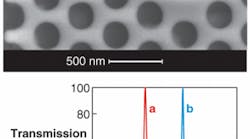
    A 370-nm-diameter latex sphere captured in the central defect (685-nm-diameter) of a two-dimensional photonic-crystal microcavity (top) causes a redshift of approximately 4 nm in the spectral signature of the sensor (bottom). An increase in the sphere diameter corresponds to an increasing redshift.
    One-dimensional photonic crystals and photonic-crystal microcavities have already been used for the detection of DNA, proteins, and even bacteria.
    Jan. 1, 2008
    (Courtesy of Kyoto Institute of Technology)
    Eight frames from a continuously moving 3-D image of a femtosecond light pulse as it converges and diverges through a convex lens are captured using a new holographic recording technique. The movie shows the pulse as it converges (a-e), reaches a focus point (f), and then diverges (g-h); the time interval between frames is 15 ps.
    For the first time, three-dimensional (3-D) images of femtosecond light-pulse propagation have been observed and recorded by researchers at the Kyoto Institute of Technology (...
    Jan. 1, 2008
    (Courtesy of Nature Medicine)
    An optical-frequency-domain image of the coronary artery of a pig shows a metal stent in the artery (blue) and damage to the inner surface of the artery (gray).
    A research team at Massachusetts General Hospital (MGH; Boston, MA) has developed a laser-based technique that, because it can visualize deposits of plaque, macrophages, and other...
    Jan. 1, 2008
    FIGURE 1. The current response for a commercially available amorphous-silicon photodiode as a function of illumination follows an exponential curve.
    While it is impossible to reproduce the brightness level of the Sun, it is possible to simulate a photovoltaic detector’s response with improved accuracy by integrating a white...
    Jan. 1, 2008
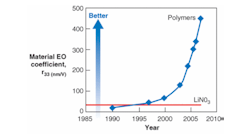
    FIGURE 1. The electro-optic efficiency of polymer devices, measured as the r33 coefficient, has more than tripled since 2003, and is now more than 10 times the value for LiNbO3, as shown in this plot by DARPA program manager Dev Shenoy.
    Research on organic nonlinear materials dates back a couple of decades, but those efforts have only recently started paying practical dividends.
    Jan. 1, 2008
    (Images courtesy of R. Neumeyer/Fraunhofer ILT)
    Laser-induced fusion technology (LIFTEC) developed at the Fraunhofer Institute for Laser Technology in Germany creates effective bonds between dissimilar materials such as steel and PMMA (plastic) (top) or Teflon and PMMA plastic (bottom).
    Industry is still seeing a rise in the use of plastics as a material in integrated technologies and the superior mechanical and electrical properties of metals ensures their place...
    Jan. 1, 2008
    (Courtesy of Josh Semeter, Boston University)
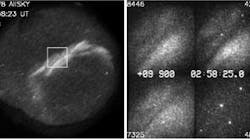
    FIGURE 1. An aurora was imaged from the Sondrestrom Upper Atmospheric Research Facility with a traditional all-sky (fisheye) white-light imager (left) and the Simultaneous Multispectral Imager (right).
    Etched liquid-crystal Fabry-Perot tunable optical filters can provide high-enough spectral resolution for background discrimination and rapid tuning in atmospheric sensing.
    Jan. 1, 2008
    FIGURE 1. Five Shack-Hartmann wavefront sensors-one on-axis and four off-axis-measure the quality of mobile-phone camera lenses. Light from a multipinhole light source is used to illuminate the lens, and the five cameras record the spot patterns. A calibration image is taken using parallel light from a high-quality lens. After analysis, the good and bad lenses are automatically sorted out. The whole operation takes less than five seconds. The off-axis angles can be defined by the user.
    A new generation of diagnostic instruments based on the Shack-Hartmann method can be used to measure the optical quality of single or complex lenses, measuring on-axis as well...
    Jan. 1, 2008
    (Courtesy of ORC Southampton)
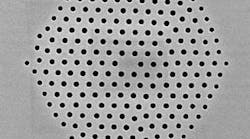
    FIGURE 1. A silica microstructured optical fiber fabricated at the University of Southampton Optoelectronics Research Centre demonstrates the flexibility of sizes and arrangement of holes that can be fabricated in a single fiber.
    The use of a novel chemical-vapor-deposition process to integrate metals and semiconductor films in microstructured optical fibers may soon enable nanometer-scale waveguides and...
    Jan. 1, 2008
    Th 0801lfw3f1
    In seafarers’ maps of Renaissance times, the term terra incognita was used to denote unknown land-areas beyond the known frontiers that were yet to be documented.
    Jan. 1, 2008
    Th 271121
    Surface plasmons can be thought of as light waves trapped and traveling along the interface between a metal and a dielectric material.
    Jan. 1, 2008
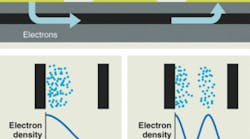
    FIGURE 1. A basic field-effect transistor consists of a source and drain of charge carriers that connect to a channel controlled by a gate (top). A fundamental standing-charge-density oscillation, known as a plasmon, sloshes between two boundaries (bottom left). Increased current causes a higher harmonic of the fundamental plasmon, splitting the group in two (bottom right). Like a spring constant, increasing the carrier density in the channel increases the resonant frequency.
    Plasmon-based grating-gate detectors based on hot-electron bolometer mixers are being explored as tunable detectors of terahertz radiation—the next big thing in security applications...
    Jan. 1, 2008
    A retinal flow cytometer developed by researchers from the Wellman Center for Photomedicine at Massachusetts General Hospital and Harvard Medical School (Cambridge, MA) has demonstrated...
    Jan. 1, 2008
    Th 271046
    White-light organic and polymer light-emitting diodes (WOLEDs and WPLEDs) show promise for use in full-color displays, liquid-crystal-display backlights, and solid-state lighting...
    Jan. 1, 2008
    Th 271045
    Although mid- to far-infrared quantum-cascade (QC) lasers are ideal for gas sensing, free-space optical communications, and imaging, their high beam divergence (typically about...
    Jan. 1, 2008
    Th 0801lfwnbf2
    High-speed switching or tuning of light in fiber Bragg gratings (FBGs) can be applied to Q-switching, cavity dumping, and pulse picking in a fiber laser, among other applications...
    Jan. 1, 2008
    Leoni (Nuremberg, Germany), a wire, cable, and wiring systems specialist, is further expanding its activity in the high-growth market for fiber optics by acquiring 90.2% of the...
    Jan. 1, 2008
    Th 271080
    Snell, Fraunhofer, Fresnel, Fizeau, and Raman: a few of the numerous men after whom optical principles are named.
    Jan. 1, 2008
    1304qa Chang New
    Q: My impression is very few photonics technologies that came out of government-sponsored research, even when they are useful product ideas, are ever licensed.
    Jan. 1, 2008
    Conard Holton2
    Machine vision inspects the surfaces of medical stents.
    Jan. 1, 2008
    A corner detector can be used to detect the positions of the threads and the number of threads on a bolt (top). The corner detector applies differentiating kernels over an area, A, and weights the results with a Gaussian curve. An edge detector’s response varies somewhat with edge angle (bottom).
    In machine vision, edge-detection algorithms locate intensity transitions within an image that correspond to physical edges.
    Jan. 1, 2008
    That’s a very serious question, believe you me. The winners of the 2007 Nobel Prize in Physics barely made a minor dent in the major media in the U.S.
    Jan. 1, 2008
    Despite softness in some photonics market segments and the economic challenges of 2007 - which included record energy prices and the housing credit debacle in the U.S. - the lasers...
    Jan. 1, 2008
    In your November 2007 issue, you report about a composite solar cell with record efficiency.
    Jan. 1, 2008
    Ultrafast-fiber-laser manufacturer IMRA America (Ann Arbor, MI) and Toptica Photonics (Munich, Germany), manufacturer of diode lasers and femto-fiber technology for industrial...
    Jan. 1, 2008
    Boston Micromachines (Watertown, MA), a provider of microelectromechanical systems (MEMS)-based deformable-mirror products for adaptive-optics systems, has been selected by the...
    Jan. 1, 2008
    SEMI (San Jose, CA), the global industry association for the manufacture of semiconductors, displays, photovoltaic cells, and related products, and Freiburg Wirtschaft Touristik...
    Jan. 1, 2008
    Th 0801lfwams Tech
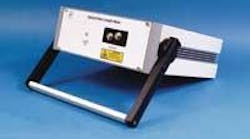
    The Optical Fiber Length Meter from Oz Optics measures the lengths of multimode, single-mode, and polarization-maintaining fibers, including fibers for nontelecom wavelengths....
    Jan. 1, 2008
    (Courtesy of University of Surrey)
    Trapping a rainbow: the constituent frequencies of a wave package are stopped at different thicknesses inside a tapered, metamaterial left-handed heterostructure (LHH). The index of refraction, n, is highest in the middle layer, and lowest in the upper layer. Open arrows reveal direction of light propagation, while the thin black arrows show direction of phase propagation, β.
    The ability to route, switch, and store information in broadband telecommunications networks typically depends on electrical signals, but a new optical technique to slow down ...
    Jan. 1, 2008
    The OSA’s Optical Phenomena Poster Series sparks discussion in classrooms around the globe.
    Jan. 1, 2008
    Laser-diode controllers, unlike general-purpose power supplies, provide constant current to laser diodes, as well as solutions to system-design tasks.
    Jan. 1, 2008
    Transverse-magnetic differential gain coefficients and threshold current densities are calculated for silicon germanium quantum-cascade lasers designed for operation near 50 µm (6 THz; solid lines) and 25 µm (12 THz; dashed lines).
    The quest for practical terahertz sources and detectors has been driven by the tremendous potential of these devices in medical diagnostics, security screening, and manufacturing...
    Jan. 1, 2008
    (Courtesy of Fetah Benabid)
    FIGURE 1. This SEM image shows the profile of the transmitted light through the Kagome-lattice hollow-core PCF. The fiber can accommodate broadband guidance in the core with a continuum of cladding modes without interaction.
    A team of physicists has reported using a photonic-crystal fiber to manipulate light a million times more efficiently than previously known possible.
    Jan. 1, 2008
    Surrounding a second-order tantalum pentoxide (Ta2O5) photonic-crystal structure with a first-order structure as shown in this micrograph reduces light losses from the device. A section of one of the four corners of the device without gain material is shown here.
    A team of researchers from AMO (Aachen, Germany), IBM Research (Rüschlikon, Switzerland), and the University of Wuppertal (Wuppertal, Germany) recently investigated the combination...
    Jan. 1, 2008
    (Courtesy of Lehigh University)
    FIGURE 1. A colloidal SiO2/polystyrene crystal forms a two-dimensional microlens array on top of an InGaN QW LED structure, to more than double the extraction efficiency of the device.
    The light-extraction efficiency of quantum-well (QW) light-emitting diodes (LEDs) is one of the keys to the quantum efficiency of these devices.
    Jan. 1, 2008
    (Courtesy of USC)
    Images of carbon nanotubes before and after deposition of silver nanoparticles shows SERS-induced burnout. The white circle indicates the size and location of the laser spot. A lithographically patterned gold strip appears bright (left) due to an electron-beam-induced charge contrast.
    Raman spectroscopy enables chemical identification of many substances through the vibrational energies of molecules, but the scattering cross section of most molecules is extremely...
    Jan. 1, 2008
    Th 0801lfw01f1
    The laser industry feels the effects of larger economic issues in 2007.
    Jan. 1, 2008
    In single-molecule double-slit experiment polarized light shines down onto the hydrogen molecule (left) initially causing emission of fast and slow electrons at different angles. Equivalent slit separation is 1.4 au (the internuclear distance in the hydrogen molecule), and the light wavelength is 3.75 au, corresponding to an electron energy of 190 eV. Photoionization by circularly polarized light launches a coherent spherical photoelectron wave at each nucleus of the molecule (center). In cases in which slow electron energy is negligible (right), large horizontal side lobes in measured electron angular distribution indicate diffraction pattern due to quantum behavior.
    A team of researchers has performed the smallest and simplest double-slit experiment to date.
    Jan. 1, 2008