• Home >
  • Back Issues >
  • Laser Focus World >
  • Volume 44, Issue 3
  • Volume 44, Issue 3

    More content from Volume 44, Issue 3
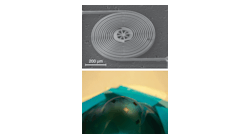
    (Courtesy Stanford University)
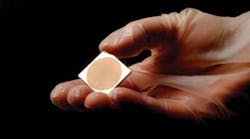
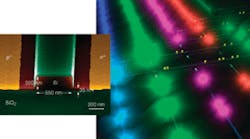
    A scanning-electron micrograph shows a silicon island surrounded by coiled silicon wires (top). When the wires are uncoiled and attached to other silicon islands, the flexible array (bottom) can be used for large-area silicon-based applications including lower-cost solar cells and distributed sensor arrays.
    When we think about silicon photonics, we often picture a uniform, monolithic wafer of material.
    March 1, 2008
    Researchers at National Taiwan University (Taipei, Taiwan) and National Tsing-Hua University (Hsinchu, Taiwan) are showing that gamma-ray irradiation may be superior to electron...
    March 1, 2008
    Th 0803lfwnb1
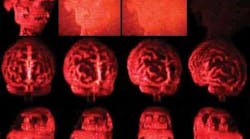
    Researchers from the University of Arizona, in conjunction with Nitto Denko Technical Corporation (Oceanside, CA), have created a holographic three-dimensional (3-D) display that...
    March 1, 2008
    Th 0803lfwnb2
    The ultimate goal of the Old World alchemist was to turn inexpensive metals into gold.
    March 1, 2008
    Optical designers require radially and azimuthally polarized beams to improve performance of systems like confocal microscopes and lithography systems.
    March 1, 2008
    Th 0803lfwnb
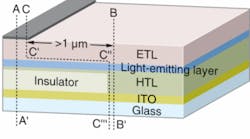
    The path toward creating an electrically pumped organic laser is hindered by the fact that metallic contacts quickly absorb light in organic light-emitting diodes (OLEDs) and ...
    March 1, 2008
    (Courtesy of The Spaceward Foundation)
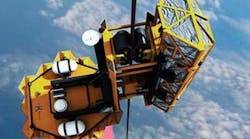
    FIGURE 1. An artist’s rendering illustrates the concept of the space elevator, a platform powered by a ground-based laser-diode unit that climbs into space from Earth on a ribbon or tether.
    Improved efficiency of diode lasers and the growing photovoltaic market have accelerated interest in power beaming (wireless power transfer). The NASA-sponsored Space Elevator...
    March 1, 2008
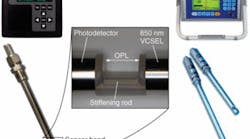
    FIGURE 1. An optical cell-density probe provides real-time, in situ process data, measuring the optical loss across a known distance (OPL) to give a measure of the suspended-particle density.
    Optically based monitoring of bioprocess reactors enables real-time, noninvasive interrogation of the bioprocess state, bringing the promise of significant improvements in process...
    March 1, 2008
    (Courtesy of IBM)
    FIGURE 1. IBM’s new silicon Mach-Zehnder optical modulator converts a digital electrical signal carried on a wire into a series of light pulses carried on a silicon nanophotonic waveguide. The waveguides are made of tiny silicon strips (purple) in a silicon-on-insulator wafer (inset).
    Nanoscale techniques are yielding chip-level modulators, transceivers, VOAs, and even lasers—all made from silicon.
    March 1, 2008
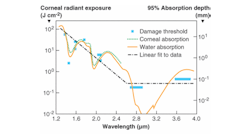
    FIGURE 1. The measured threshold for corneal damage from nanosecond pulses in J/cm2 (blue bars) tracks the 95% absorption depth in the cornea (green dotted line), which is close to that of water (yellow line). Because the data show absorption depth, the low points in the curve correspond to peaks of attenuation where light is absorbed very efficiently. The dashed black line is a linear fit of the data, which safety specialists propose as a tool to calculate maximum permissible exposures.
    Shifting to wavelengths not transmitted to the retina relaxes eye-safety requirements for applications that require beam transmission through open air, but corneal safety remains...
    March 1, 2008
    (Courtesy of Kopin)
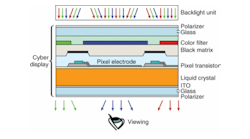
    FIGURE 1. A schematic cross-sectional view shows a full-color Kopin CyberDisplay liquid-crystal display (LCD) with color filters. The light transmission through each color dot is independently controlled by the voltage applied to each pixel electrode, resulting in a wide full-color gamut.
    Transmissive liquid-crystal technology based on single-crystal silicon backplanes enables ultralow power consumption, wide operating-temperature range, and “instant-on” performance...
    March 1, 2008
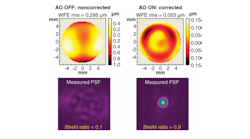
    FIGURE 1. The impact of adaptive optics on laser spot quality is evident from these images comparing corrected and uncorrected laser output. The Strehl ratio (the ratio between the actual spot intensity and the theoretical maximum intensity), increases from less than 0.1 without correction to more than 0.9 when adaptive-optics correction is applied.
    An adaptive-optics phase-correction mechanism combined with a specially designed filter can prevent catastrophic damage to critical optical components in a high-intensity laser...
    March 1, 2008
    (Courtesy of R. Noak/Max Planck Institute)

    FIGURE 1. The basic structure of 3-D metamaterials is illustrated in this artist rendering.
    Moving a step closer to optical cloaking, researchers at the University of Stuttgart (Stuttgart, Germany) recently created a stacked split-ring metamaterial for the optical wavelength...
    March 1, 2008
    (Courtesy of Boris Zhdanov)
    A hydrocarbon-free potassium alkali laser with buffer gas pressure below 1 atmosphere emits at 770 nm and shows no carbon contamination at operating temperatures up 150ºC (top). A system containing ethane shows contamination at 120ºC (bottom).
    Progress is being made in the development of diode-pumped alkali-vapor lasers, according to a paper presented by Boris Zhdanov, research professor in the Laser and Optics Research...
    March 1, 2008
    (Courtesy of Odae Kwon, POSTECH)
    A blue photonic-quantum-ring laser showcases 3-D whispering-cave-mode emission with ultralow threshold current less than that of VCSELs or LEDs.
    Lord Rayleigh wrote about the two-dimensional whispering gallery mode (WGM) in 1910 after a visit to the dome of St. Paul’s cathedral in London.
    March 1, 2008
    (Courtesy of Nature magazine)
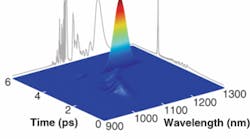
    A short-time Fourier transform shows the time-wavelength profile of an optical rogue wave, generated within a nonlinear optical fiber from a gradual seed pulse with weak noise perturbations. The broadband wave has steep slopes in the time domain compared with typical events just like rogue waves seen on the open ocean, which have been described as “walls of water.”
    Once thought to be mythical, giant waves on the open ocean that could swallow entire ships before vanishing without a trace were finally recorded for the first time at the Draupner...
    March 1, 2008
    Th 0803lfwsydorinst
    The compact VCSEL comb generator delivers 1 mW power on the order of several gigahertz for time-based calibration of electro-optic instrumentation, sensors, detectors, and streak...
    March 1, 2008
    (Courtesy of Coherent)
    Coherent displayed its unique optically pumped semiconductor laser via a multiwatt four-color (460, 532, 577, and 635 nm) diode-laser display.
    Despite record attendance of more than 17,500 at SPIE’s Photonics West in San Jose, CA, recession fears in the U.S. cast a shadow on an otherwise bright outlook for the solid,...
    March 1, 2008
    The four-wave mixing scheme for optical signal regeneration (top) exploits the high optical nonlinearity of silicon nanowaveguides (SEM image; bottom) and reduces low-level noise and timing jitter.
    Optical communications systems find their limits as signals degrade along the network, but a new approach may provide a way to simply and cheaply maintain signal fidelity.
    March 1, 2008
    Infrared stimulation in the cochlea can selectively stimulate a population of cochlear neurons (blue line). The results are similar to the selectivity of acoustic stimulation at low sound levels (black line). It is not possible to achieve the same selectivity of stimulation with electrical stimulation.
    In recent years the bulk of the scientific sessions at the SPIE Biomedical Optics (BiOS) conference have focused on optical imaging for diagnostic and biological applications....
    March 1, 2008
    (Courtesy of E. Auksorius)
    An intensity-merged fluorescence lifetime image of 200 nm fluorescent beads is shown in confocal mode (left) and with sub-diffraction-limit resolution using the STED (right) mode.
    Stimulated emission-depletion microscopy represents one of the most straightforward among techniques to image at a resolution beyond the diffraction limit.
    March 1, 2008
    (Courtesy University of St. Andrews)
    Scanning-electron micrographs of the directional coupler switch show two photonic-crystal waveguides composed of three regions: the central directional coupler region of length 5.2 µm and the input and output regions (top). An overview image of the structure shows s-bends (bottom left) used to prevent interactions between the access waveguides and to provide sufficient spatial separation at the facets to observe each output port. The photonic-crystal portion of the coupler contains three different hole sizes (bottom right) to engineer the dispersion of the photonic-crystal waveguides.
    Most optical switches operate by shutting light on or off, or by directing light between two different ports of the device through inducing a refractive-index change or phase ...
    March 1, 2008
    (Courtesy Jean-Luc Lacour from CEA, Commissariat à l’Energie Atomique)
    An artist rendering shows the rover planned for the NASA Mars Science Laboratory (MSL09) mission in 2010-2011 performing laser-induced breakdown spectroscopy (LIBS) using a lightweight, ruggedized system designed by Thales Laser.
    After several years of intensive development activity, Thales Laser (Orsay, France) delivered the ChemCam Laser Flight Model to the Centre National d’Etudes Spatiales (CNES; Paris...
    March 1, 2008
    Fiber-to-the-home (FTTH) transceiver developer Enablence Technologies (Ottawa, ON, Canada) will acquire all the outstanding shares of ANDevices (Fremont, CA), a supplier of planar...
    March 1, 2008
    Princeton Lightwave (PLI; Cranbury, NJ), manufacturer of optical semiconductor components and subsystems, was awarded a two-year, $3.5 million contract for the development of ...
    March 1, 2008
    Mobius Photonics (Santa Clara, CA) has entered into an exclusive licensing agreement with Harvard University (Cambridge, MA) regarding U.S. patent 5,745,284.
    March 1, 2008
    A few days ago I spent an entire day on the phone trying to reach various accounting departments to sort out my current crop of bills.
    March 1, 2008
    While the role of nanotechnology in many recent photonics advances may be intuitively obvious, a recently released report from the EU offers an unusually comprehensive look at...
    March 1, 2008
    Th 0803lfwscf1
    Light-emitting diodes (LEDs) appear in everything from display technologies such as flat-panel computer displays to light sources like traffic lights and flashlights.
    March 1, 2008
    Conard Holton2
    Vision-based music synthesizer uses pattern recognition.
    March 1, 2008
    1304qa Chang New
    Q: I am fighting with my CEO. As founder of the company I am frustrated because he is not getting strategic deals done and he accuses me of not making adequate progress in product...
    March 1, 2008
    John Ellis
    After the final SPIE Optics East conference in Boston ended this past September, I found myself wondering if I had missed something.
    March 1, 2008