• Home >
  • Back Issues >
  • Laser Focus World >
  • Volume 44, Issue 9
  • Volume 44, Issue 9

    More content from Volume 44, Issue 9
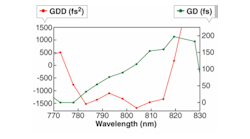
    A multilayer high-dispersion mirror for use around 800 nm has a group delay that varies with wavelength, resulting in a large group-delay dispersion of about ~1300 fs2 in the 785 to 815 nm spectral range.
    An improved chirped-mirror design developed by scientists in the Krausz group at Ludwig-Maximilians-Universität-München and the Max-Planck-Institut für Quantenoptik (both in Garching...
    Sept. 1, 2008
    Th 0809lfwnb2
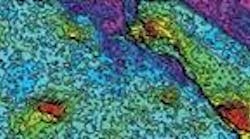
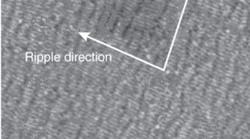
    Paleontologists now have a new tool to perform 3-D interpretations of complex sets of dinosaur trackways: light detection and ranging (lidar).
    Sept. 1, 2008
    Optical limiters are nonlinear materials that exhibit a drop in transmittance as the energy of incident laser pulses increases, usually above a certain threshold.
    Sept. 1, 2008
    A hybrid optical-plasmonic waveguide developed by researchers at the University of California, Berkeley, confines 1550 nm light to dimensions far below a wavelength in two dimensions...
    Sept. 1, 2008
    To better understand how interactions between molecules within a cell regulate such activities as the properties of the cytoskeleton as well as critical division and growth processes...
    Sept. 1, 2008
    Silk-based biomaterials have unique biophysical features that can be exploited to create optical sensors that could host “living” blood or pH indicators, and would biologically...
    Sept. 1, 2008
    (Courtesy of Rice University)
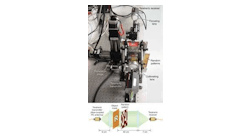
    FIGURE 1. In a terahertz single-pixel camera experimental setup (top; schematic at bottom), an opaque object with a transmissive hole shaped as the letter “R” is imaged through a mask consisting of a random pattern of opaque pixels.
    A terahertz camera with a one-pixel detector can be the solution to high-speed imaging in the terahertz region for detecting concealed weapons at airports, locating defects in...
    Sept. 1, 2008
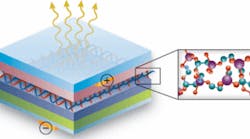
    FIGURE 1. DNA possesses some interesting optical and electrical properties, and is being explored as a natural material for synthesis into biopolymer thin films that can be used in a variety of optoelectronic devices.
    Made mainstream by its role in human-genome mapping, genetic-trait analysis, and forensics, deoxyribonucleic acid is also playing a role as a biopolymer for the creation of novel...
    Sept. 1, 2008
    Th 0809lfw02f1
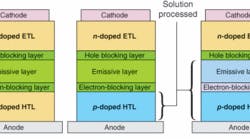
    Current organic-light-emitting-diode (OLED) device performance meets or exceeds the requirements for display applications.
    Sept. 1, 2008
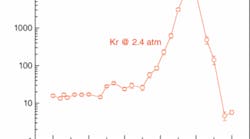
    FIGURE 1. A white-light continuum source is formed by sending 775 nm pulsed laser light through Krypton gas, creating energy for use in nonlinear experiments at any wavelength from 400 to 800 nm.
    Where linear spectrophotometers leave off, high-power ultrafast lasers and novel white-light continua are enabling novel nonlinear Z-scan devices that measure two-photon absorption...
    Sept. 1, 2008
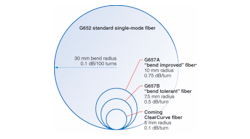
    FIGURE 1. Bend radii and loss compared for three types of fibers designed specifically for fiber drops. G652 is standard single-mode fiber; other types were designed with reduced bend losses, specified for a given number of turns around a mandrel of the specified size.
    Technology innovation is being driven by the goal of scaling up FTTH to 100 megabits per second throughout the U.S. by 2015.
    Sept. 1, 2008
    (Courtesy of University of Hertfordshire)
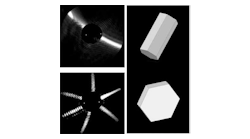
    The scattering pattern of individual ice crystals (left) can be used to accurately identify the size and shape of a micron-size column and hexagonal platelet of ice (right). Such microscopic data, which was previously unattainable, can aid in understanding how clouds affect Earth’s climate.
    Atmospheric scientists have created an optical-scattering instrument designed to capture high-resolution spatial light-scattering patterns of ice crystals like those found in ...
    Sept. 1, 2008
    (Courtesy of Harvard University and Hamamatsu Photonics)
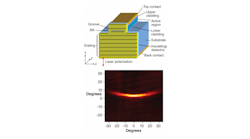
    The grooves on the face of a metal-coated quantum-cascade laser (top) act effectively as an antenna to concentrate light exiting a slit into a small solid angle. The two-dimensional far-field intensity distribution was measured from above the QCL facet (bottom). The slight curvature of the output is an edge effect.
    Unlike gas and solid-state lasers that emit in a characteristically narrow beam, edge-emitting semiconductor lasers have a wide beam divergence, requiring bulky optics and meticulous...
    Sept. 1, 2008
    (Courtesy of Massachusetts Institute of Technology)
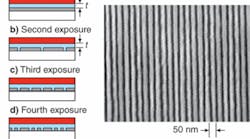
    A grating is fabricated using four 200-nm-period grating levels in a unique interference-lithography process (left). The fourth exposure produces a 50-nm-period grating with feature sizes as small as 25 nm (right).
    Although still not capable of producing the complex, nonperiodic structures necessary for most integrated-circuit (IC) designs, interference lithography has been used to successfully...
    Sept. 1, 2008
    Th 0809lfw05f1
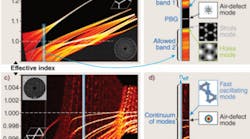
    The development of nonlinear and quantum optics applications based on gas-phase materials has been impeded by the lack of a suitable technology for creating devices that guide...
    Sept. 1, 2008
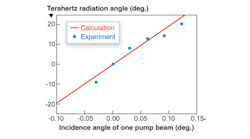
    Very slightly steering one of two ultrafast pump beams impinging on a nonlinear optical device greatly steers the resulting terahertz beam.
    Two researchers at RIKEN (Sendai, Japan) have come up with a way of quickly and easily steering a beam of terahertz radiation over a wide angular range (potentially ±90°).
    Sept. 1, 2008
    Th 0808lfwphotonics Ind
    The PS Series picosecond laser converts up to 120 W of 1064 nm output to up to 80 W of 532 nm output, 30 W of 355 nm output, or 10 W of 266 nm output, while maintaining TEM00 ...
    Sept. 1, 2008
    (Courtesy of ANU)
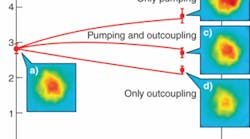
    The quantity of remaining atoms in the laser mode (red) of an atom-laser BEC (yellow) varies depending on whether or not the system is being pumped. The initial quantity (a) increases with pumping and no outcoupling (b), stays the same with pumping and outcoupling (c), and decreases with outcoupling but no pumping (d). Independence of pumping and outcoupling mechanisms indicates that atom replenishment is functioning properly. The curves are calculated from a rate-equation model, and error bars (red) represent the standard deviation of the mean calculated from repeated independent measurements.
    Recently reported research results from Australian National University (ANU; Canberra, Australia) appear to pave the way for development of continuous-wave (CW) free-space atom...
    Sept. 1, 2008
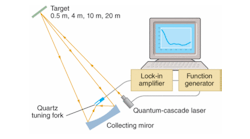
    An eye-safe quantum-cascade laser sends pulses of IR light onto a remote target. A collecting mirror focuses the reflected light onto a quartz tuning-fork sensor. The amplitude of the photoacoustic vibrations on the tuning fork is recorded as a function of illumination wavelength.
    The ability to detect explosives remotely may soon be possible using “standoff” photoacoustic spectroscopy, say scientists at Oak Ridge National Laboratory (ORNL; Oak Ridge, TN...
    Sept. 1, 2008
    A new annual grant program endowed by the H.M. Pollicove Memorial fund and matched by the OSA Foundation provides support to students who are pursuing a degree in precision optics...
    Sept. 1, 2008
    (Courtesy of Case Western Reserve University)
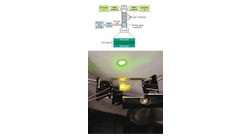
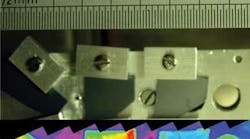
    An all-polymer distributed-Bragg-reflector (DBR) laser is fabricated from melt-processed layers in an extrusion process that is amenable to future roll-to-roll manufacturing methods (top). The assembled low-threshold, high-efficiency DBR lasers (bottom) have well-defined spatial and temporal modes.
    Polymer lasers are attracting attention for their potential processing advantages and the ability to broadly tailor wavelength output based on simple dopant and material modifications...
    Sept. 1, 2008
    Th 0809lfwdesk Web
    The attractive properties of diamond films—used as dynode materials requiring few gain stages—enable the development of micromachined, large-area, low-noise photon-counting detector...
    Sept. 1, 2008
    (Courtesy of the University of New South Wales)
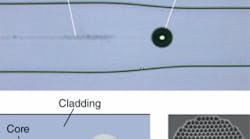
    A normal single-mode fiber and a photonic-crystal fiber (cross section, lower right) are spliced together, forming a spherical microcavity at their junction that functions as a strain sensor (the photonic-crystal fiber collapses and becomes solid).
    Researchers Gang-Ding Peng from the University of New South Wales (Sydney, Australia) and Enbang Lin and Xin Ding from Tianjin University (Tianjin, China) have developed a fiber...
    Sept. 1, 2008
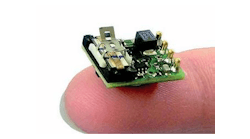
    Varioptic (Lyon, France), the liquid-lens company, and Shenzhen Akkord Electronics (Shenzhen, China), an OEM for leading electronics brand names in Europe, launched the first ...
    Sept. 1, 2008
    Fiber-to-the-home (FTTH) and optical communications components and subsystems provider Enablence Technologies (Ottawa, ON, Canada) signed a definitive Asset Purchase Agreement...
    Sept. 1, 2008
    Imaging systems company Goodrich (Charlotte, NC) signed an agreement with Bourns (Riverside, CA) to acquire the Chicago Aerial Industries and Pacific Optical Division assets of...
    Sept. 1, 2008
    Provider of precision motion products and lasers for medical, electronics, industrial, and semiconductor applications, GSI Group (Rugby, England) agreed to acquire Excel Technology...
    Sept. 1, 2008
    In the article “Ultrafast fiber lasers forge new microprocessing frontiers,” the author incorrectly refers to the Intralase laser as being based on Nd:YAG with 10 kHz repetition...
    Sept. 1, 2008
    Not so long ago, when purchasing a television set, most consumers took little interest in the technology behind the TV display itself because the cathode ray tube was ubiquitous...
    Sept. 1, 2008
    Don’t worry if you have never heard of The Needham Question. Neither had I, until I read Simon Winchester’s fascinating new book, The Man Who Loved China: the Fantastic Story ...
    Sept. 1, 2008
    Peter Baker
    Let’s face it—we have all benefited greatly from the explosive growth of laser applications.
    Sept. 1, 2008