• Home >
  • Back Issues >
  • Laser Focus World >
  • Volume 45, Issue 8
  • Volume 45, Issue 8

    More content from Volume 45, Issue 8

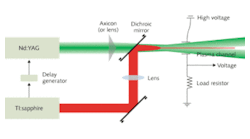
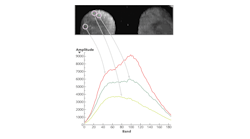
    A 532 nm pulse from a nanosecond Nd:YAG laser revives a faded plasma filament that was created by a femtosecond Ti:sapphire laser. A third pulse at 1064 nm (not shown) can then further increase the revived filament’s free-electron density to beyond that of the original filament.
    Plasma filaments generated by femtosecond-laser pulses in air are not just a spectacular effect–they are potentially useful too.
    Aug. 1, 2009
    Researchers at Stanford University (Stanford, CA) have developed an incredibly small two-photon microscope imager that uses a microelectromechanical systems (MEMS) laser-scanning...
    Aug. 1, 2009
    Th Pressure 0809 01
    Engineers at Opalux (Toronto, ON, Canada) have developed a technology platform that exploits the properties of electrically, mechanically, or optically stimulated photonic crystals...
    Aug. 1, 2009
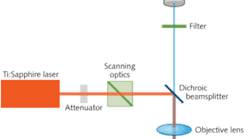
    FIGURE 1. A typical multiphoton-microscopy (MPM) setup includes the excitation laser, scanning and imaging optics, filters, and photomultiplier-tube (PMT) detector.
    In multiphoton microscopy, ultra-high-transmission filters with deep blocking and steep sides can effectively block all the excitation light while transmitting the precious fluorescence...
    Aug. 1, 2009
    (Courtesy of SiOnyx)
    FIGURE 1. Black silicon structures are fabricated using an industrial CMOS process.
    Femtosecond-laser engineering of silicon with a CMOS-compatible process results in the creation of black silicon, which offers high optical sensitivity in the near- and short-...
    Aug. 1, 2009
    Th 0908lfw Fea2 Femtofit
    The annual PhAST/Laser Focus World Innovation Award ¿honors groundbreaking photonics products.
    Aug. 1, 2009
    (Courtesy of Toptica and High Finesse)
    FIGURE 1. Toptica’s most recent offering is the Ultimate 2 in the WSU series of wavelength meters, offering the best absolute accuracy on the market of up to ±2 MHz for 370 to 1100 nm (5 × 10⁻⁶ nm resolution at 800 nm wavelength), achieved when using a calibration laser with a linewidth known to better than 1 MHz. The Fizeau-interferometer-based system for pulsed or CW lasers allows high-speed measurement and feedback control of up to eight lasers with a repeatability of up to 500 kHz.
    When high-accuracy wavelength measurement is required, comparing products is easier if you understand how manufacturers specify the accuracy–whether in megahertz, picometers, ...
    Aug. 1, 2009
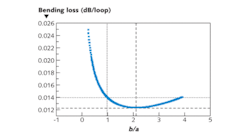
    The dependence of bending loss for an experimental fiber (at a bending radius of 5 mm and a wavelength of 1550 nm) reaches a theoretical minimum when b/a is 2.12. The b/a for the fabricated fiber was very different–0.98–but the bending loss was only slightly higher than the minimum.
    One can imagine the twists and turns taken by an optical fiber as it is routed in a fiber-to-the-home application.
    Aug. 1, 2009
    (Courtesy of DESY)
    In the “light shining through walls” experiment, the laser is at left, the HERA dipole magnet at center, and the detector at right.
    In a small experiment at the DESY synchrotron source (Hamburg, Germany), a detector is effectively staring at a wall, waiting for light to come through.
    Aug. 1, 2009
    (Courtesy of the University of Glasgow)
    Imaging cameras enable an operator to feel the actual measured forces exerted on a bead in an optical trap as in interacts with a silicon cube.
    A low-cost, imaging-based force-feedback device has been created that allows users to perceive real Brownian motion and viscosity when using optical tweezers; in effect, the user...
    Aug. 1, 2009
    FIGURE 1. In the CARS scheme, pump pulses (ωp) and Stokes pulses (ωs) result in a measured signal frequency of ωas.
    A turnkey, single-box, solid-state-laser-based light source for coherent anti-Stokes Raman scattering (CARS) microscopy eliminates the need for two highly synchronized Ti:sapphire...
    Aug. 1, 2009
    Th Laser 0809 01
    One of the more intriguing aspects to this year’s Laser, World of Photonics exhibition and conference in Munich, Germany, was the apparent sense of calm that has settled over ...
    Aug. 1, 2009
    Under conditions typically used in dynamic live-cell imaging, sCMOS provides a much wider field of view and improved signal-to-noise ratio at approximately 70 frames/s (left), compared with interline CCD’s 11 frames/s (above).
    Choosing a rapid frame rate has traditionally meant compromising on other capabilities such as wide dynamic range.
    Aug. 1, 2009
    (Image courtesy of Toptica Photonics)
    Th Astronomy 0809 01
    Large ground-based telescopes can use a sodium “guidestar” to enable active compensation of atmospheric disturbances using adaptive optics and making possible high-resolution ...
    Aug. 1, 2009
    (Courtesy of Headwall Photonics)
    Hyperspectral instruments generate high-contrast images of latent fingerprints while also yielding chemical “signature” information about material left behind that could be associated with the fingerprint. This image shows that a fingerprint can be nondestructively viewed and analyzed with the spectral signature identified at three discrete points within the field of view.
    ChemImage (Pittsburgh, PA), an analytical-imaging company, recently made improvements to its CONDOR Hyperspectral Imaging System that allow the system to see enhanced ridge detail...
    Aug. 1, 2009
    Th 0908lfw Online Qua
    For the latest in new products, see Photonics Products Online on our home page and at www.laserfocusworld.com/exclusives/highlights.html
    Aug. 1, 2009
    Th Manu 0809 01
    Make sure the laser beam you expect is the one that is delivered. See how beam profiling can help you get the most performance out of your laser.
    Aug. 1, 2009
    Many of the technical papers and product announcements at recent industry conferences serve to underscore the considerable engineering and design effort being undertaken by laser...
    Aug. 1, 2009
    1304qa Chang New
    I was a member of the senior research staff in a major corporate research laboratory, which was closed down a few years ago.
    Aug. 1, 2009
    A clever combination of optics and genetics may allow neuroscientists to identify and control brain circuits with unprecedented precision.
    Aug. 1, 2009
    Th New P 0809 01
    The Alliant 100 W infrared fiber laser features high single-mode beam quality and wall-plug efficiency that delivers maximum power at the smallest focused spot, or high brightness...
    Aug. 1, 2009
    (Courtesy of OPTRA)
    FIGURE 1. The IR scene projector contains two telecentric Koehler illumination assemblies for the two DMDs, as seen in a top view (top left). The red DMD illumination path (light rays) is below the projector path (dark rays) at a 24° angle in the plane normal to the page. The two images are superimposed by the beam combiner. A side view shows the red DMD illuminated at 24° (top right). The DMD itself is normal to the projection axis to ensure good projected image quality. A three-dimensional view of a solid model shows the entire optical path (bottom right-hand corner).
    An infrared scene simulator uses two digital-micromirror devices to rapidly generate simulated events in two wavelength bands, enabling realistic testing of infrared threat-detection...
    July 25, 2009