
• Home >
  • Back Issues >
  • Laser Focus World >
  • Volume 45, Issue 10
  • Volume 45, Issue 10

    More content from Volume 45, Issue 10

    (Courtesy of CBrite)
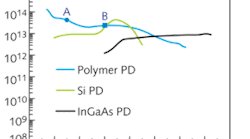
    Detectivities of Si, InGaAs, and polymer photodetectors are plotted as a function of wavelength. Note that high detectivities of the InGaAs detectors require cooling the devices to 4.2 K. Detectivities of the polymer photodiodes were calculated at λ = 500 nm (point A) and λ = 800 nm (point B) biased at -100 mV. The solid blue curve was obtained from the measured photoresponsivity data with absolute magnitude determined by points A and B.
    In September, Laser Focus World reported on quantum-dot-infused polymer photodetectors with responsivity from 300 to 1250 nm.
    Oct. 1, 2009
    (Courtesy of Australian National University, Canberra)
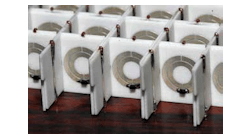
    FIGURE 1. Split-ring resonators are shown arranged in a uniformly spaced array in a negative-index metamaterial for microwave frequencies. Optical metamaterials use nanometer-scale elements.
    Tailoring the internal structure of metamaterials to vary optical properties controls how they transform light—leading to applications from optical cloaking to the optical counterparts...
    Oct. 1, 2009
    (Courtesy of RPI)
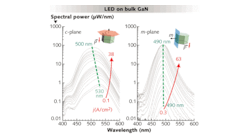
    FIGURE 1. Electroluminescence spectra are shown for polar c-plane (left) and nonpolar m-plane (right) LED structures on bulk GaN. With increasing current density, peak emission blue-shifts in the polar structure, while it remains stable at 490 nm in the nonpolar one. This stability allows predictable laser-diode cavity design and is expected to result in lower threshold densities.
    With blue laser diodes in wide use in BlueRay DVDs, bridging the green gap from the blue end is a lingering challenge that is being met through improved epitaxial semiconductor...
    Oct. 1, 2009
    Th Silicon 1009 01
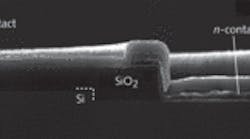
    Monolithically grown germanium/silicon APDs have high sensitivity, low noise, and world-record gain-bandwidth product.
    Oct. 1, 2009
    FIGURE 1. Specialty fiber is made with various coatings and dual claddings to ensure that it can withstand harsh conditions (below). Fiber with polyimide coatings (above) are designed for applications that involve high-temperature.
    The properties of optical fibers can be tailored to match specific operating conditions and enable fiber-optic systems to operate in a broad range of hostile settings.
    Oct. 1, 2009
    (Courtesy of the University of Illinois)
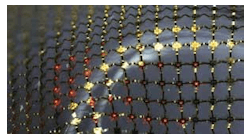
    A stretchable ILED display consists of an interconnected mesh of printed micro-ILEDs bonded to a rubber substrate.
    Flexible displays are not known for their durability. Often based on organic LED (OLED) technology, they suffer from a fundamental problem: if the display is to bend, the light...
    Oct. 1, 2009
    (Courtesy of Kerry Vahala)
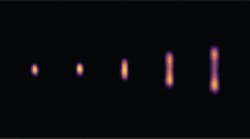
    Ion-luminescence images of an atom show the transition from random to coherent motion.
    Researchers in Germany have demonstrated the long-postulated “phonon laser”—a system for the resonant oscillation and coherent amplification of vibrational energy packets in perfect...
    Oct. 1, 2009
    (Courtesy of Akela Laser)
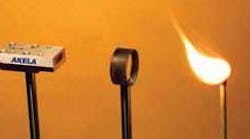
    In a simple illustration of laser-assisted initiation, a collimated 2 W laser-diode module operating at 1.68 µm ignites a match.
    Technology once relegated to secret defense laboratories is finally seeing the light.
    Oct. 1, 2009
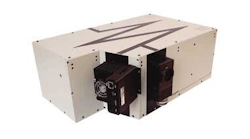
    FIGURE 1. Newport’s new benchtop MS257 can be configured as a spectrometer or a spectrograph that covers the UV/VIS/NIR range using three different gratings optimized for the wavelengths of interest and various detectors.
    Used in nearly every physical science, from astronomy to zoology, spectrometers present buyers with a wealth of choices.
    Oct. 1, 2009
    (Courtesy of the University of Cologne and Purdue University)
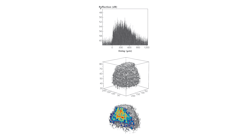
    A holographic optical-coherence-imaging (HOCI) technique records depth-resolved photons scattered coherently from a tissue sample in a photorefractive polymer. Here, individual holographic images (top) are stacked to create a three-dimensional (3-D) volumetric representation of an 800-µm-diameter spheroidal rat tumor (center). The tumor can be analyzed as a whole or through a series of vertical cuts (bottom).
    Collection of three-dimensional (3-D) data from confocal scanning microscopy and optical coherence tomography (OCT) is lengthy due to the sequential acquisition of image pixels...
    Oct. 1, 2009
    (Courtesy of NIST)
    A lithium niobate waveguide (bottom left) combines a pump laser and a near-IR signal, up-converting the signal to a visible wavelength. Two prisms (right) separate the signal from the combined beam and send the signal to an avalanche-photodiode detector (top left), which reads the upconverted signal.
    It’s not every day that the performance of an optical instrument is boosted by a factor of a thousand.
    Oct. 1, 2009
    The 0.95-m-diameter Kepler telescope—a photometer—was launched into an Earth-trailing heliocentric orbit on March 6 to detect Earth-size exoplanets.
    Oct. 1, 2009
    (Courtesy of Universität Karlsruhe)
    A chiral metamaterial (left) composed of close-proximity gold helices acts as a circular polarizer. Basically a series of modified split-ring resonators (right); the collective helical forms have a broadband influence over the polarization of light (top), transmitting either right circularly polarized (RCP) light or left circularly polarized (LCP) light while blocking the other (center and bottom) based on the handedness of the helical structures.
    In his Photonic Devices and Applications Plenary presentation, “Photonic Metamaterials: Optics Starts Walking on Two Feet,” at the 2009 SPIE Optics and Photonics Conference (Aug...
    Oct. 1, 2009
    Th 0910lfe2v
    For the latest in new products, see Photonics Products Online on our home page and at www.laserfocusworld.com/exclusives/highlights.html
    Oct. 1, 2009
    The gain medium of an OPSL has a very short excited-state lifetime, and thus virtually no stored gain. The result for a 532-nm-emitting frequency-doubled OPSL is no “green noise” and low overall noise.
    A green-emitting optically pumped semiconductor laser (OPSL) introduced on June 12 by Coherent (Santa Clara, CA) is potentially a big deal in the scientific-laser marketplace,...
    Oct. 1, 2009
    Single-shot FROG measurements of the compressed pulses show spectral (left) and temporal (right) information for both normalized intensity (solid black) and phase (dotted). The spectrum was also recorded by a spectrometer (left, red).
    A spectral-broadening technique developed by Tamas Nagy and Peter Simon at the Laser-Laboratorium Göttingen has allowed them to produce sub-25-fs deep-UV pulses with an energy...
    Oct. 1, 2009
    The Emil Wolf Outstanding Student Paper Competition was established by the OSA Foundation to recognize the contributions of Dr.Wolf, a professor of optics at the University of...
    Oct. 1, 2009
    Th Manu P 1009 01
    Siskiyou top-adjust components let you put many degrees-of-freedom in a small volume.
    Oct. 1, 2009
    The announcements earlier this year by Sumitomo (Kyushu, Japan) and Osram Opto Semiconductors (Regensburg, Germany) that they each have developed green-emitting laser diodes (...
    Oct. 1, 2009
    1304qa Chang New
    I have been advised that to succeed in America I should improve my communication skills and be more assertive.
    Oct. 1, 2009
    “Sic transit gloria mundi,” I always mutter when someone asks me why I never use my Kindle.
    Oct. 1, 2009
    Th New Prod 1009 01
    Thin-film plate polarizers from Alpine Research Optics are optimized for use with Nd:YAG, Nd:YVO4, and Nd:YLF lasers operating at 1064, 1053, 532, 355, and 266 nm.
    Oct. 1, 2009