• Home >
  • Back Issues >
  • Laser Focus World >
  • Volume 45, Issue 6
  • Volume 45, Issue 6

    More content from Volume 45, Issue 6

    (Courtesy of NTT-AT)
    A KTN scanner for a small beam diameter can be quite compact due to the small size needed for the crystal (top). For an applied electric field lower than ±200 V/mm, the scanning angle of a KTN crystal is proportional to the square of the electric field; at higher fields, the relationship becomes linear due to saturation of the dielectric constant (bottom).
    Potassium tantalate niobate (KTN) (see www.laserfocusworld.com/articles/185766), a nonlinear optical crystal first synthesized in the 1950s, is well known as a crystal with a ...
    June 1, 2009
    (Courtesy of Vanderbilt University)

    FIGURE 1. In a laser-scanning microscope, data can be gathered either by current integration or by photon counting. Each line (row of pixels) is defined by the line synchronization signal. During the period that a single pixel is scanned (typically a few microseconds defined by the pixel clock), each incident photon will produce a current pulse in the photomultiplier tube (PMT) signal. When the current is integrated, dark events as well as pulse amplitude variation lead to increased noise in the output signal. Alternatively, in photon counting, if the pulses are discriminated (rising above the dotted line), shaped, and then counted, no additional noise is introduced.
    Recent advances in single-photon-counting detectors can be incorporated in commercial microscope systems to improve fluorescence-signal detection in live-cell imaging.
    June 1, 2009
    FIGURE 1. Photon’s NanoScan scanning slit profilers provide NIST-traceable measurement for CW and kilohertz-pulse laser beams with wavelengths from 190 nm to the far infrared beyond 20 µm. Scanning-slit technology enables direct measurement of focused and high-power beams without extensive attenuation. Instruments are available to measure beam diameters as small as 4 mm or as large as 25 mm.
    When choosing a laser-beam profiling system, you’ll need to know a few things about your laser and what you want to measure.
    June 1, 2009
    Th Surving 01
    The significance of photonics technologies in terms of Europe’s future economic growth cannot be understated.
    June 1, 2009
    (Courtesy of Trumpf)
    FIGURE 1. For laser cladding applications, powder blown through a nozzle or nozzles is sintered using heat from the central laser beam.
    The process of using a laser and donor materials for component prototyping and repair—loosely termed “laser additive manufacturing”—is just now gaining widespread adoption, thanks...
    June 1, 2009
    (Courtesy of Politecnico di Milano)
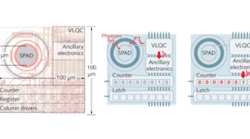
    FIGURE 1. The layout of a pixel in a 32 × 32 photon-counting camera includes a SPAD detector, front-end quenching circuit, and counter. When a photon triggers the SPAD, the VLQC senses the avalanche, quenches the current, and resets the SPAD (right); the ancillary electronics send a count to the counter.
    A 32 × 32-pixel single-photon-counting camera consists of single-photon avalanche diodes with all electronics incorporated within each pixel.
    June 1, 2009
    (Courtesy of ULIS)
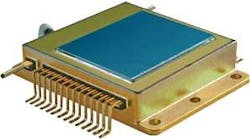
    A 17 µm pixel-pitch detector is fabricated using standard CMOS processes for high-definition surveillance applications and has ultralow pixel-defect rates. It is small in size and does not require thermoelectric cooling.
    Detector manufacturer ULIS, a subsidiary of Sofradir and GE Equity, launched a fourth-generation IR detector; the XGA format (1024 × 768), 17 µm pixel-pitch sensor enables high...
    June 1, 2009
    (Courtesy of NIST and OFS Laboratories)
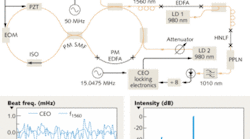
    A vibration-immune fiber-laser frequency comb is based on a femtosecond fiber figure-eight laser phase-locked to a 1560 nm fiber-laser source with sub-hertz residual linewidth. Black lines represent wire and brown lines fiber. The beat spectrum of this optical lock is also shown. The beat frequency of both the optical (f1560) and the carrier-envelope offset (CEO) lock was taken while the setup was subjected to vibrations at more than 1 g, and reveals that the comb remains phase-locked over the whole measurement.
    With applications in distance metrology, microwave generation, spectroscopy, and optical-waveform measurement, frequency combs have moved well beyond their initial application...
    June 1, 2009
    (Courtesy of UCLA)
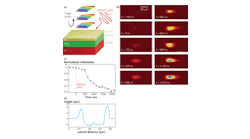
    The STEAM camera was used for real-time imaging of laser ablation (a), revealing multiple two-dimensional (2-D) real-time images with a temporal resolution of 163 ns and shutter speed of 440 ps (b). Changes in sample surface reflectivity due to the laser-induced mass ejection are evident after the excitation pulse hits the sample at 50 ns. The time-sequenced surface reflectivity shows that the time delay between the pulse excitation and the sudden decrease in the surface reflectivity correlates with the ablation process (c); depth profile measurements (d) indicate that the silicon-on-insulator layer was exposed.
    Multikilowatt laser-diode systems typically reach their high output powers through wavelength coupling of a number of individual diode stacks.
    June 1, 2009
    (Courtesy of MIT)
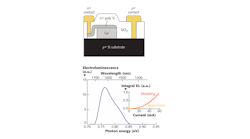
    A monolithically integrated Ge-on-Si device (top) exhibits direct-bandgap luminescence at room temperature. The electroluminescence (spectrum at bottom) increases in intensity as a function of electrical-injection current (inset).
    The last few years have seen a surge in the development of silicon-based photonic components.
    June 1, 2009
    (Courtesy of Philips)
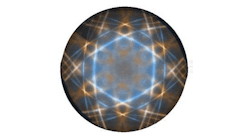
    Data from scattering measurements were used to construct these far-field emission patterns of PC LEDs. A PC with a lattice constant of 315 nm and weak photonic coupling emits a relatively simple pattern (top; blue and yellow correspond to TE and TM polarizations from the LED modes), while one with a 250 nm lattice constant and strong photonic coupling creates a much-more-complex pattern (bottom). The light in the complex pattern fills the extraction cone more uniformly.
    In a step toward reaching the ultimate light-extraction efficiency for high-power, high-brightness LEDs, researchers at Philips Lumileds Lighting (San Jose, CA) and Philips Research...
    June 1, 2009
    (Courtesy of Sematech)
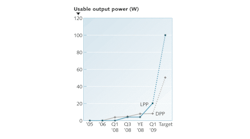
    FIGURE 1. Usable EUV output power from laser-pumped plasma sources (green squares) currently exceeds that from discharge-pumped plasma sources (gray diamonds).
    Shorter wavelengths promise higher resolution and smaller features when fabricating semiconductor chips.
    June 1, 2009
    (Courtesy of Exfo)
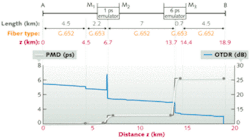
    A distributed-PMD analyzer measures PMD along a sample fiber-optic link (top), displaying cumulative PMD (bottom; white line) as a function of individual fiber sections along the link.
    Measurement of the distributed polarization-mode dispersion (PMD) along an optical fiber has been actively researched over the past decade or so, and a number of approaches proposed...
    June 1, 2009
    Th Flourine 01
    Reliable fiber-optic communications in high-radiation environments such as linear accelerators and nuclear reactors is made possible by silica fibers with optimized fluorine-doped...
    June 1, 2009
    TecnoCientifica’s sampling device is an instrumented aluminum chute. The UltraNIR system, an economic instrument for processing small grains, incorporates an inexpensive Ocean Optics spectrometer (inset).
    Companies storing or processing grain must rapidly determine its quality before directing an incoming load of wheat, and spectroscopy is often the answer.
    June 1, 2009
    Th Phon Po
    For the latest in new products, see Photonics Products Online on our home page and at www.laserfocusworld.com/exclusives/highlights.html
    June 1, 2009
    Forty finalists in the 2009 Intel Science Talent Search competition spent a week in the nation’s capitol, where they competed for more than $500,000 in awards and scholarships...
    June 1, 2009
    (Courtesy of MPI)
    A xenon-filled gas cell is at the core of an instrument that measures CEP and pulse with of a few-cycle laser pulse. Above-threshold ionization caused by the pulse’s electric field is detected by microchannel plates (MCPs).
    Few-cycle-pulse researchers take heed: your experiment could soon benefit from on-the-fly, single-shot measurements of the carrier-envelope phase (CEP) as well as pulse width....
    June 1, 2009
    Th 324402
    More than 50 mW of output power and over 25 meters coherence length (< 5 MHz linewidth) at 405 nm — a commercial world record!
    June 1, 2009
    I was most interested to read the article “Fluorescent microspheres enable adaptive-optics microscopy” Although an adaptive optical system may well be an effective way to improve...
    June 1, 2009
    Among the many negative numbers of last month’s first-quarter financial results from some of the photonics market leaders were glimmers of a slightly brighter outlook for the ...
    June 1, 2009
    I am prepared to stand on my copyrights, but when money talks, rights walk.
    June 1, 2009
    1304qa Chang New
    The company my friend works for is in need of engineering development resources because of layoffs during the downturn.
    June 1, 2009
    Th New P 01
    PhaseCam IR laser interferometers make surface and wavefront measurements at 3.39 or 10.6 µm.
    June 1, 2009
    Th Anti S 01
    Laser speckle, rather than sensor resolution or an optical system’s diffraction limit, can be the limiting condition of performance in applications including metrology, interferometry...
    June 1, 2009