• Home >
  • Back Issues >
  • Laser Focus World >
  • Volume 45, Issue 9
  • Volume 45, Issue 9

    More content from Volume 45, Issue 9

    (Courtesy of ASU)
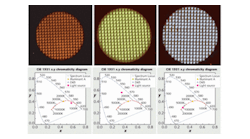
    Quantum-dot-based inks can be inkjet-printed to create arrays of red (left), green (center), and blue (right) LEDs (the diagrams at bottom indicate the LEDs’ colors on the CIE color-space chromaticity diagram).
    Inkjet printing is so good at positioning and meting out the right quantity of material that it can be used not just for producing documents, but in industry as well–for example...
    Sept. 1, 2009
    Even though small second-harmonic-generation (SHG)-based external-cavity green lasers are readily available, the advantages of pure semiconductor laser diodes–such as miniature...
    Sept. 1, 2009
    (Courtesy of Brad Plummer/SLAC)
    Quadrupole focusing magnets between each of 33 undulators guide the electron pulses through the Linac Coherent Light Source.
    Scientists now have access to the world’s most brilliant source of hard x-rays at the Linac Coherent Light Source.
    Sept. 1, 2009
    (Courtesy of Purdue University)
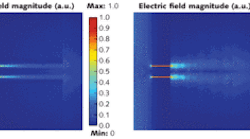
    FIGURE 1. A finite-element simulation depicts an extraordinary wave with a wavelength of 350 nm, which is incident from the left onto a metallic mask of thickness 30 nm containing a double slit with 5 nm slits and a 35 nm center-to-center distance. The electric-field amplitude is shown for two cases: a 100 nm silver/silica (Ag/SiO2) bulk anisotropic slab (left) and a ten-layer Ag/SiO2 stack with each layer 10 nm thick (right). The bulk anisotropic slab has a filling fraction of 0.5 (equal volumes of Ag and SiO2).
    The quest for subwavelength imaging through anisotropic metamaterials has produced a design for a bilayer lens that can restore a nearly perfect image.
    Sept. 1, 2009
    (Courtesy of Michelson Diagnostics)
    FIGURE 1. OCT makes clearly visible the boundary between a pearl’s nacre and its interior, as well as the layers within. The thickness and quality of the nacre is a key indication of pearl quality.
    The speed, precision, and cost benefits of optical coherence tomography are beginning to attract the interest of industrial end users. For detailed subsurface imaging of small...
    Sept. 1, 2009
    FIGURE 1. Traditional PIN APD devices (left) don’t measure up to SAM-APD devices (right), whose gain enhancement is made possible through the use of the separate absorption and multiplication (SAM) regime.
    Nitrides offer considerable advantages over other materials for ultraviolet detection. Recently, they proved useful for creating the world’s first UV single-photon detectors with...
    Sept. 1, 2009
    (Courtesy of Xceed)
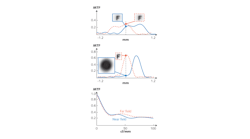
    Modulation-transfer-function (MTF) simulations for a 3-mm-diameter eye pupil compare far-field results (dashed curves) and near-field results (solid curves) with no change in eye-lens focus. A contact lens with the EDOF pattern at a spatial frequency of 30 cycles/mm shows good imaging for both near and far field (top); without the EDOF pattern at the same frequency, far-field imaging is poor (center). An MTF chart shows that near- and far-field imaging results are almost identical (bottom).
    A new type of contact lens created by researchers at Xceed Imaging (Petach-Tikva, Israel), Tel Aviv University (Tel Hashomer, Israel), and Bar-Ilan University (Ramat-Gan, Israel...
    Sept. 1, 2009
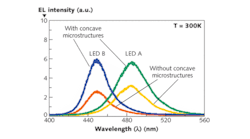
    Electroluminescence (EL) spectra of LED A and LED B show that the addition of a layer of concave plastic microlenses onto the LEDs greatly boosts light output.
    Semiconductors that make up an LED have such a high refractive index that much of the light produced by a conventional LED never escapes from the device into the surrounding air...
    Sept. 1, 2009
    (Courtesy of Emcore)
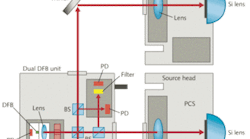
    FIGURE 1. An integrated frequency-domain terahertz source and detector module uses dual lasers.
    Single-package hybrid optical integration of two semiconductor laser chips with a high-resolution wavelength discriminator has been used to realize a tunable terahertz source ...
    Sept. 1, 2009
    Each pixel defined by the filter array combines the four narrow bands, expressed by central wavelengths 1 2 3 4; in addition, each covers 16 pixels on the monochromic CMOS sensor (left). Within the useful pixel region (considering the overlapping areas among the filters), the hue value for each wavelength of a new pixel is calculated by averaging the color value of the area in red (right).
    A miniaturized sensor developed at the Georgia Institute of Technology, which is claimed to be the first such device able to produce narrowband multispectral imagery in real time...
    Sept. 1, 2009
    (Courtesy of the University of Linz and Siemens)

    The shadow cast by illuminating a slide of a monarch butterfly with light at a 1310 nm wavelength was imaged with a QD-sensitized near-IR imager (top). The photosensitive layer consists of polymer materials and PbS QDs sandwiched with other materials to create a large-area imager (bottom left). The QDs are visible within the active layer (bottom right).
    Indium gallium arsenide (InGaAs) photodiodes and quantum-well IR photodetectors are typical methods of choice for near-IR detection and imaging applications in the spectral region...
    Sept. 1, 2009
    Th Laser 0909 01
    In contrast to the Space Elevator concept, in which high-power continuous-wave lasers beam light to photovoltaic cells attached to a vehicle that rides into space on a cable at...
    Sept. 1, 2009
    (Courtesy of VSL and TU Delft)
    A frequency-comb laser is the basis for an interferometric distance-measurement setup accurate to 25 µm over a 50 m distance.
    Interferometric methods are often used for long-distance measurements in air that require high accuracy.
    Sept. 1, 2009
    Thanks to the advent of precision glass molding–which enables the cost-effective manufacture of aspheric glass lenses–glass aspheres can now be incorporated in cost-conscious ...
    Sept. 1, 2009
    Th Ppo 0909 01
    For the latest in new products, see Photonics Products Online on our home page and at www.laserfocusworld.com/exclusives/highlights.html
    Sept. 1, 2009
    (Courtesy of Giorgio Adamo)
    A cross-sectional drawing shows electrons entering a light well (top) that consists of a hole passing through stacked metal and dielectric layers. The well is about 700 nm in diameter (bottom).
    An international team of researchers has demonstrated a tunable nanophotonic source based on free electrons passing through a metal/dielectric stack.
    Sept. 1, 2009
    Th Tera 0909 01
    Accurate and reliable calibration of terahertz time-domain spectrometers is essential to spectroscopic investigations in the frequency range from 0.1 to 3 THz
    Sept. 1, 2009
    Th Manu 0909 01
    T-rad an incredibly sensitive Broad-band Pyroelectric Radiometer featuring DSP Lock In LabView Software.
    Sept. 1, 2009
    In September of last year I happened to be in Europe on “beam day”–the day on which the Large Hadron Collider (LHC) was turned on for the first time.
    Sept. 1, 2009
    Th New P 0909 01
    LightTools 6.3 illumination design and analysis software adds an alternate optimization engine that supplements the existing optimizer and lets users address a broader range of...
    Sept. 1, 2009
    Airlines often use marginal pricing to sell empty seats. But for airline seats the marginal cost does not tend to zero dollars and hence the seats are never free.
    Sept. 1, 2009
    (Courtesy of Xceed)
    Modulation-transfer-function (MTF) simulations for a 3-mm-diameter eye pupil compare far-field results (dashed curves) and near-field results (solid curves) with no change in eye-lens focus. A contact lens with the EDOF pattern at a spatial frequency of 30 cycles/mm shows good imaging for both near and far field (top); without the EDOF pattern at the same frequency, far-field imaging is poor (center). An MTF chart shows that near- and far-field imaging results are almost identical (bottom).
    A new type of contact lens created by researchers at Xceed Imaging (Petach-Tikva, Israel), Tel Aviv University (Tel Hashomer, Israel), and Bar-Ilan University (Ramat-Gan, Israel...
    Sept. 1, 2009