
• Home >
  • Back Issues >
  • Laser Focus World >
  • Volume 45, Issue 11
  • Volume 45, Issue 11

    More content from Volume 45, Issue 11
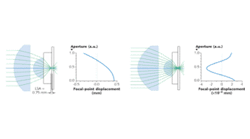
    The original lithographic setup (left) produced 0.75 mm of longitudinal spherical aberration (LSA; seen as focal-point displacement as a function of aperture) at a recording wavelength of 632 nm. The improved setup, containing an asphere, is still simple in form but has a greatly reduced LSA.
    Given the choice between developing a custom optical system or one that can make do with commercial “off-the-shelf” lenses, any designer would choose the latter.
    Nov. 1, 2009
    Modelocked lasers produce ultrashort pulses at high frequencies, but generally with low pulse energies (or with ultralong cavity lengths to increase pulse energy).
    Nov. 1, 2009
    (Courtesy of Photon Kinetics)
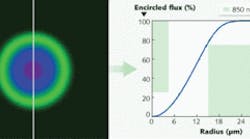
    FIGURE 1. A near-field image of a pigtailed VCSEL source is shown with the encircled flux calculated from the image plotted with limits established for 1 Gbit VCSELs (< 25% at 4.5 µm and > 75% at 15 µm; right).
    While single-mode fibers dominated the fiber-optic landscape in the 1990s, multimode fibers have charged back into the limelight, thanks in part to optical measurement standards...
    Nov. 1, 2009
    (Courtesy of Edmund Optics)
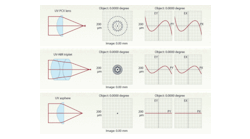
    FIGURE 1. Three Standard high-numerical-aperture, near-UV component designs operate at 266 nm. The aspheric lens provides two orders of magnitude smaller spot size than the spherical singlet.
    Limited choices for substrate/coating materials and processing costs keeps deep-ultraviolet (100–250 nm) applications relatively sparse, but the near-ultraviolet (250–400 nm) ...
    Nov. 1, 2009
    (Courtesy of Hella)
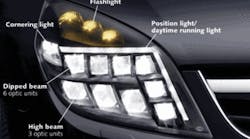
    FIGURE 1. A full-LED headlamp prototype for an Opel Signum auto uses different optical modules for different signal functions: six lenses for the dipped beam/low beam; three lenses at the bottom for the main beam/high beam; two small lenses for the cornering light; and daytime running lights from ten LEDs behind a flat light-guide element. The direction indicator consists of three LEDs with reflector systems on the top of the headlamp. Based on individual light-source data for different LED types, Hella uses its own calculation software for free-form lenses and reflectors to optimize each part of the light distribution—especially the homogeneous transition between different areas.
    Whether it’s LED headlamps, night-vision safety systems, or emerging laser-ignition systems, the compact, low-energy-consumption performance-rich attributes of photonic technologies...
    Nov. 1, 2009
    (Courtesy of Lawrence Livermore)
    FIGURE 1. NIF’s Laser Bay 2, shown looking away from the target area, includes 96 of the 192 beam lines. Note the three workers in yellow hard hats for scale.
    The National Ignition Facility has yet to reach its full 1.8 MJ UV pulse energy, but it has already begun target experiments. Managers plan a slow ramp-up to full power, and hope...
    Nov. 1, 2009
    Courtesy of PerkinElmer
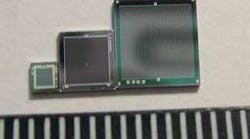
    FIGURE 1. Examples of SiPM chips are sensors with sizes of 1.4 × 1.4, 3 × 3, and 5 × 5 mm.
    A silicon photomultiplier with two forms of crosstalk suppression is a nearly ideal photon detector for industry, nuclear medicine, and research.
    Nov. 1, 2009
    (Courtesy of Max Planck Institute for Biophysical Chemistry)
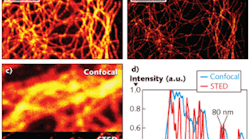
    Imaging of a fluorescent-stained mammalian microtubular cell network shows better detail using the single-path STED microscope (b) than a conventional confocal microscope (a), especially evident in a close-up region (c) in which STED microscopy discerned individual fibers. The smallest distance between well-resolved features for the STED setup is 80 nm (d).
    In 2008, researchers at the Max Planck Institute for Biophysical Chemistry (Göttingen, Germany) and the German Cancer Research Center (Heidelberg, Germany) developed an isotropic...
    Nov. 1, 2009
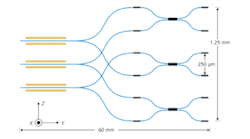
    FIGURE 1. A three-beam interferometric combiner is fabricated in lithium niobate. Inputs are from the left; phase-modulating electrodes are shown in color.
    The search for exoplanets (planets orbiting other stars) has taken several forms; a well-known one is the transit method, in which the brightness of a star is monitored to spot...
    Nov. 1, 2009
    (Courtesy of the National Institute for Materials Science)
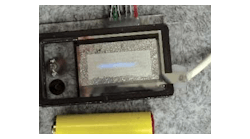
    A prototype far-UV emitter combines a cold-cathode electron emitter with an hBN FED array 17 × 1.6 mm in size (bluish-white line). Note the AA battery placed next to it as a size comparison. For this particular device, impure hBN powder was used for the fluorescent screen because it emits blue light that can be captured with a commercially available digital camera.
    Flashlights are handy things. With the advent of LEDs based on gallium nitride, near-UV flashlights have recently become available; they are useful for some forensic work, as ...
    Nov. 1, 2009
    (Courtesy of Universidad de Murcia)
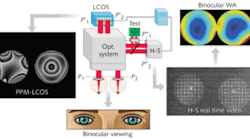
    A mathematical algorithm converts the image formed by the reflection from two eyes passing through an adaptive-optics apparatus that includes a liquid-crystal-on-silicon programmable phase modulator (PPM-LCOS) to a microlens-covered sensor (Hartmann-Shack or H-S real time video) into a wavefront-aberration (WA) plot for the right and left eye. The adaptive-optics vision simulator is used to study the impact of ocular aberrations on binocular vision.
    Adaptive-optics (AO) technology is actively applied in the field of ophthalmology for diagnosis of retinal disease and analysis of ocular aberrations such as coma and spherical...
    Nov. 1, 2009
    (Courtesy of LLNL)
    In the Confined Large Optical Scintillator Screen and Imaging System (CoLOSSIS), an x-ray beam penetrates the test object, which casts shadow on the glass scintillator. The scintillator converts the x-ray radiation to green light, which is reflected by mirrors (not shown) and imaged by four lenses onto four CCD cameras.
    The U.S. Department of Energy’s National Nuclear Security Administration (NNSA) continues to pursue a smaller, safer, more secure, and less-expensive nuclear-weapons arsenal.
    Nov. 1, 2009
    Th Optics F 1109 01
    Precision glass molding of aspheric lenses allows a wide variety of optical designs with smaller size, reduced weight, and no post-polishing; these lenses can be made economically...
    Nov. 1, 2009
    Th Photo Po 1109 01
    For the latest in new products, see Photonics Products Online on our home page and at www.laserfocusworld.com/exclusives/highlights.html
    Nov. 1, 2009
    (Courtesy of Mark Foster)
    The time-domain telescope (above, top) is analogous to a spatial telescope, but with temporal lenses instead of spatial lenses. This system allows for compression of temporal optical waveforms as shown in the example experimental traces (bottom) in which an optical waveform is compressed by a factor of 27. The device is created on a silicon photonic chip (below).
    A data-pulse-compression technique that borrows ideas wholesale from classical optics has been shown to vastly increase the data-carrying capacity of telecom-wavelength pulses...
    Nov. 1, 2009
    Th Manu P 1109 1
    FEMTO Messtechnik GmbH offers the 200 MHz low-noise transimpedance amplifier DHPCA-100.
    Nov. 1, 2009
    There’s great potential here for massive consumer bafflement that will make buying a 3-D television more of a horror story than the films you can to see.
    Nov. 1, 2009
    Though not yet running at full capacity, the National Ignition Facility at Lawrence Livermore National Laboratory (Livermore, CA) is now operational.
    Nov. 1, 2009
    Th New P 1109 01
    The MPC-D40x Series of thermoelectric coolers (TECs) incorporates microstructuring technology to produce an electrical resistance of more than 30 Ω on a 1 mm2 footprint.
    Nov. 1, 2009
    Members of the U.S. Physics Traveling Team.
    Some of the top high school physics students in the United States were members of the U.S. Physics Team that competed at the International Physics Olympiad Competition held in...
    Oct. 19, 2009