• Home >
  • Back Issues >
  • Laser Focus World >
  • Volume 48, Issue 02
  • Volume 48, Issue 02

    More content from Volume 48, Issue 02

    1304qa Chang New
    We are a €20 million venture fund in Eastern Europe. Would you be willing to introduce us to American VCs who are interested in co-investing with us, both here and in the US?
    Feb. 7, 2012
    1202lfw P22table Web
    Access Optical Networks (AON) has developed several technologies for holographic data storage (HDS) with write-only, read-only, and rewrite capability in a volumetric crystal ...
    Feb. 7, 2012
    (Courtesy of BMW)
    Blue laser light forms a “birthing tunnel” that highlights a BMW high-efficiency i-series car. In keeping with the theme of energy efficiency, optically pumped semiconductor lasers (OPSLs) were used to create the light tunnel and other effects.
    To officially launch its i-series of high-efficiency, environmentally friendly automobiles at the Frankfurt International Motor Show IAA, BMW used the services of Lobo, a laser...
    Feb. 6, 2012
    (Courtesy of UCSB)
    A superconducting array of microwave kinetic inductance detectors (MKIDs) is mounted in a gold-plated copper box (shown); a square array of circular microlenses (at center) focuses incoming light onto the individual detectors. The entire structure is cooled in a dilution refrigerator to about 100 mK.
    A superconducting array of cryogenic microwave kinetic inductance detectors (MKIDs) is the basis of a photon-counting focal-plane array developed by researchers at the University...
    Feb. 2, 2012
    Interfering polariton condensates induced from two pump-laser beams input to a semiconductor microcavity produce oscillating quantum states of laser light as the spacing between pump spots is varied. Each image shows a different quantum state directly.
    University of Cambridge researchers can see quantum mechanics at work with the naked eye.
    Feb. 1, 2012
    (Reprinted with permission from Analyt. Chem., 82, 8427–8431; Copyright 2010 American Chemical Society)
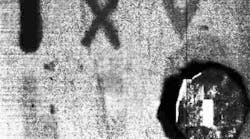
    FIGURE 1. An image shows a polyester fabric with lettering made from blood, with “I” at full concentration and “X,” “V,” “L,” and “C” made from blood at 10-, 25-, 50-, and 100-fold dilutions. The image was made using in-phase detection of an AC (alternating-current)-modulated reflectance. The object in the lower right is a reflectance reference for phase detection.
    Once limited to destructive chemical and laboratory intensive procedures, the processing of crime scene evidence is now possible using nondestructive photonics technology—even...
    Feb. 1, 2012
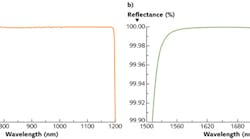
    FIGURE 1. A mirror designed for use inside a laser cavity has R >99.95% over a bandwidth of 500 nm (a). A mirror for cavity ring-down spectroscopy (CRDS) has R = 99.9994% at 1650 nm (b).
    With carefully controlled absorption and scattering losses, high-reflectivity, low-loss dielectric mirrors enable demanding applications such as gravitational-wave detection and...
    Feb. 1, 2012
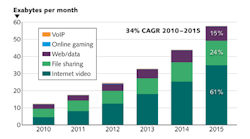
    FIGURE 1. Global Internet traffic demand as projected by Cisco in 2011.
    The implementation of multilevel modulation formats, in conjunction with coherent detection, will significantly increase the information capacity of future fiber-optic links through...
    Feb. 1, 2012
    FIGURE 1. A schematic shows the Faraday rotation spectroscopy (FRS) detection scheme. The input linearly polarized light is a superposition of two circularly polarized waves that have different refractive indices under magnetic circular birefringence (MCB). The FRS signal is measured by placing the sample between two polarizers so that the Faraday rotation can be detected as intensity modulation of the light emerging from the second polarizer. The magnetic field is in the same direction with the light path.
    With an emission wavelength that reaches from the mid-IR to the far-IR and high power efficiency, quantum-cascade lasers are the heart of powerful chemical sensors for environmental...
    Feb. 1, 2012
    FIGURE 1. High harmonic generation in a noble gas generates peaks at odd harmonics. Power drops at higher harmonic numbers up to a point, then levels out in a plateau before dropping at much higher harmonics. Actual measurements of harmonic power may include more features, such as a low-intensity zone between the lowest harmonics and the plateau.
    Improved high harmonic generation techniques are squeezing pulse duration down toward zeptosecond time scales, and have extended frequency-comb spectroscopy into the extreme ultraviolet...
    Feb. 1, 2012
    Conard Holton2
    Photonics West lived up to expectations for innovation, diversity, and enthusiasm.
    Feb. 1, 2012
    FIGURE 1. A transmission electron micrograph shows the Brightlock monolithic diffraction-grating spectral control layer within a high-power laser diode.
    On-chip wavelength stabilization technology for high-power laser diodes operating between 700 and 2000 nm brings an accurate and narrow spectral width that is locked over a wide...
    Feb. 1, 2012
    This year, due largely to tougher economic reasons, I did not cover the giant Consumer Electronics Show, held last month in Las Vegas, NV. Happily, however, I discovered an alternative...
    Feb. 1, 2012
    FIGURE 1. A Michelson white-light scanning interferometer takes advantage of a three-chip color CCD camera to obtain accurate surface profiles.
    Basing a white-light scanning interferometer on a color CCD camera with three separate chips reduces root-mean-square (RMS) measurement error.
    Feb. 1, 2012