• Home >
  • Back Issues >
  • Laser Focus World >
  • Volume 48, Issue 05
  • Volume 48, Issue 05

    More content from Volume 48, Issue 05

    Ultrahigh-intensity laser pulses could be measured with relativistic electrons
    Researchers at the Max-Planck-Institut für Kernphysik have proposed an accurate peak-intensity measurement technique that relies on the interaction of the laser pulse with a beam...
    May 11, 2012
    “Fast” (superluminal) light pulse created in a rubidium-vapor cell
    Researchers from the National Institute of Standards and Technology (NIST) and the University of Maryland have used a 4WM scheme in a rubidium-vapor cell to generate both a superluminal...
    May 11, 2012
    2D broadband invisibility-cloak array works in the visible spectral region
    In an arXiv preprint, researchers at Towson University and the University of Maryland describe their fabrication of large arrays of small 2D broadband invisibility cloaks that...
    May 9, 2012
    Courtesy of CREOL
    The intensity profile of pump and signal modes are shown for a few-moded fiber amplifier (left), along with their normalized intensity profiles as viewed along the x-axis (right).
    Researchers at CREOL—The College of Optics & Photonics at the University of Central Florida—and NEC Laboratories America have developed a method for controlling modal gain in ...
    May 4, 2012
    Experimental work led by physicists at Queens College, City University of New York (CUNY) in collaboration with City College of CUNY combined with theoretical work from Purdue...
    May 4, 2012
    Courtesy of University of Göttingen
    SEM shows a gold nanotip (top) and localized photocurrent from the nanotip apex (middle). A schematic depicts the photoelectron escape trajectory (with quenched quiver motion) from the nanolocalized field (bottom).
    Scientists at the University of Göttingen have demonstrated that in the so-called strong-field regime—the interaction of extremely high-intensity laser light with atoms and surfaces...
    May 3, 2012
    (Courtesy of the Dutch Metrology Institute)
    An ultrafast-laser-produced frequency comb and a virtually imaged phase array create many thousands of frequency modes for distance-measuring interferometry.
    Modifications to a “massively parallel spectroscopy” technique have led researchers to a new means of measuring absolute distance with extraordinary precision.
    May 3, 2012
    The temporal shape of a femtosecond pulse is varied by superimposing subpulses generated by adjacent elements of a retroreflector array at small tilt angles (less than 0.1°). Two normalized autocorrelation traces of approximately equal FWHM pulse duration, but significantly different distribution functions, are produced. Best fits are Lorentzian and Gaussian profiles (dark cyan and dark gray, respectively).
    A micro-optical retroreflector array is at the heart of a device developed by researchers at the Max-Born-Institut für Nichtlineare Optik und Kurzzeitspektroskopie and the Fern...
    May 2, 2012
    (Courtesy of University College London)
    Photoacoustic imaging clearly identifies changes in blood vessels that feed a cancer tumor after administration of a therapeutic vascular disruption agent. The technique penetrates tissue to depths of 10 mm.
    Researchers at University College London (UCL) have developed a new photoacoustic scanner based on a Fabry-Perot polymer film ultrasound sensor with a unique image reconstruction...
    May 2, 2012
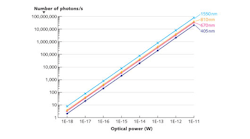
    FIGURE 1. The wavelength-dependent correlation between power and number of incident photons is shown for a single-photon detector.
    Avalanche-photodiode (APD)-based photon counters have many benefits compared to other photon-counting technologies. Operated in Geiger mode for single-photon detection, they can...
    May 1, 2012
    1205lfwscf1
    Most optical engineers can adequately perform their engineering tasks by assuming that the light propagating through their systems is either totally spatially incoherent or coherent...
    May 1, 2012
    (Courtesy of K. Novoselov, University of Manchester)
    Heterostructure showing two layers of graphene (black spheres) separated by one layer of boron nitride (colored spheres).
    The remarkable electronic and photonic properties of graphene have been used for demonstrations ranging from transparent conductive coatings to saturable absorbers and plasmonic...
    May 1, 2012
    FIGURE 1. A frequency upconverter is based on a PPLN waveguide. (Abbreviations: PC, polarization controller; LPF, longpass filter; BPF, bandpass filter; PH, pinhole; TmDFA, thulium-doped fiber amplifier)
    Long-wavelength pumped, periodically poled lithium niobate waveguides upconvert single photons, allowing efficient, low-noise silicon avalanche photodiodes to detect the signal...
    May 1, 2012
    1205lfw5 Award Biophotonic
    The 2012 CLEO/Laser Focus World Innovation Awards program is designed to honor the most timely, groundbreaking products in the field of photonics and laser science. The awards...
    May 1, 2012
    FIGURE 1. A schematic of the photomixing setup shows two lasers with slightly offset frequencies coupled into optical fiber that are used as optical pumps to generate carriers in a photoconductive device. The generated AC current drives a planar metal antenna radiating the terahertz wave to the input window of a vacuum Fourier-transform infrared spectroscopy (FTIR) system. Finally, a liquid-helium-cooled bolometer is used to detect the terahertz waves.
    By incorporating nanoantenna structures into a photomixer, terahertz emission power can be enhanced more than two orders of magnitude compared to a photomixer using typical interdigitat...
    May 1, 2012
    Courtesy of World Wind Energy Association
    FIGURE 1. Worldwide wind energy capacity continues to grow, with 2011 reaching a record high total of close to 239 GW.
    One of the most exciting commercial applications for light detection and ranging (lidar) technology is to estimate wind speed and direction in order to optimize the performance...
    May 1, 2012
    (Courtesy of Caltech/MIT LIGO Laboratory)
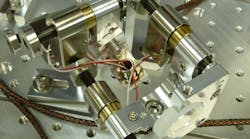
    FIGURE 1. New Focus UHV Picomotor actuators are used in the Laser Interferometer Gravitational Wave Observatory (LIGO) as part of the Transmission Monitor Suspended Optical Bench. This platform will monitor the light transmitted through the End Test Mass. The actuators will enable control of precision alignment from outside one of the world's largest vacuum systems.
    As the number of applications for ultrahigh-vacuum (UHV) environments increases, motion systems must be modified to manipulate optics, particle beams, and measurement devices ...
    May 1, 2012
    Conard Holton2
    The rise of advanced manufacturing processes and the use of laser-based equipment in China helped the global laser industry recover quickly from the recession.
    May 1, 2012