• Home >
  • Back Issues >
  • Laser Focus World >
  • Volume 47, Issue 2
  • Volume 47, Issue 2

    More content from Volume 47, Issue 2
    Pennwell web 350 198
    Conventionally, an optical fiber carrying continuous light at a single wavelength transmits no data (other than that the light source is on). Amplitude modulation is what carries...
    Feb. 1, 2011
    Massachusetts General Hospital researchers were among five "Dream Teams" selected from 237 submissions by Stand Up to Cancer.
    Feb. 1, 2011
    79062
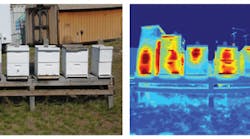
    Scientists now have a new tool to study the alarming collapse of honeybee populations.
    Feb. 1, 2011
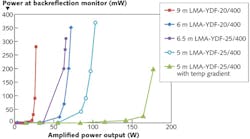
    FIGURE 1. The SBS threshold in fiber amplifiers can be raised by adopting LMA fibers with 20 or even 25 μm core diameter that allow the maximum power of single-frequency devices to exceed 50 W. A temperature gradient can be used to further increase the threshold to over 150 W.
    Improvements in high-finesse fiber amplifiers have boosted their optical output to the hundreds-of-watts range, making them an excellent tool for scientific uses such as trapping...
    Feb. 1, 2011
    (Courtesy of National Taiwan Ocean University)
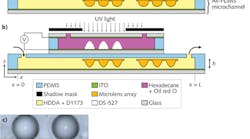
    A schematic illustrates a continuous, high-throughput fabrication process for microlenses and microlens arrays in microchannels (a) before and (b) after applying voltages to the electrostatic-force-modulated (EFM)-3D gray mask. The microlenses and arrays can be dynamically adjusted during the fabrication process (c).
    Microlenses and microlens arrays can be fabricated using a myriad of methods such as ultraviolet (UV) molding, hot embossing, photoresist and electron-beam lithography, and microjet...
    Feb. 1, 2011
    (All images courtesy of Cascade Technologies)
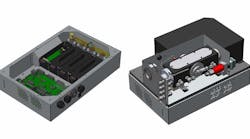
    FIGURE 1. A modular, ruggedized architecture includes interchangeable laser modules and dual-path-length gas cells, easily configured to meet particular application requirements.
    A patented quantum-cascade laser intrapulse technique is at the heart of a ruggedized, accurate, industrial measurement platform designed to disrupt conventional gas measurement...
    Feb. 1, 2011
    (Courtesy of Rochester Institute of Technology)
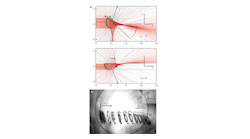
    Mathematical modeling shows the force and torque exerted on an arc-shaped glass rod by uniform, nongradient illumination (a). An actual semicylindrical rod immersed in liquid and exposed to a 130 mW light source (in the z direction out of the paper or screen) lifts sideways from left to right due to the transverse optical lift force (b). The rod initially experiences torque, and then is translated with velocity vx toward the right. The lift force brings the rod out of focus in the z direction.
    Rochester Institute of Technology researchers have mathematically predicted and experimentally observed the optical equivalent of aerodynamic lift.
    Feb. 1, 2011
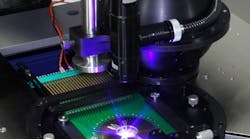
    FIGURE 1. Devices are tested on a prober using an integrating sphere to assess performance characteristics during the sorting process known as binning.
    The performance of LEDs must be well characterized during production to ensure the devices meet end-user requirements across a range of operating parameters.
    Feb. 1, 2011
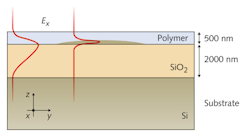
    A thin variable-thickness layer of Si between layers of polymer and SiO2, all fabricated on a Si substrate, serves as a 2D Luneburg lens for light traveling in the waveguide and polarized in the x direction (Ex).
    One of the most interesting gradient-index lenses is the Luneburg lens, which takes the form of a sphere with a radially varying refractive index; its most well-known version ...
    Feb. 1, 2011
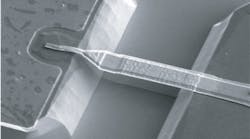
    FIGURE 1. Scanning electron micrograph of an air-bridge Schottky barrier diode made at CNR-IFN shows that the metal connection between the anode pad and the Schottky junction has been suspended in order to reduce parasitic capacitance. The suspended structure was obtained by wet chemical removal of the GaAs under the metal bridge, after lithographic definition of the two mesas.
    Terahertz detectors with microsecond response time can be obtained by fabrication of air-bridge pixels compatible with monolithic array integration, due to both active region ...
    Feb. 1, 2011
    (Courtesy of the J. Stefan Institute)
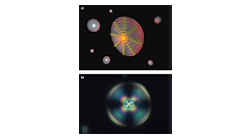
    Helical liquid-crystal structures self-assemble inside a cholesteric liquid-crystal (CLC) microdroplet, creating concentric shells of constant refractive index that form a dielectric structure known as a Bragg-onion optical microcavity, shown here as a drawing (a). This 3D laser emits omnidirectional light (b) and is tunable by simply modifying the temperature of the lasing medium.
    Researchers at J. Stefan Institute and the University of Ljubljana have demonstrated for the first time fully tunable lasing from their 3D or omnidirectional-lasing dye-doped,...
    Feb. 1, 2011
    (Courtesy of the Fraunhofer-Institute for Applied Optics and Precision Engineering)
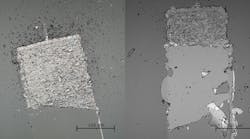
    When subjected to a scanning scratch test, a HfO2 coating with a total thickness of 270 nm failed by abrasion (a), while a 969 nm thick coating delaminated (b).
    Sapphire is an exceptional optical material: in addition to its extreme hardness, it transmits light of wavelengths between 0.2 and 5.5 μm, is highly transparent for all but the...
    Feb. 1, 2011
    30573
    In a recent posting on his Opto Insider blog, my colleague Tom Hausken from Strategies Unlimited (Mountain View, CA) stated: "The time for mid-infrared lasers has finally come...
    Feb. 1, 2011
    This is not a column about Facebook or any of the other over-hyped, time-wasting social engineering networks. Nor is this column about lasers or optoelectronics.
    Feb. 1, 2011
    1304qa Chang New
    Q: I was fortunate to get hired as a CEO during the telecom bubble but have not had a good job since. I have been looking at the mobile space and also thinking about an MBA. I...
    Feb. 1, 2011
    (Image courtesy of X.Y. Wu, Quantum Dot Corp.)
    FIGURE 1. Experimental results show drastically reduced photobleaching in cell imaging with quantum-dot (QD) labels (red) compared to organic dye molecules (green). Images shown are complementary; the nucleus is labeled with QD 630-steptavidin and the periphery labeled with AlexaFluor 488 in the top panel, whereas the inverse labeling scheme is used in the bottom panel.
    Understanding the microscopic origin of fluorescence blinking in quantum emitters such as quantum dots, rods, and wires is crucial in designing novel structures that show a substantial...
    Feb. 1, 2011
    (Courtesy of University of California–San Diego)
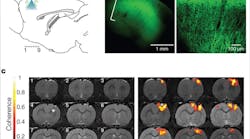
    FIGURE 1. An optogenetic functional magnetic resonance imaging (ofMRI) technique delivers 473 nm blue light to the motor cortex region of a rat’s brain (a). The channelrhodopsin (ChR2) expressing region in the brain is co-localized with the fluorescent tag as shown in the confocal microscopy images (b). A blood-oxygenation-level dependent (BOLD) signal appears in the light-activated brain (c; right) in the presence of ChR2, but not in the brain treated with a saline injection (c; left), indicating that selective stimulation of excitatory neurons expressing ChR2 is the source of the BOLD signal.
    An emerging form of phototherapy, optogenetics uses light to selectively activate light-sensitive proteins delivered to the brain and other tissues, promising a new host of medical...
    Jan. 25, 2011