• Home >
  • Back Issues >
  • Laser Focus World >
  • Volume 47, Issue 4
  • Volume 47, Issue 4

    More content from Volume 47, Issue 4

    (Courtesy of LIOS Technology GmbH)
    FIGURE 1. As the depth of available energy resources continues to increase-along with temperature and pressure-alternative techniques such as steam-assisted gravity drainage (SAGD) for oil-sand resource recovery are needed. Here, optical fiber monitors the temperature and pressure to optimize the fuel-recovery process.
    As oil prices rise, energy companies are turning to fiber-optic sensors for monitoring temperatures and pressures in downhole petroleum and geothermal environments to maximize...
    April 1, 2011
    Pennwell web 350 289
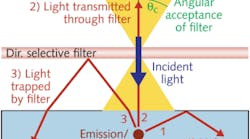
    A novel way to trap light in solar cells to boost efficiency is being developed by a team of researchers from the Fraunhofer Institute for Solar Energy Systems ISE (Freiburg, ...
    April 1, 2011
    Deep-UV lasers are especially good at ablating eye tissue and make excellent surgical tools, but due to the lack of a fiber-optic delivery system are currently limited to extraocular...
    April 1, 2011
    FIGURE 1. The low-lying energy levels of their single valence electron makes alkali metals an attractive laser gain medium-energy levels in the rubidium laser are shown here with the pump and laser transition.
    With low photon deficit when pumped with laser diodes, alkali-vapor lasers such as rubidium promise very high efficiency. Recently demonstrated flowing-gas versions promise very...
    April 1, 2011
    (Courtesy of SLAC)
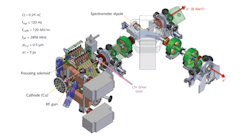
    FIGURE 1. A key component of next-generation FELs is the photoinjector driven by an ultrafast laser amplifier.
    Free electron lasers support unique time-resolved experiments over a wide range of x-ray wavelengths, with ultrafast laser systems enabling both enhanced FEL operation and diverse...
    April 1, 2011
    FIGURE 1. A micrograph shows the typical micromachined structures in a microbolometer focal-plane array (FPA). The pixels are suspended above the readout integrated circuit and the long skinny legs provide thermal isolation for the pixels.
    Amorphous-silicon bolometer technology has always lagged somewhat in performance. But material improvements and smaller pixels may see it move into the lead for the next generation...
    April 1, 2011
    (Courtesy of Energetiq)
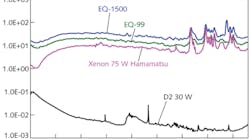
    Compared to traditional xenon and deuterium lamps, the LDLS has substantially higher spectral brightness levels ranging from 170 nm in the DUV through visible and into the NIR.
    Energetiq (Woburn, MA) has developed a laser-driven plasma light source for spectroscopic and imaging applications that delivers broadband spectral output from 170 nm in the deep...
    April 1, 2011
    (Courtesy of LLNL)
    FIGURE 1. Calculated electrical-field intensity (in terms of intensification) is shown for the hafnia layers surrounding a conical mitigation structure in a 24-layer hafnia/silica reflective dielectric coating for s-polarized light impinging at 45° from the left. Views are from the top and side cross-section, with the coating thickness enlarged for easier viewing. The cone angle is 15°. Red and orange correspond to higher intensification.
    Intentionally fabricated conical flat-bottomed pits have damage thresholds much higher than the coating flaws they replace, allowing large optics with imperfect coatings to be...
    April 1, 2011
    A fiber circulator introduces a singlemode beam into an optical TTD device based on a tilted diffraction grating. The beam is reflected from a steering mirror to a collimating lens. Turning the mirror translates the collimated beam across the grating, changing the optical path length. The light is diffracted back along its path and back into the fiber circulator.
    Microwave-photonic systems are frequently assisted by photonic devices operating at optical wavelengths. For example, true time-delay (TTD) lines, which are essential parts of...
    April 1, 2011
    Modifications to photomask patterns that are calculated by a level-set inverse-lithography model result in image patterns that are consistently better through focus when defocus effects are minimized (a) and, if a specified amount of coma is introduced, when effects of the coma are minimized (b).
    Keeping the world on track with Moore's law (in which the number of transistors on a leading-edge semiconductor chip doubles every two years) involves improvements to many technologies...
    April 1, 2011
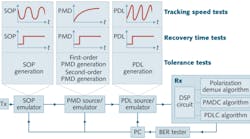
    FIGURE 1. A coherent receiver generally includes three polarization-related circuits/algorithms for polarization demultiplexing, PMD compensation, and PDL compensation functions. Three types of emulation equipment are required to generate the different polarization parameters for the complete characterization of these functions, including the PMD/PDL tolerance range; the tracking speed in response to SOP, PMD, or PDL variations; and the recovery time needed to respond to an abrupt change in these parameters.
    Test methods and related instruments for the characterization of all polarization-related functions help different customers quantitatively evaluate their coherent transceivers...
    April 1, 2011
    Pennwell web 90 86
    Increasing global demand for energy is driving up costs and pushing energy providers to seek more efficient production methods.
    April 1, 2011
    It is not an act of mere hyperbole to describe the great Italian astronomer Galileo Galilei as a true "Renaissance" man. Known to his scholarly contemporaries not only as a learned...
    April 1, 2011
    (Photo originally appeared in "Crystalline resonators add properties to photonic devices," Vladimir S. Ilchenko, Anatoliy A. Savchenkov, Andrey B. Matsko, David Seidel, and Lute Maleki, authors; SPIE Newsroom, Feb. 17, 2010; doi: 10.1117/2.1201002.002536)
    A crystalline WGM microresonator made of CaF2 has an unloaded Q factor of 2 × 10⁹. Its extremely high Q results in significant surface Rayleigh backscattering (the lower the losses elsewhere, the more important becomes the Rayleigh scattering), allowing the resonator to be coupled to a distributed-feedback semiconductor laser. The result is a narrowing of the laser's linewidth to less than 200 Hz.
    Lasers with very long coherence lengths have numerous uses that include lidar, optical communications, interferometry, monitoring smart structures, and, in the mid-infrared (IR...
    April 1, 2011
    (Courtesy of Yale University)
    Modulation depth (M; the ratio of maximum to minimum output intensity obtained by varying the relative input phase of two counter-propagating beams) is shown as a function of wavelength for an anti-laser configuration (a). The ratio of these maximum and minimum values to the value 2(Reflectance + Transmittance), obtained when the two input beams do not interfere coherently, demonstrates both enhancement and suppression of cavity absorption by interference (b). Squares (a) and triangles (b) are experimental data; in (b), upright triangles denote reduced absorption, whereas inverted triangles denote enhanced absorption. Solid curves are theory, including resolution effects.
    Last summer, applied physics professor A. Douglas Stone and colleagues at Yale University (New Haven, CT) published a study explaining the concept behind an anti-laser—a laser...
    April 1, 2011
    1304qa Chang New
    It is very difficult to get venture funding in my country because there are only two VC firms and both are small and extremely risk averse. Is it possible to raise venture capital...
    April 1, 2011
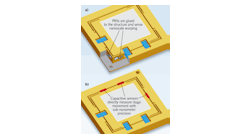
    FIGURE 1. A nanopositioning stage equipped with inferred-metrology piezoresistive sensors (PRSs; a) is compared to a more precise unit with direct-metrology capacitive feedback (b). In the latter, the stage platform is measured directly, greatly improving stability and position linearity and eliminating crosstalk errors.
    Nanometer resolution for motion-control devices is becoming increasingly necessary in many areas of photonics. Advances in piezo motion control are eliminating traditional tradeoffs...
    March 21, 2011
    (Courtesy of Interferometric Optics)
    A control interferogram (left) recorded at the detection plane an interferometric distance of 7.235 m away corresponds to the interferometric character a (N = 2; two slits are illuminated). When a spiderweb fiber is placed orthogonally to the propagation plane (parallel to the slits) at a distance of 15 cm from the detector, the diffraction pattern generated by the fiber (right) is superimposed over the central order of the interferogram—easily detected to ensure 'secure' or untappable optical transmission.
    Researchers at Interferometric Optics (Rochester, NY), the US Army Aviation and Missile Command (Redstone Arsenal, AL), Science Applications International Corporation (SAIC), ...
    March 1, 2011