• Home >
  • Back Issues >
  • Laser Focus World >
  • Volume 47, Issue 7
  • Volume 47, Issue 7

    More content from Volume 47, Issue 7
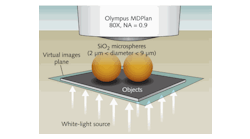
    FIGURE 1. A schematic shows a white-light microsphere nanoscope (a microsphere superlens integrated with a classical optical microscope) with λ/8 to λ/14 imaging resolution. The spheres collect the near-field object information and form virtual images that are then captured by the conventional lens.
    A new white-light microscope uses microsphere superlenses to magnify underlying near-field objects up to eight times before projecting them into a conventional microscope's objective...
    July 1, 2011
    Researchers at the National Institute of Standards and Technology (NIST) have developed a broadband trace-gas sensor that they say is 100 times faster and more sensitive than ...
    July 1, 2011
    (Courtesy of Stanford Photonics)
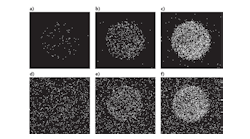
    FIGURE 1. Images (400 × 400 pixels) taken of a constant-output 1.25-in.-diameter luminescent disk. 33, 250, and 1000 ms exposures were captured by a Stanford Photonics XR/Turbo-Z ICCD camera (a, b, and c, at -20°C) and a Hamamatsu ImagEM EMCCD (d, e, and f, at -70°C). The green emission was filtered at 550 nm to limit light to the nominal peak of the QE curves for each sensor. The ICCD camera detects 87 photons in the 33 ms exposure shown. The EMCCD cannot detect the object since clock-induced charge (CIC) noise exceeds the photon level within the target region of interest.
    With parameters such as quantum efficiency, signal-to-noise ratio, resolution, and speed all coming into play in the low-light-imaging arena, ICCD cameras can offer a quantifiable...
    July 1, 2011
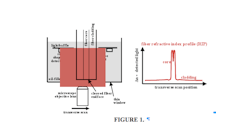
    FIGURE 1. Depicted are a schematic illustration of RNF (a) and sample RIP data for a singlemode fiber (b). The RIP data are often expressed as Δn, which is the difference between the measured refractive index and that of pure fused silica.
    Several new phase-based techniques allow the refractive-index profile of an optical fiber itself to be measured, rather than that of its preform; in addition, the measurements...
    July 1, 2011
    (Courtesy of QED Technologies)
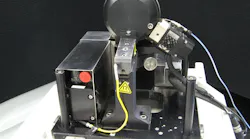
    A miniature MRF polishing head with an improved fluid-delivery system is small enough to fit on an end table. The polishing wheel is at the top; the ribbon of MR fluid is held on the wheel’s rim.
    Magnetorheological finishing is an optical-fabrication technique whose name is synonymous with QED Technologies and with good reason: MRF, invented in the former Soviet Union ...
    July 1, 2011
    (Courtesy of OSA)
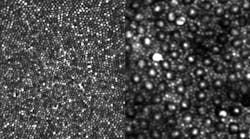
    An afocal broadband adaptive-optics scanning ophthalmoscope images photoreceptors in a living human eye: cones in the fovea (left), and a combination of cones and rods in an area away from the center of the retina (right). In the right-hand image, the large bright dots with a dark ring around them are cones, and the surrounding (and far more abundant) smaller spots are rods.
    Researchers at the Flaum Eye Institute and the Institute of Optics, both at the University of Rochester, have created a reflective scanning ophthalmoscope that for the first time...
    July 1, 2011
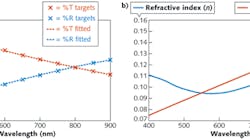
    FIGURE 1. Input percentage reflectance and transmission characteristics of a 10 nm silver film where X represents measured data and the dashed line represents fitted data (a). The dispersion models of both the index and extinction coefficients for this very thin layer are also shown (b).
    When referring to optical coating design software a discussion may turn to some of the powerful numerical methods utilized within an individual software package.
    July 1, 2011
    Pennwell web 90 86
    By the close of Laser World of Photonics 2011 at the end of May it was obvious that the event had shaken off the economic malaise surrounding the prior Laser conference held in...
    July 1, 2011
    Been down to your local hardware store recently to replace several of those annoying 60 W bulbs that seem to pop off without warning?
    July 1, 2011
    (Courtesy of Max Planck Institute for Quantum Optics)
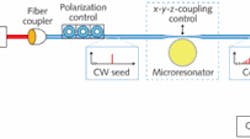
    FIGURE 1. A microresonator is used to generate a mid-IR frequency comb centered at 2.5 µm through four-wave-mixing effects.
    Interest in the mid-infrared (mid-IR) spectral region continues to grow for applications in molecular fingerprinting, IR countermeasures, near-field microscopy, and materials ...
    July 1, 2011
    FIGURE 1. The terahertz band in the electromagnetic spectrum sits between the optical (shorter-wavelength) and radio-frequency (longer-wavelength) domains, and has traditionally been difficult to exploit for sensing and imaging.
    Subwavelength antennas in the metal interconnection layer of an inexpensive CMOS chip couple terahertz radiation to the chip's electronics, enabling the creation of inexpensive...
    July 1, 2011
    (Courtesy of Praevium Research [a] and Thorlabs [b])
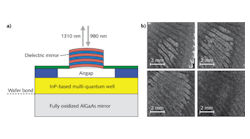
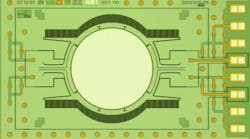
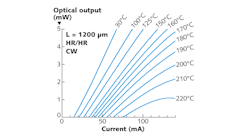
    A mirror bonded to a quantum-well structure comprises the heart of a tunable vertical-cavity surface-emitting laser (VCSEL), with tunable 1310 nm emission aided by an electrostatically actuated dielectric mirror placed over the structure (a). As the tunable source for an optical-coherence tomography (OCT) system, the tunable VCSEL enables a 760 kHz axial scan rate for finger-pad imaging (b). Here, a series of four 512 × 512 en-face finger-pad images separated by 125 µm in depth show the scanning-OCT capabilities enabled by the tunable VCSEL.
    Microelectromechanical systems (MEMS)-tunable vertical-cavity surface-emitting lasers (VCSELs) would be ideal for swept-source optical-coherence tomography (OCT) applications ...
    July 1, 2011
    (Courtesy of Katholieke Universiteit Leuven)
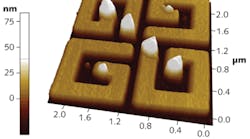
    Plasmon “hotspots” can physically alter nanostructures.
    The ability to image surface-plasmon resonances allows researchers to map the local electric fields that create the unusual optoelectronic properties of metamaterials, for example...
    July 1, 2011
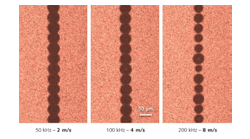
    FIGURE 1. Consistency of individual ablation spots degrades at higher repetition rate and scan speed in a thin-film PV P2 scribe of a-Si panels using a typical DPSS Q-switched laser.
    A new generation of Q-switched solid-state lasers is enabling thin-film laser scribing with a new set of processing parameters: High quality scribes for amorphous-silicon thin...
    July 1, 2011
    (Courtesy of IPG Photonics)
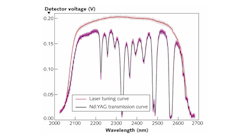
    An example mid-IR transmission spectrum is shown for a 10-cm-long neodymium (0.5%): yttrium aluminum garnet (Nd:YAG) crystal measured in 0.5 ms with the rapidly tunable erbium (Er) fiber chromium:zinc sulfide (Cr:ZnS) fiber-bulk hybrid laser using an indium-gallium-arsenide (InGaAs) detector-oscilloscope combination.
    Many mid-infrared (mid-IR) solid-state laser sources do not operate at room-temperature due to the deactivation of energy accumulated in the gain media via nonradiative phonon...
    July 1, 2011
    (Images courtesy of Robert Kalinowski)
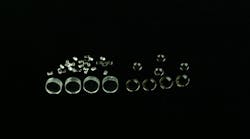
    FIGURE 1. Molded optics can start with raw materials made of plastic (left) or glass (right). Thermoplastic resins for plastic optical injection molding are provided in extruded and cut pellet form. The PGM process requires a precision preform prior to molding.
    Advances in mold tooling and glass technologies have enabled production of molded glass optics that are cost competitive with plastic optics for an increasing range of applications...
    July 1, 2011
    (Courtesy of Rice University)
    FIGURE 1. Nanocomplexes delivered in vivo are observed with near-IR fluorescence imaging of mice for control, low HER 2 expressing tumors (top row) and HER 2 expressing tumors (bottom row). HER 2 is a type of antibody that targets breast cancer. The animals were imaged at 0.3, 2, 4, 24, 48, and 72 hours postinjection. Fluorescence intensity comparison of tumors between the HER 2 expressing tumors and control shows a 71.5% increase in signal at 4 h in HER 2 expressing over the control tumors. The dotted line is a guide to the eye.
    Theranostics defines the unique technologies that combine both medical diagnostics and therapeutics, such as laser-induced nanobubbles created by gold nanoparticles that both ...
    June 17, 2011