• Home >
  • Back Issues >
  • Laser Focus World >
  • Volume 47, Issue 12
  • Volume 47, Issue 12

    More content from Volume 47, Issue 12

    (Courtesy of Newport Corp.)
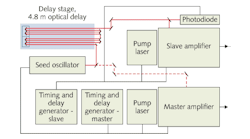
    A block diagram shows how to create a delay for pump-probe experiments by synchronizing two amplifiers, slave and master, with a single seed oscillator.
    Delay lines that introduce a quantifiable separation between laser pulses are necessary for time-resolved experiments in ultrafast science such as pump-probe spectroscopy.
    Dec. 5, 2011
    The experimental output spectrum of the JAWS filter has a sawtooth shape. The period can be varied simply by changing the spacing in the VIPA.
    A type of optical filter developed by engineers at Beijing Jiaotong University, the University of California–Los Angeles, and the California NanoSystems Institute, and aptly called...
    Dec. 5, 2011
    (Courtesy of the US Naval Research Laboratory)
    A microscope image shows a trapped cell in the optical chromatography setup. Cells enter the channel by a pressure-driven fluid flow that runs from the top left to the bottom right of the image. Laser light enters from the opposite direction, and the fluid flow is adjusted until the optical and fluidic forces balance, causing the cell to rest at the measurement location.
    The US Naval Research Laboratory (NRL) is aiming to sort particles in biological fluids using laser-based, optofluidic methods that do not require prior knowledge of DNA sequence...
    Dec. 2, 2011
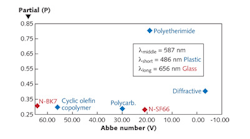
    FIGURE 1. When designing an imaging system with multiple refractive elements, the selection of starting component types uses a partial glass map similar to this example of a map for visible wavelength plastics.
    Hybrid optical components can replace a multielement system design and offer advantages to standard optical components; they are ideal for a variety of imaging, broadband illumination...
    Dec. 1, 2011
    (Courtesy of Carnegie Mellon University)

    FIGURE 1. A wearable camera harness allows a person’s motions—even rapid ones, like running—to be captured outside, even as the person traverses great distances.
    Some of this year’s ‘transformative’ technologies show the fun side of photonics in entertainment, while others get down to the business of advancing science and research.
    Dec. 1, 2011
    (Courtesy of the University of St. Andrews)
    A lunchbox-sized (20 × 13 × 7 cm3) explosive-vapor-detection system measures fluorescent photoluminescence decay from a thin-film photoemissive polymer material using a CMOS-based detection system.
    Using a microsystem based on a chemosensory conjugated (semiconducting) polymer, a team of Scottish researchers from the University of St. Andrews, University of Edinburgh, and...
    Dec. 1, 2011
    (All figures courtesy of Oclaro and NEL America)
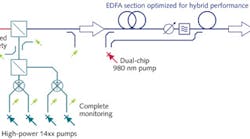
    FIGURE 1. In a hybrid Raman/EDFA system, the high-power 14xx nm Raman pump diodes are combined and launched into the fiber span counter-propagating with respect to the signal. Distributed Raman preamplification provides low noise, and the EDFA section provides high gain and high output-signal power. Flat gain spectra over a wide range of gains are provided by the combination of the four-pump-wavelength Raman pump configuration and the two-stage EDFA with variable optical attenuator and gain-flattening filter between the two stages.
    C- and L-band erbium-doped fiber amplifiers, hybrid Raman/EDFA systems, new gain-medium materials, and semiconductor optical amplifiers continue to extend the reach of wavelength...
    Dec. 1, 2011
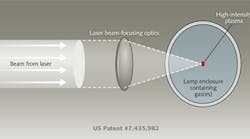
    FIGURE 1. Light emitted by an LDLS arises from the interaction of a focused laser beam with xenon or a mixture of inert gases.
    An ultrawideband laser-driven light source has the long life and high spatial and spectral stability needed to fulfill demanding requirements in the sciences.
    Dec. 1, 2011
    A couple of years ago, I wrote a somewhat facetious column bemoaning the lack of decent (or even indecent) quantum physics jokes. So far as I can determine, then and now, there...
    Dec. 1, 2011
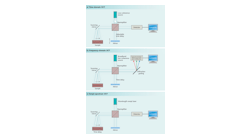
    FIGURE 1. Three variations on OCT. a) In time-domain OCT, output of a low-coherence source is split between two arms, one of which scans the sample, while the other provides an adjustable time delay. The two arms are phase-matched so the returned light interferes constructively only for light backscattered from a particular depth. b) Frequency-domain OCT splits light from a broadband source between the sample and the reference arms, then recombines the beams through a spectrometer onto a detector array. c) Swept-spectrum OCT splits light from a high-speed wavelength-swept laser source between the sample and reference arms, then recombines the light at a detector array. In all cases, output goes to a computer for processing and image generation.
    In the last 20 years, optical coherence tomography (OCT) has emerged as a valuable noninvasive imaging technology for medical applications without the hazards of radiation. New...
    Dec. 1, 2011
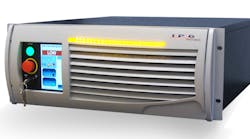
    FIGURE 1. A quasi-CW high-pulse-energy fiber laser supports high-pulse-energy, low-duty-cycle laser processing.
    Fiber lasers offer benefits such as long lifetimes, low complexity, reduced running costs, and low maintenance, which can now be found in a variety of fiber-based products with...
    Dec. 1, 2011
    Conard Holton2
    As 2011 ends, this issue finds us studying the past year for innovations and changes, and hoping to anticipate important technology developments in 2012. These developments will...
    Dec. 1, 2011
    Three different tests of relative reflectivity as a function of exposure dose show improvements in the EUV coating technology for Cymer’s HVM. The March 2011 results indicate no degradation even after 4 MJ have been delivered to the illuminator’s intermediate focus (akin to its output). The 4 MJ reported corresponds to 512 wafers using 10 mJ/cm2 resist.
    As it did in the 1980s when it developed an excimer laser designed from the ground up for optical lithography, Cymer is aiming to capture virtually the entire market for next-...
    Nov. 30, 2011