• Home >
  • Back Issues >
  • Laser Focus World >
  • Volume 49, Issue 02
  • Volume 49, Issue 02

    More content from Volume 49, Issue 02

    (Courtesy of ORC)
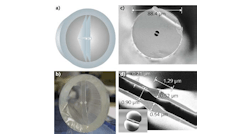
    A dual-core fiber is shown in a schematic (a), as a preform (b), and as a finished fiber in scanning electron micrographs (c) and (d).
    Researchers at the University of Southampton (Southampton, England) have shown off a novel dual-core fiber architecture that permits changes in the coupling between the cores,...
    Feb. 12, 2013
    The ultimate efficiency of a TiN nanowire-based metamaterial emitter is compared to that to that of an ideal blackbody with a 0.71 eV material bandgap, a value equivalent to that of gallium antimonide (a). Angularly averaged spectral-emission characteristics between the two materials are compared (b); while the efficiency of energy conversion for both materials is maximized at 1500 K, the narrowband emission of the metamaterial give it great advantages for TPV use.
    A group at the University of Alberta has designed a plasmonic-metamaterial-based emitter that, based on computer models, should achieve the omnidirectional thermal emission, narrowband...
    Feb. 11, 2013
    (Courtesy of F. Macera, D. Beller, A. Honglawan, and S. Čopar)
    Physical templates can be used to manipulate the surface and orientation of liquid crystals.
    Researchers from the University of Pennsylvania have demonstrated a new method to direct the assembly of photonic liquid crystals, generating small features that spontaneously...
    Feb. 11, 2013
    Content Dam Lfw Print Articles 2013 02 1302lfwnbf4web
    Brillouin optical time-domain analyzer (BOTDA) sensors can be used to monitor lengths of optical fiber many kilometers long for the distribution of temperature and strain along...
    Feb. 11, 2013
    Content Dam Lfw Print Articles 2013 02 1302lfwnbf2web
    Sparkle Optics has achieved a record 14 W of diffraction-limited laser power at 946 nm using their rotary disk laser technology.
    Feb. 8, 2013
    1302lfwnbf3web
    Researchers at the University of Southampton in England are drawing from the geometry of natural moth eyes by creating hexagonal nanoscale arrays that have small regular areas...
    Feb. 8, 2013
    Content Dam Lfw Print Articles 2013 02 1302lfwnbf1web
    Scientists at the Massachusetts Institute of Technology (MIT) and Sandia National Laboratories have developed an “adiabatic” silicon microring modulator that maintains high speed...
    Feb. 8, 2013
    Conard Holton2
    The potential diplomatic and economic clashes over the availability of rare earths in 2010—along with a speculative bubble—have mostly subsided.
    Feb. 1, 2013
    (Courtesy of Warsaw University of Technology)
    FIGURE 1. Paper binary phase diffractive lens for use in the terahertz region are easily made by laser cutting (a and b). A paraxial design (a) and aspherical design (b) were tested. Two types of paper were considered for the experiment: a green paper with metallic flakes and a white paper. Because time-domain spectroscopy data (c) showed that the white paper had slightly less absorption, it was chosen for the actual experiment. However, the white paper, which is widely available, is very similar and would have presumably worked well too.
    An efficient nonparaxial paper diffractive lens for use with terahertz radiation can be quickly laser-cut for flexibility in prototyping.
    Feb. 1, 2013
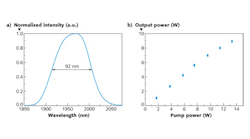
    FIGURE 1. The amplified spontaneous emission (ASE) of Tm3+-doped silicate glass fiber (a) enables fabrication of a laser with output power (b) shown as a function of absorbed pump power at 798 nm in a cladding-pumped 2 μm Tm3+-doped silicate glass fiber laser (20-cm-long, 18-μm-core-diameter fiber).
    Highly thulium-doped silicate glass fibers can be used to develop single-frequency fiber lasers with 1.9–2.1 μm operating wavelengths, and Q-switched fiber lasers and self-starting...
    Feb. 1, 2013
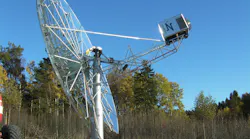
    FIGURE 1. The Cleanergy (Göteborg, Sweden) dish system has a capacity of 11 kW electric power and may be used in standalone or other decentralized applications, as well as clusters with a capacity of up to several hundred megawatts. The parabolic concentrator reflects the incoming solar radiation onto a cavity receiver, which is located at the concentrator's focal point.
    A beam characterization system shows how the solar energy distribution on a mirror's focal point can be accurately measured for criteria such as solar beam image size and power...
    Feb. 1, 2013
    (Courtesy of Lawrence Livermore National Laboratory)
    FIGURE 1. One 96-beam bay inside the National Ignition Facility. The small yellow objects are hard hats worn by workers.
    The National Ignition Facility (NIF) can deliver 1.8 MJ pulses of ultraviolet energy onto a target the size of a pencil eraser. That unparalleled capacity is exploring frontiers...
    Feb. 1, 2013
    FIGURE 1. A moonbow—a rainbow formed by the light of full moon—can be successfully imaged in full color with a FLIR Tau CNV camera and a 25 mm, f/0.95 lens.
    Recent developments in ultralow-noise silicon imaging sensors have made it possible to image scenes in full color under lighting conditions that defy the ability of the human ...
    Feb. 1, 2013
    [Courtesy of P. Greb, USDA/Agricultural Research Service (ARS)]
    FRONTIS. Rare-earth oxides are prevalent in the development of today's photonics-enabling technologies. Clockwise from top center: praseodymium, cerium, lanthanum, neodymium, samarium, and gadolinium.
    Rare-earth and other chemical elements play an important role in the photonics industry, routinely used in semiconductor, PV, and photodetector devices and to power solid-state...
    Feb. 1, 2013