• Home >
  • Back Issues >
  • Laser Focus World >
  • Volume 48, Issue 04
  • Volume 48, Issue 04

    More content from Volume 48, Issue 04

    1204breaks Fig1
    Queen’s University physicist and principal investigator James Fraser and doctoral candidate Paul Webster have solved a significant problem inherent in the use of lasers in automated...
    April 3, 2012
    So, under enormous pressure from well-meaning family members and friends, I recently junked our miserable, 18 in., CRT-based television set and replaced it with a huge, 42 in....
    April 2, 2012
    1304qa Chang New
    How would you recommend young technical professionals prepare themselves to be a CEO of a startup company?
    April 2, 2012
    Submarine cables from Tokyo to London are planned for two distinct routes through the Arctic Ocean. The Polarnet Project plans to lay the ROTACS cable through the Russian region of the Arctic (yellow line). Arctic Fibre has chosen a route along the Northwest Passage through the Canadian Arctic (black line); Arctic Link will follow a similar route. Construction is slated to begin this year on ROTACS and Arctic Fibre.
    The demand for better connections between Tokyo and London is driving construction of the first submarine fiber-optic cables to span the Arctic Ocean.
    April 2, 2012
    Conard Holton2
    Education and fashion are two sometimes related topics of interest to the general public and—as we show in this issue—the photonics community.
    April 1, 2012
    FIGURE 1. In a micrograph of a cow-eye retinal sample, retinal pigment epithelial (RPE) cells that were damaged by laser exposure appear dark, while living cells fluoresce.
    A more complete understanding of thermally induced injury of the retina provides the basis for optimizing international laser exposure limits, allowing higher laser powers that...
    April 1, 2012
    FIGURE 1. The structure of a fiber laser includes a doped inner core, which is the laser itself; an undoped outer core (also called an inner cladding) through which the pump light is channeled; and an outer cladding.
    Fiber lasers are compact and rugged, don't go out of alignment, and easily dissipate thermal energy. They come in many forms, sharing technology with other type of lasers but ...
    April 1, 2012
    FIGURE 1. A traditional tiled HMD (a), a novel tiled HMD (b), and a detail of a free-form compensation lens giving see-through capability are illustrated.
    Free-form optics tiling can potentially overcome the invariant on the field of view and the resolution in a head-mounted display, and enable the design and development of lightweight...
    April 1, 2012
    FIGURE 1. One pixel in a microbolometer array. An infrared-absorbing surface is elevated above the substrate and thermally isolated from adjacent pixels. Low mass increases the temperature change from heat absorption. Read-out circuits typically are in the base layer, which may be coated with a reflective material to reflect transmitted IR and increase absorption of the pixel.
    Built around arrays of tiny thermal detectors, uncooled IR cameras avoid the high cost and cooling requirements of photon detectors for long IR wavelengths. Steady improvements...
    April 1, 2012
    (Courtesy of LumiGram)
    FIGURE 1. Side-illuminating optical fibers coupled to LEDs can create some interesting clothing options.
    Imagine a world in which optoelectronics such as OLEDs are freed from their rigid, confining encapsulation and intimately integrated into our daily lives-into our clothing or ...
    April 1, 2012
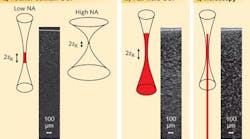
    FIGURE 1. A test object with scattering nanoparticles was used to compare the depth of field (DOF) and lateral resolution of optical coherence tomography (OCT), optical coherence microscopy (OCM), swept-source full-field OCT, and holoscopy. The DOF and lateral resolution are schematically shown (red) in relation to the corresponding Gaussian beam waist.
    By combining digital holography with optical coherence tomography (OCT) in a process known as holoscopy, 3D parallel image acquisition with extremely high data throughput at high...
    April 1, 2012
    1204lfw7 Frontis
    Students interested in a career in optics and photonics should carefully research which institutions are a geographic, academic, and financial fit; which institutions offer a ...
    April 1, 2012
    Adding a plane-mirror pair (M1 and M2: M1 has 50% reflectivity) in close proximity to a diffraction grating, a field-translation effect occurs that effectively doubles the number of grooves, increasing spectrometer resolution. An additional mirror pair (M3 and M4: M3 has 50% reflectivity) doubles the resolution yet again (inset).
    Researchers at the Korea Research Institute of Standards and Science (KRISS) have developed a purely optical approach using plane-parallel mirrors and have demonstrated a factor...
    March 30, 2012
    (Courtesy of the University of Southampton)
    High-speed electronics are fabricated directly in capillaries of microstructured optical fibers, rather than relying on external electronics.
    A technique to deposit precisely doped semiconductor materials into microstructured optical fibers (MOFs) is coming of age, demonstrated by gigahertz-bandwidth photodetectors ...
    March 29, 2012
    Spot intensities at two photodetectors are measured as a function of lateral sample displacement along the x-axis. The solid curves depict the theoretical behavior (the difference between measurement and theory is probably due to a nonideal transfer function of the optics). Each detector count is equal to about 10 photoelectrons.
    Dutch researchers from the University of Twente, the FOM Institute for Atomic and Molecular Physics, and Philips Research Laboratories have created a nonimaging speckle interferometer...
    March 28, 2012
    ARL and UC Berkeley
    A slow-light, hollow-core waveguide array is represented schematically (a) as a structure composed of subwavelength high-contrast gratings or HCGs. The device (b) as shown in a SEM photo is fabricated using simple etching steps and demonstrates slow-light waveguiding with ultralow loss.
    High-contrast gratings (HCGs)—alternating stripes of semiconductor materials and air (or silicon) with subwavelength periodicity—are an emerging integrated photonics platform ...
    March 27, 2012