• Home >
  • Back Issues >
  • Laser Focus World >
  • Volume 47, Issue 3
  • Volume 47, Issue 3

    More content from Volume 47, Issue 3

    (Courtesy of Physikalisch-Technische Bundesanstalt)
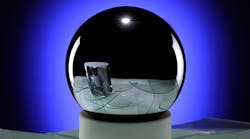
    One of two spheres used for precisely determining the Avogadro constant is made of pure enriched 28Si from a dislocation-free boule; its diameter and variations in diameter are known to an accuracy of 0.6 pm.
    The Avogadro project was started in 2003 by a consortium of measurement-standards laboratories.
    March 1, 2011
    Periodically poled magnesium-doped lithium niobate (LiNbO3) or PPMgLN is a commonly used crystal for laser frequency conversion using the quasi-phase-matching technique due to...
    March 1, 2011
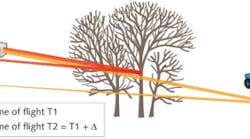
    FIGURE 1. A 3D lidar sensor uses independent time-of-flight measurements at every pixel to acquire distance information for objects in the scene. Obscuring objects in the foreground (such as foliage) can be eliminated based on the distance data collected.
    By hybridizing Geiger-mode APD arrays to suitable CMOS readout integrated circuits, a focal-plane array can be developed that serves as an ideal sensor engine for 3D imaging lidar...
    March 1, 2011
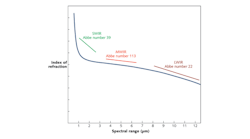
    FIGURE 1. The spectral variation in refractive index for zinc sulfide (ZnS) shows very different V-numbers (or Abbe numbers) for the SWIR, MWIR, and LWIR.
    By taking into account the "volatility" of optical dispersion, optical materials can be combined to create a single refractive lens system for imaging across the visible and infrared...
    March 1, 2011
    (All images courtesy of SOHO)
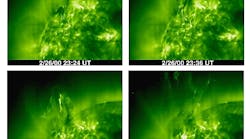
    FIGURE 1. The EIT recorded one hour of a coronal mass ejection at 19.5 nm on Feb. 26–27, 2000.
    Data from imagers, spectrometers, and other optical sensors aboard numerous Sun-observing spacecraft are being used to understand solar flares, the source of coronal mass ejections...
    March 1, 2011
    (Image adapted with permission from Fuller and Millett [2], The Future of Computing Performance: Game Over or Next Level?, 2011, National Academy of Sciences, courtesy of the National Academies Press, Washington, DC)

    FIGURE 1. Single-processor performance rose steadily from 1986 until about 2004, when it abruptly leveled off. Single points show performance of individual processors at their date of introduction, as measured by the SPECint2000 benchmark test. The solid line shows the actual trend; the dashed line shows the target from the International Technology Roadmap for Semiconductors from 2009 to 2020.
    Massive parallelism and dramatic cuts in energy budgets are crucial for the future of high-performance computing. Integrated photonics can help developers reach those goals by...
    March 1, 2011
    FIGURE 1. The AFM-IR technique combines an atomic force microscope with an IR spectrometer as shown in this schematic. After illumination with a pulsed OPO IR source, the cantilever ringdown characteristics from the sample provide both spectral and mechanical data about the sample.
    Combining infrared spectroscopy with probe microscopy provides a powerful new analytical instrument capable of simultaneous nanoscale chemical and physical analysis of materials...
    March 1, 2011
    FIGURE 1. An optical plate for a direct-diode system includes a beam-combiner enclosure and fiber-output couplings (top). Weld penetration versus welding speed for a 3 kW system is shown for two spot sizes (bottom).
    A passively cooled, fiber-coupled diode module has a previously unachieved combination of high power and high beam quality.
    March 1, 2011
    (Courtesy of the University of Cincinnati)
    A simplified diagram shows traditional RGB and RGBW color-filtering systems for e-paper displays (a and b). The newly proposed single-layer bi-primary color system (c and d) shares two colors in a single pixel. The colors RGBWCMYK correspond to red, green, blue, white, cyan, magenta, yellow, and black. CF is the color fraction and Refl. is the white reflectance.
    In the short term, it is unlikely that pigment-based electronic paper or e-paper displays (such as the Kindle) will provide the high-quality, full-color performance of conventional...
    March 1, 2011
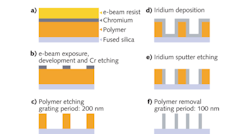
    A lithographic process for doubling the frequency of an initially created polymer grating results in an iridium wire-grid grating with a 100 nm period.
    With their large spectral range and conveniently thin platelike form, wire-grid optical polarizers work well in many types of optical systems. At one time only available for the...
    March 1, 2011
    1304qa Chang New
    To never borrow is usually the right thing to do, but companies do borrow; even established companies with substantial assets have lines of credit.
    March 1, 2011
    FIGURE 1. The quantum efficiency curve of sCMOS cameras is now much closer to that of CCDs than that of the CMOS cameras of just a few years ago.
    While enhanced CCDs still provide important niche application performance, recent advances are enabling new CMOS imagers to address scientific applications.
    March 1, 2011
    A quantum-cascade TPV structure contains an embedded grating that scatters light to maximize absorption of both TM and TE polarized light.
    While photovoltaic (PV) cells that extract energy from sunlight are getting much attention, another type of PV device has great promise too.
    March 1, 2011
    (Courtesy of Princeton University)
    The beam from a 'backward laser' created in air can have common beam profiles that include Gaussian (a) and donut-shaped (b).
    What could make the detection of gas leaks, explosives, or noxious chemicals at a distance easier than ever?
    March 1, 2011
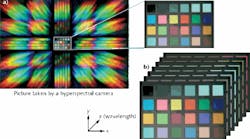
    (Courtesy of Horiba Scientific)
    In the SHI camera, a raw image (a) consists of a zero-order image that replicates the original scene surrounded by several higher diffraction orders in both directions that contain all the spatial and spectral information in the scene. The 'data cube' or hypercube (b) is generated by software reconstruction using the image in (a) as the input.
    Commercially available spectral imaging systems capture the intensity information from a scene and display it as a digital image (with x and y spatial coordinates), while also...
    March 1, 2011
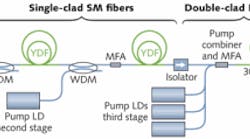
    (Courtesy of Laser Zentrum Hannover)
    Two 600 mW and three high-power fiber-coupled pump lasers amplify a microwatt-level seed laser to a 270 kW peak-power level using a three-stage all-fiber technique.
    Laser Zentrum Hannover researchers have, to the best of their knowledge, achieved the highest extracted pulse energy from an all-fiber amplification system seeded by a gain-switched...
    March 1, 2011
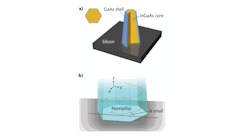
    A pillar-shaped InGaAs laser resonator has six facets (a); laser light follows a helical path down the pillar into the Si substrate (b).
    Successful growth of nanopillar III-V lasers on silicon (Si) by Connie Chang-Hasnain's group at the University of California at Berkeley has opened a new approach to integrating...
    March 1, 2011
    30573
    Like so many other innovations, the charged coupled device (CCD) was invented at AT&T Bell Labs.
    March 1, 2011
    I was surprised to learn just how critical the so-called "rare earth elements" are in the development of complex electronics for the high-performance consumer and military/defense...
    March 1, 2011