• Home >
  • Back Issues >
  • Laser Focus World >
  • Volume 45, Issue 2
  • Volume 45, Issue 2

    More content from Volume 45, Issue 2

    (Courtesy of Hewlett-Packard Laboratories)
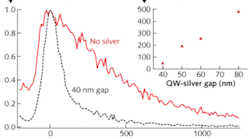
    Time-resolved photoluminescence measurements are compared for two structures: an LED epitaxial stack without a silver layer (red line) and an LED epitaxial stack with a 40 nm gap between the quantum well of the stack and a silver layer (dashed black line). Decay time is significantly decreased due to the presence of surface plasmon polaritons for the device with a silver layer. The gap between the silver layer and the quantum well structure also has a major impact on decay time (inset).
    Commercial light-emitting diodes (LEDs) are only capable of 1 GHz maximum modulation speeds because of slow carrier recombination, limiting them to applications in short-haul ...
    Feb. 1, 2009
    Solar cells fabricated from silicon can benefit from a photon upconversion (UC) process in which two or more low-energy photons are converted to a higher-energy photon.
    Feb. 1, 2009
    Infrared quantum-cascade detectors (QCDs) with high detectivities tend to have narrow spectral linewidths, due to the means of detection (optical bound-to-bound transitions).
    Feb. 1, 2009
    Although confocal microscopy (CM) is effective for subcellular imaging to depths of tens of microns (and for imaging fluorescently tagged tissues, unlike optical-coherence tomography...
    Feb. 1, 2009
    A metamaterial consisting of periodic regions of high electrical conductivity in a 3 × 3 × 1.5 mm synthetic-diamond crystal has been fabricated by researchers at Kyoto University...
    Feb. 1, 2009
    Th Diff 01
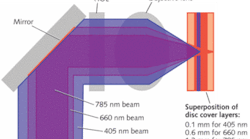
    A harmonic optical element added behind the objective lens of a Blu-ray pickup allows it to handle Blu-ray, DVD, and CD wavelengths with a single optical system.
    Feb. 1, 2009
    (Courtesy of University College Cork)
    FIGURE 1. In the experimental setup (top), mirrors M1 and M2 are high-reflectivity mirrors forming an optical cavity. Lenses L1 and L2 are used to focus the light into the cavity and into an optical fiber, respectively. In the actual setup (below), the super-quiet xenon lamp is in the back, the sample-filled cavity is in the foreground, and the fiber-coupling unit for the transmitted light is on the left (green fiber).
    High-resolution Fourier-transform cavity-enhanced absorption spectroscopy in the near-IR gains wide spectral coverage from an incoherent broadband light source.
    Feb. 1, 2009
    (Courtesy Swiss Federal Institute of Technology)

    FIGURE 1. The Jungfraujoch observatory in the Swiss Alps houses instrumentation that uses vibrational Raman spectroscopy to measure water vapor in the troposphere, as well as rotational Raman spectroscopy to perform temperature measurements on air molecules at altitudes up to 20 km. Differential-absorption LIDAR (DIAL) is also used to measure ozone in the troposphere.
    In our increasingly “green” world, the need for portable and accurate atmospheric monitoring equipment, in which photonics plays a significant role, has expanded as society weighs...
    Feb. 1, 2009
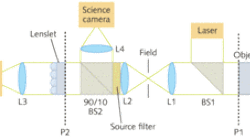
    FIGURE 1. In the microscope with a Shack-Hartmann wavefront sensor, the 45° beamsplitter1 (Semrock, Rochester, NY) allows the laser light to be focused onto the sample, while the 90/10 beamsplitter BS2 allows the science camera and the wavefront sensor to see the fluorescent microsphere simultaneously. Lenses L1 and L2 are 65-mm-focal-length lenses that image the aperture of the objective onto the Shack-Hartmann sensor; P1 and P2 are conjugate planes. The field-stop between L1 and L2 blocks the light coming from other parts of the field of view, allowing only the light from the bead to pass. Note, the field-stop could be moved farther down the system because it is needed only by the wavefront sensor. The large distance between L1 and the aperture (P1) allows for the excitation laser (HeNe, λ = 632 nm) to be placed in this area. A source filter was added after L2 to reduce the effect of scattered light by the embryo and allow the wavefront sensor to see only the emission light. L3 demagnifies the pupil by a factor of two so that it can fit into the cooled camera (Roper Scientific, Acton, NJ).
    Adaptive optics has tantalized researchers looking for ways to image through thick biological tissue–but the approach is not straightforward.
    Feb. 1, 2009
    (LLNL photo)
    FIGURE 1. The Solid State Heat Capacity Laser at the Lawrence Livermore National Laboratory used ceramic slab amplifiers to generate an average power of 67 kW.
    Ceramic hosts, transition-metal doping of II-VI hosts, and optically pumped semiconductor lasers are expanding the range of solid-state laser capabilities to new wavelengths and...
    Feb. 1, 2009
    As the demand for higher-resolution complementary metal-oxide semiconductor (CMOS) image sensors continues to increase for cell-phone and digital-camera applications, shrinking...
    Feb. 1, 2009
    FIGURE 1. Drivers provide the operating current entering a system. The 500B series laser-diode driver from Newport (left) is a low-noise current source with long-term stability of better than 50 ppm/°C with four models covering laser currents from below 50 mA up to 6 A. A USB 2.0 connector interface is unique for interfacing with a remote computer. The LDX36000 family of high-power laser-diode current sources from ILX Lightwave (right) provides continuous-wave and pulsed operation with currents up to 220 A and voltages to 70 V for driving stacks and arrays of lasers.
    Bench-top laser-diode drivers and controllers have a wide variety of features, from voltage and temperature control to safety features and surge protection. Know the most important...
    Feb. 1, 2009
    Sunlight (not shown) enters the top surface of a luminescent solar concentrator (LSC) and stimulates emission of luminescent rays that either proceed, through total internal reflection, to the solar cell (at left of each drawing) or exit the concentrator if they fall within the escape cone (top). When mirrors are applied directly to bottom and edges (blue), total internal reflection ceases, and all rays reflect with the reflection coefficient of the mirror, which leads to a reduction in reflection and power-conversion efficiency for rays outside of the escape cone (bottom left). An air gap between the mirror and the LSC, however, enhances efficiency by combining total internal reflection with mirror reflection of escaping rays (bottom right) [1].
    A multi-institutional team of researchers, working through the FULLSPECTRUM project of the European Commission, has published encouraging research results from a five-year investigation...
    Feb. 1, 2009
    Th New P 01
    Off-axis beam collimators have a surface accuracy better than λ/10 p-v, producing no central obscuration and obtaining efficient transmission.
    Feb. 1, 2009
    (Courtesy of Bielefeld University)
    FIGURE 1. A panoramic imaging device is mounted on the lens of a CCD camera (left). The device contains two optical elements: a plano-concave lens, and a more-complex element that contains an outer and an inner aspheric surface (right, cross section). Black denotes the outer refractive surface, while red and blue denote the reflective and refractive portions of the inner surface, respectively. In this vertical position, the imager captures from the zenith to the horizon in all directions, as well as downward from the horizon an additional 40°.
    Using only two optical components, researchers have created a panoramic imager that fits over a standard 6 mm C-mount lens for a 1/2 in. CCD camera to give the camera an unobstructed...
    Feb. 1, 2009
    (Courtesy of KAIST)
    A SNOF architecture (left) produces local Raman gain that enables detection of molecules such as benzenethiol using SERS (a). Optical-microscope (b) and scanning-electron-microscope (c) images confirm that a single gold nanowire is present on the gold film. The SERS spectra of benzenethiol using different nanowire and film materials (right) show the highest Raman gain for the silver nanowire on silver film combination.
    Researchers from KAIST (Daejeon, Korea), Korea University, and Soongsil University (both in Seoul, Korea), have developed an efficient and highly reproducible surface-enhanced...
    Feb. 1, 2009
    (Courtesy of Kevin MacDonald)
    A signal is coupled into and out of a grating-containing waveguide with a modulation provided by pumping the metal layer directly.
    The field of so-called active plasmonics has seen an unprecedented leap in switching times, thanks to the favorable properties of aluminum and the efforts of a number of researchers...
    Feb. 1, 2009
    (Courtesy of Thales Research and Technology)
    The output from three separate fibers interferes with another plane-wave input to produce a series of interference fringes on a CCD (above). This interference signal is then transmitted to a spatial light modulator, which acts as a dynamic digital hologram that can generate a phase-conjugated segmented wavefront that is then fed back into the signal to create a phase-locked output (right) in the far field. When phase correction is stopped, the beams are unlocked (left).
    Tremendous strides have been made in increasing the output power of single-mode fiber lasers.
    Feb. 1, 2009
    (Courtesy of JPL/TAU)
    A silver halide preform for an octagonal photonic-crystal fiber has an outer diameter of 16 mm (left). A photonic-crystal fiber extruded from the preform has an outer diameter of 900 µm (right, central portion of fiber is shown).
    An improved form of an optical component called a modal filter has been developed by researchers at the Jet Propulsion Laboratory (JPL; Pasadena, CA) and Tel Aviv University (...
    Feb. 1, 2009
    FIGURE 1. The standard architecture of most commercial microscope systems (top) consists of a high-numerical-aperture (NA) objective lens (L1), and a low-NA tube lens (top). The researchers’ design (center) adds a second high-NA objective lens, a mirror (M1), and a beamsplitter (BS). The fast, remote-focusing architecture is combined with a real-time Nipkow-disc confocal microscope in a system (bottom) that also includes an extra mirror (m2) near the pupil plane of Lens1. A laser provides illumination, and a polarizing beamsplitter and quarter-wave plate ( λ/4) direct illumination light through the system into the specimen and back through to the confocal microscope.
    Because a standard confocal microscope efficiently images only regions of a specimen that lie close to the focal plane, producing a 3-D depiction requires that the microscope ...
    Feb. 1, 2009
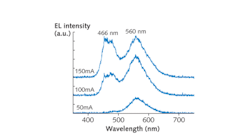
    FIGURE 1. The emission spectrum of a strain-adjusted LED, shown here in arbitrary units (a.u.), changes shape with increasing injection current, causing the color to change from yellow to white to blue.
    Two types of phosphor-free white-emitting LEDs have been developed that appear, at first glance, to rely on the same concept for white-light emission; however, when examined in...
    Feb. 1, 2009
    Th Manu 01
    Nanopositioning piezo-based stages and actuators deliver nanometer resolution, fast response and are robust.
    Feb. 1, 2009
    Environmental sensing and monitoring is rather vague terminology for an extremely broad and ever growing field that encompasses a vast array of detection and analysis techniques...
    Feb. 1, 2009
    In my view, inspiration and reality are often quite different, especially given the worldwide economic chaos that we face today
    Feb. 1, 2009
    1304qa Chang New
    Q: I am a mechanical engineer working in operations for an early-stage medical diagnostic company.
    Feb. 1, 2009