• Home >
  • Back Issues >
  • Laser Focus World >
  • Volume 45, Issue 1
  • Volume 45, Issue 1

    More content from Volume 45, Issue 1
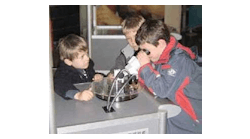
    (Courtesy of the ICFO)
    Using a microscope, children examine several samples on a turntable that have been laser microprocessed: a stent, a tooth, porous plastic foil, gummi bears, and a microscopic statue of Venus.
    At the Institute of Photonic Sciences (ICFO; Barcelona, Spain), a unique outreach project just finished.
    Jan. 1, 2009
    Th Absorber 01
    While laser welding of polymers is used in many industrial applications, an infrared (IR) absorber material is typically required to laser-weld transparent thermoplastics.
    Jan. 1, 2009
    Th Does 01
    Laser metal deposition (also called laser additive welding or laser cladding) is becoming more common for such industrial applications as repair of damaged or worn turbine blades...
    Jan. 1, 2009
    Th Hybrid 01
    Integrated silicon (Si)-based optical-communication networks don’t just need light sources, amplifiers, and detectors; they need switches, too.
    Jan. 1, 2009
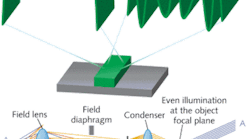
    FIGURE 1. In conventional microscopy (top), a feature larger than the wavelength of light used to illuminate it will image with well-defined edges (left), while a feature smaller than the light wavelength produces a signature–and an image without clear edge definition (right). This is true when imaging both single features and arrays of features. Historically, we would dismiss the latter result as having insufficient resolution, but we now know that the signature actually contains helpful information. The optical configuration (bottom) includes access to a conjugate back focal plane that enables illumination engineering.
    Advances in optical microscopy have enabled unprecedented achievement in metrology and imaging.
    Jan. 1, 2009
    FIGURE 1. Basic geometries for QC-based lasers include FP-QCL (top), DFB-QCL (middle), and ECqcL (bottom). The gain medium is shown in gray, wavelength-selection mechanism in blue, facet coatings in orange, and output in red.
    Combining quantum-cascade media with external-cavity laser geometries produces mid-IR quantum-cascade lasers with narrowband output, ultrabroadband single-mode tuning abilities...
    Jan. 1, 2009
    (Courtesy of United States Air Force)

    FIGURE 1. The MQ-1 Predator, which has seen combat over Bosnia/Serbia and the Middle East, can carry a dual-missile payload (top). Visual information including video is transmitted to a ground station for analysis (bottom). Here, U.S. Air Force Captain Richard Koll, left, and Airman First Class Mike Eulo, right, perform function checks at Balad Air Base, Iraq, after Predator launch. Koll and Eulo control the Predator in a radius of approximately 25 miles around the base before handing it off to controllers stationed in the U.S. to continue its flight.
    Vision for an unmanned aerial vehicle is critical to that vehicle performing its intended task, which is sometimes a covert imaging operation in a hostile setting that is unsuitable...
    Jan. 1, 2009
    (Courtesy of UDC)
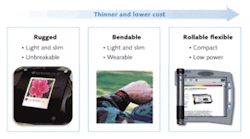
    FIGURE 1. In the roadmap for the development of flexible OLED displays, ruggedness is achieved first, followed by bendability, then by true flexibility (rollability).
    Phosphorescent OLED displays built on metal-foil substrates offer new attributes: flexibility, ruggedness, and extreme thinness, in addition to low power consumption.
    Jan. 1, 2009
    The resonant wavelength of a photonic crystal depends on size of the holes, so layers with different size holes reflect different wavelengths. This increases transmission bandwidth of a photonic-crystal fiber and decreases its dispersion, although attenuation also increases.
    By creating photonic bandgaps analogous to the electronic bandgaps that underlie modern semiconductor electronics, photonic crystals have created new types of optical devices,...
    Jan. 1, 2009
    BiOptix’s detector measures the phase change of p-polarized light reflected from the biochip surface. The phase change depends on the amount of captured biological or chemical material.
    The annual Pittcon conference schedules a full menu of coverage of advances in analytical chemistry and applied spectroscopy.
    Jan. 1, 2009
    FIGURE 1. Manufacturing and stacking of a high number of lenses at the wafer level is the future of cost-effective camera manufacturing.
    A combination of ultraprecision diamond-turned hard tools and microlithography, as well as advances in metrology, pave the way for high-volume production of wafer-level stacks...
    Jan. 1, 2009
    (Courtesy of University of South Florida)
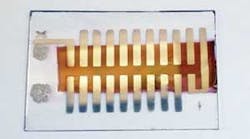
    Twenty miniature organic solar cells are connected in series to create a 2.2 cm2 solar array that is close to creating enough voltage to power a tiny microelectromechanical system (MEMS) device. The overall device is one square inch in size, and each of the solar cells has an active area of 1 mm2.
    To perform its intended function, a microelectromechanical system (MEMS) needs its own power source.
    Jan. 1, 2009
    Th Photonics Enters 01
    The laser business is already feeling the pinch of the global economic recession. The questions are: how long and how severe will the impact be, what laser segments (if any) will...
    Jan. 1, 2009
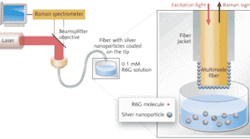
    FIGURE 1. The double substrate SERS probe involves a multimode fiber sensor (enlarged at right) with a coating of silver nanoparticles on its tip that react with the target solution. The excitation source is directed through the fiber, while the Raman signal is directed back up through the fiber for detection.
    The combination of SERS and optical fiber enables sensors for biological and chemical agents with the molecular fingerprinting ability of Raman scattering, the enhancement factor...
    Jan. 1, 2009
    (Courtesy of Harvey Mudd College and Los Alamos National Laboratory)
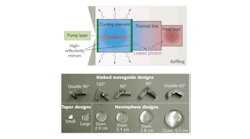
    An optical refrigerator depends on removal of high-energy photons to cool a special laser-pumped material. In the simplest implementation, this is accomplished by directly attaching a thermal link that is then butt-coupled to a heat load (top). To improve refrigeration efficiency, several versions of optical-waveguide tapers and lens elements can be used as thermal links to remove absorptive photons (bottom).
    The lure of compact solid-state diamond lasers operating in desirable spectral regions and power regimes, along with numerous other optoelectronic applications, is helping to ...
    Jan. 1, 2009
    Pennwell web 200 150
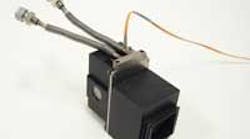
    The blue/green enhanced, 6 mm2 photodiode-preamplifier ODA-6WB-500M is designed for fluorescence detection and low-light-level medical diagnostic applications.
    Jan. 1, 2009
    A key criterion of successful cancer surgery is the ability to remove all vestiges of the tumor and thereby greatly reduce the chances that the cancer will recur.
    Jan. 1, 2009
    (Courtesy of University of Cambridge)
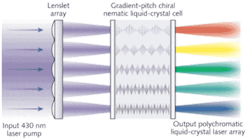
    A liquid-crystal laser consists of a single-wavelength pump source illuminating a lenslet array that directs illumination toward a liquid-crystal cell containing specific chiral bandgap formulations that produce the desired output color. When the source illuminates a gradient cell containing multiple mixtures of liquid-crystal dye formulations, multiple colors are seen at the output.
    Laser televisions and projection displays have focused on the development of low-cost, high-power red, green, and blue (RGB) laser sources.
    Jan. 1, 2009
    (Courtesy of CEA-Leti)
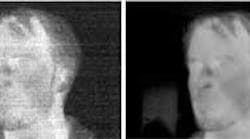
    Without gain, the noise from readout electronics dominates a low-flux IR image (left). A gain of seven makes the image significantly clearer (right).
    Mercury cadmium telluride (MCT) has long been one of the materials of choice for detection of infrared radiation, and recent years have seen focal-plane arrays (FPAs) based on...
    Jan. 1, 2009
    (Courtesy of CUNY)
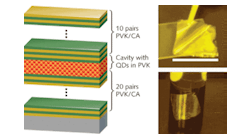
    Except for the QDs in the cavity, the layers of a flexible microcavity vertical-emitting laser are all polymer (left). Spin-coated on a glass substrate, the laser can be peeled off (upper right) and conforms to curved surfaces (lower right).
    In communications, as in many things, low cost means plastic; for example, the price of short-haul fiber-optic communications systems is lower because of the increasingly widespread...
    Jan. 1, 2009
    (Courtesy of Rochester Institute of Technology)
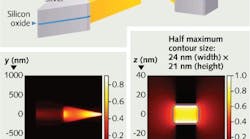
    To efficiently squeeze light into a subwavelength nanoscale-size spot, researchers at RIT coupled a standard dielectric waveguide to a metal-dielectric-metal plasmonic waveguide taper (top). Surface plasmons are funneled into the taper tip (bottom left), and the input 1550 nm light is efficiently coupled into a 21 × 24 nm spot (bottom right).
    Coupling light into a nanoscale spot is extremely important to applications in high-density optical interconnection, sensitive modulators, optical data storage, nanostructure ...
    Jan. 1, 2009
    (Courtesy of Korea Advanced Institute of Science and Technology)
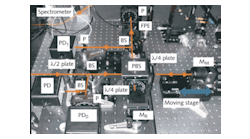
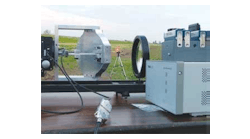
    A laboratory prototype of a long-range absolute DMI includes a TOF and SWI unit (lower left and an SRI unit (top and top left). Although the prototype was tested out in the open, an enclosed, thermally controlled version made of the proper materials could approach an accuracy of 7 nm while measuring large distances.
    Under the right environmental conditions, optical interferometers can measure macroscopic distances to nanometer accuracies.
    Jan. 1, 2009
    (Courtesy of Rensselaer Polytechnic Institute)
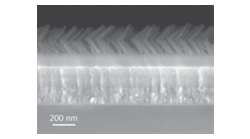
    FIGURE 1. A seven-layer, graded-index antireflection coating increases absorption of solar energy across a broad spectrum from 400 to 1600 nm at wide angles of incidence.
    Silicon solar cells hold promise for clean, renewable energy–and would be much more common as an alternative source of electricity if their cost was not so high.
    Jan. 1, 2009
    (Courtesy of the Swinburne University of Technology)
    An optical-disc-recording setup allows recording in three spatial dimensions, as well as two polarizations and multiple wavelengths (top). Experimental results with three wavelengths show that 18 pixelated images can be written in the same disc area.
    Although optical-spectrum analysis and polarization measurement methods are not generally related, a collaborative effort by scientists at Tianjin University (Tianjin, China),...
    Jan. 1, 2009
    Th 305877
    Sydor Instruments has introduced a new, compact x-ray digital camera capable of operating completely in vacuum.
    Jan. 1, 2009
    Lawrence Livermore National Laboratory (LLNL; Livermore, CA) laser scientist Ralph Jacobs died on Aug. 29 at age 65, just one week after retiring from LLNL.
    Jan. 1, 2009
    In this column last January I made an understatement of “economic-bailout” proportions.
    Jan. 1, 2009
    It’s not a word that I would use in everyday speech but if I wanted to impress you with my fancy vocabulary, I might say, “English cuisine runs the gamut from awful to appalling...
    Jan. 1, 2009
    Th Enhanced 01
    In optical-analysis programs, an optimization process systematically varies system design parameters to reach specified performance metrics.
    Jan. 1, 2009
    1304qa Chang New
    How do you expect the current financial turmoil to impact start-up funding?
    Jan. 1, 2009