• Home >
  • Back Issues >
  • Laser Focus World >
  • Volume 44, Issue 10
  • Volume 44, Issue 10

    More content from Volume 44, Issue 10

    (Courtesy of Innsbruck Medical University)
    When overlaid, two phase plates (top left and right) form a lens with a variable focal length. The moiré phase pattern, and thus the optical power, is shown for relative rotation angles of —75°, —30°, and —15° (bottom, first row) and +15°, +30°, and +75° (bottom, second row).
    While developing holographic and other diffractive optics for use with optical tweezers, two researchers from Innsbruck Medical University (Innsbruck, Austria) came up with a ...
    Oct. 1, 2008
    Researchers at the University of Geneva (Geneva, Switzerland) have determined a minimum speed for Albert Einstein’s hypothetical “spooky action at a distance” (see Salart et al...
    Oct. 1, 2008
    Existing material and other constraints preclude the creation of diffraction-limited continuous-wave fiber lasers or amplifiers with an output of greater than about 36 kW, according...
    Oct. 1, 2008
    Physicists at the University of California, Santa Barbara (Santa Barbara, CA), have demonstrated an on-chip, polarization-switchable, single-photon source using the Stark effectthe...
    Oct. 1, 2008
    Th 300204
    Researchers at the Massachusetts Institute of Technology (MIT; Cambridge, MA) have integrated 850-nm-emitting gallium aluminum arsenide (GaAlAs) vertical-cavity surface-emitting...
    Oct. 1, 2008
    Th 297161
    Multicomponent phosphate glasses are excellent host materials for amplifiers and lasers, offering high solubility for rare-earth ions, excellent optical properties, and resistance...
    Oct. 1, 2008
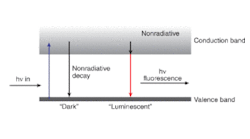
    FIGURE 1. Photon energy absorbed by optical filter glass with a semiconducting dopant is re-emitted either nonradiatively, or as fluorescence.
    Colored glass may seem to be an easy way to help block excitation and other out-of-band wavelengths in fluorescence microscopy, but care must be taken to minimize effects of fluorescenc...
    Oct. 1, 2008
    Th 300257
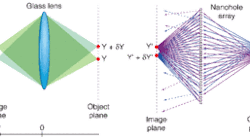
    A new type of focal-plane array made of a nanoscale metal screen mimics the function of a lens, focuses light (and plasmons) into subwavelength hot spots, and achieves high-resolution...
    Oct. 1, 2008
    (Courtesy of Aculight)
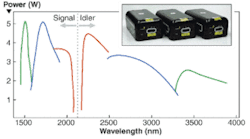
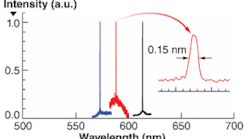
    FIGURE 1. Power as a function of wavelength is shown for three Aculight Argos modules, showing both signal and idler output branches. Three optical parametric oscillator (OPO) interchangeable modules are used to provide wavelength coverage (inset).
    Continuous-wave optical parametric oscillators producing multiwatt powers are established in the near- to mid-infrared region. New nonlinear materials promise to extend their ...
    Oct. 1, 2008
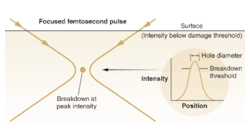
    FIGURE 1. Focusing a femtosecond pulse through a high-NA lens avoids damage to the surface, but produces an intense zone within the bulk material. Nonlinear interactions occur above a sharp threshold, as shown at right, limiting pulse effects to a subwavelength area.
    Sharply focused femtosecond pulses create strong nonlinear effects inside solids that can alter the properties of materials on subwavelength scales, writing waveguides and gratings...
    Oct. 1, 2008
    (Courtesy University of Illinois at Urbana-Champaign)
    Conventional planar processes are used to create an array of silicon optoelectronics components that are then formed into an eye-shape camera, reducing optical distortions and aberrations that occur in flat-sensor camera designs.
    Researchers at the University of Illinois at Urbana-Champaign (Urbana, IL) and Northwestern University (Evanston, IL) have succeeded in developing the first curvilinear or hemispherical...
    Oct. 1, 2008
    (Courtesy of Drexel University)
    A standard rear-view mirror has a field of view of only 15° to 20°, which results in the familiar blind spot (top). A properly shaped free-form reflector placed in exactly the same orientation (bottom) has a 45° field of view, eliminating the blind spot without producing the distorted scene that other wide-angle mirrors create.
    Just as a flat mirror is a nonimaging optic, so are most free-form reflectors. And, just as a flat mirror can be a very important visual aid, so can a properly designed free-form...
    Oct. 1, 2008
    FIGURE 2. Ultraprecision diamond milling is used to produce hard tools for wafer-level replication. Many identical lenses are machined on a 200 mm hard tool for subsequent replication. The asphere profile can be a high-NA, large sag lens.
    Despite an often higher up-front capital equipment cost and market-penetration challenges, laser welding systems are expanding into more-challenging application areas because ...
    Oct. 1, 2008
    (Courtesy Evans & Sutherland)
    FIGURE 1. Two-dimensional images are created using a grating-light-valve (GLV) modulator by scanning an image of the GLV across the image plane within one frame.
    When illuminated with a bow-tie resonator laser, a microelectromechanical-systems (MEMS) grating light valve can yield an unprecedented 33 million pixels from a single display...
    Oct. 1, 2008
    When mixed in solution with bacteria and activated by light, indocyanine green can kill nearly all the bacteria. Here, the solution is subjected to a 411 J/cm2 dose of 808 nm laser light at an intensity of 1.37 W/cm2. Varying indocyanine green concentrations were tested on three types of bacteria.
    Scientists have proved that light-activated agents can render bacteria defenseless—even those that have become resistant to drugs.
    Oct. 1, 2008
    Th New P 01
    The IndyStar compact industrial excimer laser is built on the RoHS-Almeta tube design, which delivers several billion pulses.
    Oct. 1, 2008
    (Courtesy of S. Marchesini)
    X-rays simultaneously pass through a nanoarray of holes and a 2-µm-wide image of Da Vinci’s Vitruvian Man and create a scattered-light image, captured by a CCD. The result is first Fourier-transformed and then Hadamard-transformed to produce the final image.
    Some ideas just get better with age. The pinhole camera, standby of the Renaissance greats, has a new incarnation that looks set to revolutionize x-ray holography.
    Oct. 1, 2008
    (Courtesy INRS-EMT, University of Québec)
    The uncorrected wavefront of the 200 TW Advanced Laser Light Source (top) is improved by more than a factor of two using a deformable mirror (bottom).
    Researchers have used large-aperture adaptive optics to implement laser-beam wavefront correction on the 200 TW laser system at the Advanced Laser Light Source (ALLS) in Varennes...
    Oct. 1, 2008
    (Courtesy of TU Delft and KMM Otterlo, NL)
    The face of a provincial Dutch woman with a covered head is visible in a tritonal color reconstruction of Sb (yellowish white) and Hg (red), underneath the existing 1887 Vincent van Gogh oil on canvas, Patch of Grass. Historians surmise that several years after he gave several original Head paintings to his brother, van Gogh may have come across them again, and painted a bright Parisian grassy landscape over the “old-fashioned” woman for financial reasons.
    Scientists have discovered that Vincent van Gogh’s oil-on-canvas painting, Patch of Grass (1887), is hiding a lost portrait of a woman’s face, according to art historian Joris...
    Oct. 1, 2008
    (Courtesy of Mariano Zimmler, Harvard)
    A ZnO nanowire is optically pumped along its length with an ultraviolet laser (lower inset). The peak optical power (uncorrected for 10% collection efficiency) at room temperature emitted from the nanowire exhibits linear behavior above threshold—a direct manifestation of laser action. Simply suspending the wire off the end of the silicon substrate on which it rests enables direct head-on emission detection (upper inset).
    Nanowires only hundreds of nanometers in diameter have yielded the first direct evidence of laser action, says professor of engineering Federico Capasso and colleagues at Harvard...
    Oct. 1, 2008
    (Courtesy of Xiang Zhang)
    FIGURE 1. A metamaterial that has a negative refractive index at telecommunications wavelengths is composed of 21 layers with a “fishnet” structure, one layer of which is shown here in a scanning-electron-microscope image.
    Advances in the use of metamaterials for negative refraction are being fancifully described by the media, but their first real application might be less exotic than some that ...
    Oct. 1, 2008
    Through a subsidiary, Corning (Corning, NY) signed an agreement to acquire Optimum Manufacturing (Charlestown, NH), which will become part of Corning‘s Specialty Materials segment...
    Oct. 1, 2008
    Innolume (Dortmund, Germany and Santa Clara, CA), a provider of quantum-dot (QD) laser diodes and modules, secured a Series C round of financing for $12.
    Oct. 1, 2008
    e2v (Chelmsford, England), designer, developer, and manufacturer of specialized imaging components and subsystems, was selected by Thales Alenia Space to provide the high-performance...
    Oct. 1, 2008
    Th New P 26
    The Spectra-Physics Solstice™ sets the industry standard for one-box ultrafast amplifier stability and reliability.
    Oct. 1, 2008
    As a pioneer in organic semiconductors (for example, intrinsic properties of conjugated polymers, first blue polymer LED, organic photodiode on newspaper) who has been in the ...
    Oct. 1, 2008
    Ultrafast lasers have long been “confined to a sleepy corner of the laser market and reserved for the most exotic R&D applications,” says Tom Hausken of Strategies Unlimited in...
    Oct. 1, 2008
    If half of our high school graduates can squeeze into a four-year program and emerge clutching a BA or a BS, what is the value of such a diploma?
    Oct. 1, 2008
    Th 297181
    After the enormous impact genomics has had on understanding biological systems through genome sequencing, proteomics promises even greater rewards.
    Oct. 1, 2008
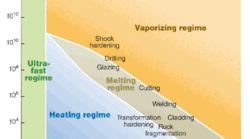
    Ultrafast laser processes are athermal or have low thermal damage (the strip on the left); accomplishing some processes more slowly. As interaction time increases for lasers directed onto a material, the more thermal is the effect, as in Q-switched and CW laser processes (to the right of the ultrafast regime).
    Ultrafast lasers have long been confined to a sleepy corner of the laser market, reserved for the most exotic R&D applications.
    Oct. 1, 2008