• Home >
  • Back Issues >
  • Laser Focus World >
  • Volume 37, Issue 11
  • Volume 37, Issue 11

    More content from Volume 37, Issue 11

    (Photo courtesy of UNL)
    University of Nebraska researchers Herman Batelaan (right) and Daniel Freimund, shown here in the laboratory, modified a basic physics experiment to become the first to observe the Kapitza-Dirac effect—an accomplishment that, among other things, may lead to measuring devices that are thousands of times more accurate than those currently in use.
    University of Nebraska (UNL; Lincoln, NE) researchers have reported what is believed to be the first observation of coherent interference patterns arising from the Kapitza-Dirac...
    Nov. 1, 2001
    (Photo courtesy of University of Aarhus)
    Optical gating of an ultrafast pulse during micromachining of a part provides depth information. At the point in time when ablation is initiated, the surface is flat (top). After 5000 shots, measurements show an uneven hole (center). After 10,000 shots, the hole has deepened (bottom). Image scale is determined by moving the sample a known amount along the laser beam for depth calibration and perpendicular to the beam for lateral calibration.
    Micromachining based on ultrafast laser pulses removes material by ablation with little or no heating of the neighboring area, reducing surrounding damage. Just as in ordinary...
    Nov. 1, 2001
    FIGURE 1. When the scratch drive is pulled toward the substrate, it is forced to bend at the corner, pushing it forward. As the force is released, friction holds the tip in place, and the rest of the device, as it unbends, moves toward it.
    At the Northern Higher Institute of Electronics (ISEN; Villeneuve d'Ascq, France), researchers have developed a way of producing fixed arrays of three-dimensional (3-D) micromirrors...
    Nov. 1, 2001
    Lfw 2001 11 Acousto
    Researchers from the Weizmann Institute of Science (Rehovot, Israel) have produced an acousto-optic focal scanner that can operate at 400 kHz and, in its initial form, operate...
    Nov. 1, 2001
    (Photo courtesy of Motorola)
    FIGURE 1. Researchers Jamal Ramdani (left) and Ravi Droopad hold the world's first 12-in. GaAs-on-silicon wafer.
    Motorola Labs (Tempe, AZ) made a big splash in the electronics world when it announced a new technique for fabricating gallium arsenide (GaAs) components on a silicon substrate...
    Nov. 1, 2001
    (Photo courtesy of The Journal of the American Chemical Society)
    Porous silicon emits orange light upon ultraviolet (365-nm) irradiation. After exposure of this sample to boiling base (pH 12 aqueous KOH), only the functionalized areas still emit light (orange areas).
    Purdue University (West Lafayette, IN) researchers have developed a method to harness the photoemissive properties of porous silicon and use them to stabilize the material's surface...
    Nov. 1, 2001
    Russian astronomy technology has been adapted to test chips like the Pentium and PowerPC. University of Rochester's Roman Sobolewski, co-creator of the detector, is shown here testing the device with a laser.
    A project that combined astronomy technology from Moscow State Pedagogical University (Moscow, Russia) with optical instrumentation from the University of Rochester (Rochester...
    Nov. 1, 2001
    (Photo courtesy of Jun Ye/Science)
    A new and flexible approach to the synthesis of coherent light has been demonstrated by researchers Robert Shelton (left) and Jun Ye, shown here in the laboratory.
    The world of ultrafast science has received a boost with the demonstration of a new and flexible approach to the synthesis of coherent light by University of Colorado (CU; Boulder...
    Nov. 1, 2001
    Buried-tunnel-junction vertical-cavity surface-emitting laser produces 1.55-µm light. Optical power vs. current at different temperatures for a device with a 5 x 6-µm aperture shows a 0.5-mW optical output at 80°C. The laser emits at temperatures up to 110°C.
    Vertical-cavity surface-emitting lasers (VCSELs) show conically shaped emission that favors coupling of the radiation into an optical fiber. In addition, they excel in longitudinal...
    Nov. 1, 2001
    (Photo courtesy of Research Support Instruments)
    Th 77921
    Most optical systems that produce images do so imperfectly. Under certain conditions, a degraded optical image can be at least partially restored by mathematically removing the...
    Nov. 1, 2001
    Narragansett Imaging is born; eMagin 'in the money'; NREL awards to boost research into thin-film solar cells...
    Nov. 1, 2001
    Nobel prize awarded for Bose condensate; Isonics and Cermet announce joint program for isotopically pure zinc oxide; Rofin-Sinar completes sale of medical-laser business...
    Nov. 1, 2001
    DRS Technologies acquires Boeing's Sensors and Electronics Systems business; CDM Optics, Carl Zeiss Group team up; Photonic-crystal startup receives $4.11 million in funding.....
    Nov. 1, 2001
    Submissions now being accepted for the Young Investigator Award; Electron laser amplifies ultraviolet light by a factor of 10 million; Aperiodically poled lithium niobate yields...
    Nov. 1, 2001
    Th 77998
    The evolution of the optical time-domain reflectometer (OTDR) over two decades has resulted in an instrument with lower noise, higher sensitivity, and wider range.
    Nov. 1, 2001
    Th 77938
    ithographic production permits the integration of multiple functions within a planar optical structure and the simultaneous production of multiple copies of devices.
    Nov. 1, 2001
    Th 77977
    A new approach to protecting the human eye and optical sensors from high-power coherent light combines carbon disulfide and dilute India ink in a cascaded-focus geometry.
    Nov. 1, 2001
    Less than a week before the September 11 terrorist attacks on New York and Washington, the Senate voted to ease restrictions on exports of high-tech products.
    Nov. 1, 2001
    Th 77930
    TOKYO—The Intelligent Devices Lab of Fuji Xerox, led by group leader Ryojiro Akashi, has developed a novel light modulation material modeled after the pigment cells of cephalopods...
    Nov. 1, 2001
    (Photo courtesy of Electrophysics)
    Th 77926
    Portable infrared (IR) cameras can be hooked to laptop computers for image recording and display, a setup that ends up being unwieldy, perhaps deserving the term "totable" instead...
    Nov. 1, 2001
    Th 77929
    TOKYO—Masaya Notomi and colleagues at the materials science division of NTT Basic Research Laboratories have developed a photonic-crystal optical waveguide that operates...
    Nov. 1, 2001
    Th 77928
    TOKYO—Engineers at Olympus Optical Co. Ltd have developed a near-infrared (near-IR) spectral reflectance detector that can be used to directly measure the surface reflectance...
    Nov. 1, 2001
    FIGURE 1. Commercial technologies discussed at the 2001 CNOM meeting included a linear optical amplifier based on long-dimension VCSEL technology (Genoa; Fremont, CA).
    Despite the fact that the annual affiliates meeting of the Center for Nonlinear Optical Materials (CNOM) at Stanford University (Palo Alto, CA) took place in the midst of an economic...
    Nov. 1, 2001
    Ca-Botics wins award for robotic installation of fiberoptics in sewers; Digital Lightwave announces cost-reduction initiatives; EXFO reports strong year-end financial results....
    Nov. 1, 2001
    The rapidly increasing rate of technology development means that one day's "high tech" product becomes almost mundane the next. But it also means that technology in its many forms...
    Nov. 1, 2001
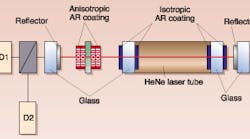
    Researchers at the University of Otago in New Zealand have used anisotropic antireflection coatings to select the direction of polarization of a helium neon (HeNe) laser beam.
    The demands on software for designing thin-film coatings are shifting significantly in response to new technology development and changing market demands.
    Nov. 1, 2001
    (Photo courtesy of MRC Systems)
    MRC supports installation of the multilaser neurosurgery system in an interventional MRI environment. High-resolution images are taken preoperatively for planning purposes, while lower-resolution images are taken during surgery to monitor progress.
    A team of European academics and vendors is collaborating on a multilaser system that can nonthermally treat and remove deep-seated brain tumors and treat functional diseases ...
    Nov. 1, 2001
    This column is being written exactly two weeks after the horrifying terrorist attacks on New York City and Washington. Federal and state government authorities are already in ...
    Nov. 1, 2001
    Th 77932
    We all learn from our mistakes. When business is good, a mistake may be only a bump in the road. When business is bad, it may be the end of the road. During the current economic...
    Nov. 1, 2001
    Th 78005
    In the race to develop microelectromechanical systems (MEMS) for optical applications, choosing software tools developed specifically for MEMS design can provide substantial advantages...
    Nov. 1, 2001
    Th 77802
    Translation stages; Fiber-coupled diodes; Laser illuminator; Cooled CCD; Low-power CO2 laser...
    Nov. 1, 2001
    1304qa Chang New
    Most of the questions I have been receiving, especially after the Sept. 11th terrorist attacks, revolve around what is going to happen to the economy, to the laser industry and...
    Nov. 1, 2001
    A listing of Meetings, Courses, and Calls for Papers ... covering December 2001 to February 2002.
    Nov. 1, 2001