3-D holographic display is updatable and rewritable
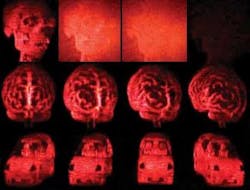
Researchers from the University of Arizona, in conjunction with Nitto Denko Technical Corporation (Oceanside, CA), have created a holographic three-dimensional (3-D) display that can record and display new images every few minutes. The display can record an image in a matter of minutes, can be viewed for several hours without the need to refresh or wear special eyewear, and can be erased and updated with new images when desired.
The key, according to researcher Savas Tay, is the photorefractive polymers on which the display is based. To be suitable for 3-D displays, photorefractive polymers must have nearly 100% diffraction efficiency, fast writing time, hours of image persistence, rapid erasure, and large area—a combination of properties that was not available before. Tay and colleagues have developed a composite that consists of a copolymer with a hole-transporting moiety and a carbaldehyde aniline group, attached through an alkoxy linker. Images are written into the polyacrylate tetraphenyldiaminobiphenyl-type polymer using a 532 nm laser and an externally applied electric field. The scientists take pictures of an object or scene from many 2-D perspectives, and the holographic display assembles the two-dimensional perspectives into a 3-D picture. The nonlinear optical properties were achieved by adding a fluorinated dicyanostryrene chromophore. The composite was formed into thin-film devices by melting it between two indium tin oxide-coated glass electrodes. The resulting prototype is the largest photorefractive 3-D display achieved to date (4 × 4 in.) and is scalable to full parallax and color. Contact Savas Tay at [email protected].