LRO spectrometer finds helium in Moon's atmosphere
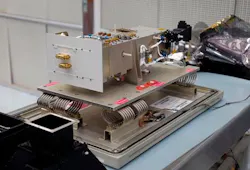
Greenbelt, MD--NASA's Goddard Space Flight Center reports that scientists using the Lyman Alpha Mapping Project (LAMP) spectrometer aboard NASA's Lunar Reconnaissance Orbiter (LRO) have made the first spectroscopic observations of the noble gas helium in the tenuous atmosphere surrounding the Moon. The remote-sensing observations complement in situ measurements taken in 1972 by the Lunar Atmosphere Composition Experiment (LACE) deployed by Apollo 17.
Although designed to map the lunar surface, the LAMP team expanded its science investigation to examine the far ultraviolet emissions visible in the tenuous atmosphere above the lunar surface, detecting helium over a campaign spanning more than 50 orbits. Because helium also resides in the interplanetary background, several techniques were applied to remove signal contributions from the background helium and determine the amount of helium native to the Moon. Geophysical Research Letters published this research in 2012.
"The question now becomes, does the helium originate from inside the moon, for example, due to radioactive decay in rocks, or from an exterior source, such as the solar wind?" says Alan Stern, LAMP principal investigator and associate VP of the Space Science and Engineering Division at Southwest Research Institute, Boulder, CO. "If we find the solar wind is responsible, that will teach us a lot about how the same process works in other airless bodies," says Stern.
If spacecraft observations show no such correlation, radioactive decay or other internal lunar processes could be producing helium that diffuses from the interior or that is released during lunar quakes. "With LAMP's global views as it moves across the moon in future observations, we'll be in a great position to better determine the dominant source of the helium," says Stern.
Another point for future research involves helium abundances. The LACE measurements from the 1970s showed an increase in helium abundances as the night progressed. This could be explained by atmospheric cooling, which concentrates atoms at lower altitudes. LAMP will further build on those measurements by investigating how the abundances vary with latitude.
During its campaign, LACE also detected the noble gas argon on the lunar surface. Although significantly fainter to the spectrograph, LAMP also will seek argon and other gases during future observations. "These ground-breaking measurements were enabled by our flexible operations of LRO as a Science Mission, so that we can now understand the moon in ways that were not expected when LRO was launched in 2009," said Richard Vondrak, LRO project scientist at NASA's Goddard Space Flight Center.
SOURCE: NASA’s Goddard Space Flight Center; www.nasa.gov/mission_pages/LRO/news/helium-detected.html
About the Author
 Gail Overton
Gail Overton
Gail Overton served as a senior editor for Laser Focus World from 2004 through 2020. She has more than 30 years of engineering, marketing, product management, and editorial experience in the photonics and optical communications industry. Before joining the staff at Laser Focus World, she held many product management and product marketing roles in the fiber-optics industry, most notably at Hughes (El Segundo, CA), GTE Labs (Waltham, MA), Corning (Corning, NY), Photon Kinetics (Beaverton, OR), and Newport Corporation (Irvine, CA). During her marketing career, Gail published articles in WDM Solutions and Sensors magazine and traveled internationally to conduct product and sales training. Gail received her BS degree in physics, with an emphasis in optics, from San Diego State University in San Diego, CA in May 1986.