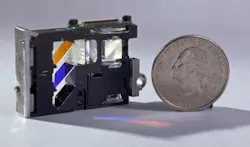
Raleigh, NC--Researchers from North Carolina State University (NC State) and ImagineOptix Corporation have unveiled a new polarization-conversion system (PCS) that makes liquid-crystal (LC) based projectors (such as many picoprojectors) almost twice as efficient. The device does this by separating light into its two polarization components, rotating one component 90° to line up with the other, then using all the light (minus any optical inefficiencies).
The most common method of polarizing light involves passing the unpolarized light through a polarizing filter. This process wastes more than 50% of the originally generated light, with the bulk of the "lost" light being turned into heat.
The new PCS is a small single-unit assembly composed of four immobile parts. A beam of unpolarized light first passes through an array of lenses that focuses the light into a grid of spots. The light then passes through the LC polarization grating, which separates the spots of light into pairs that have opposite polarizations. The light then passes through a louvered wave plate that gives the spots the same polarization. Finally, a second array of lenses focuses the spots of light back into a single, uniform beam of light. This allows approximately 90% of the initial unpolarized light to be used by the projector.
The ImagineOptix-sponsored research team has used the technology to create a small picoprojector prototype that has a high efficacy of 12 lm/W and good color uniformity.
"The commercial implications are broad reaching," says Michael Escuti, co-author of a paper describing the research and an associate professor of electrical and computer engineering at NC State. "Projectors that rely on batteries will be able to run for almost twice as long. And LC projectors of all kinds can be made twice as bright but use the same amount of power that they do now. However, we can’t promise that this will make classes and meetings twice as exciting."
Because only approximately 10% of the unpolarized light is converted into heat, the new technology will also reduce the need for cooling and enable more compact designs.
The paper was published July 10 in Applied Optics and was co-authored by Jihwan Kim and Ravi Komanduri, postdoctoral researchers at NC State; Kristopher Lawler, a research associate at NC State; Jason Kekas, of ImagineOptix Corp.; and Escuti. The research was funded by ImagineOptix, a start-up company co-founded by Escuti and Kekas.