University of Alabama installs robotic optical polisher
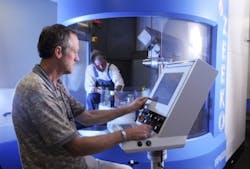
(Image: UAH-CAO)
Huntsville, AL--The University of Alabama Huntsville’s Center for Applied Optics (UAH-CAO) has acquired a Zeeko robotic polisher, helping the group to collaborate more closely with NASA's Marshall Space Flight Center (also In Huntsville). The machine could also be used to produce optical devices for optical firms that need occasional large-scale mirrors, lenses, or other items, notes Pat Reardon, CAO's interim director and principal research scientist.
Reardon says the polisher will allow UAH-CAO to support local, regional, and national teams in the fabrication of complex optical systems. It will also extend the center’s research efforts in optical fabrication process development, optical testing, and optical design. The polisher, a Zeeko IRP-600X, is relatively uncommon -- there are only four or five others in the entire U.S. It can polish surfaces up to 600 millimeters in diameter and 450 millimeters in height.
UAH-CAO acquired the robotic polisher with the help of a National Science Foundation-Major Research Innovation program grant. The chain of events that led to the delivery of the robotic polisher this summer began several years ago with a NASA-Goddard Space Flight Center program investigating the feasibility of polishing silicon carbide. “To do the necessary polishing, we leased the smaller version of this machine, the Zeeko IRP-200," says Reardon. "It allowed us to take machine-rough silicon carbide and produce a 5 nm RMS rough surface." Reardon and his colleagues, Robert Lindquist, Joseph Geary, and Richard Fork, were impressed enough that they decided to submit a grant proposal to NSF to fund acquisition of the IRP-200’s larger brother, the 600X. Their first two proposals were turned down. “But you tweak your proposal, based on the feedback they give you,” explains Reardon. The third submittal was accepted, and UAH-CAO took delivery of the polisher in late July.
Seven or more polishing variables
The operator of the Zeeko has control over a minimum of seven polishing variables, and Reardon says that amount of control can be daunting. “The power of the Zeeko system is that you have so many variables available to optimize the polishing process. But the challenge is also that you have so many variables available to select the polishing process,” he says.
The Zeeko builds on other recent acquisitions over the past two years, which include a Nanotech UPL250 precision diamond turning lathe, which arrived in January 2010. It is capable of producing free-form optical surfaces up to 350 millimeters in diameter.
The Center has used the lathe to produce and deliver optics for terahertz, visible, x-ray, and gamma-ray bands that achieved surface-smoothness (RMS) values of less than 2.5 nm.